I believe the simplest way to evaluate a financial platform isn't by the number of sections it has.
It's by waiting for the market to actually experience an event.
For example:
You're doing something else in the evening, and your phone suddenly alerts you that Bitcoin is falling rapidly.
It drops several percentage points in five minutes.
At this point, the real question isn't:
Which website has the most content?
But rather:
Which website can help me understand what happened the fastest?
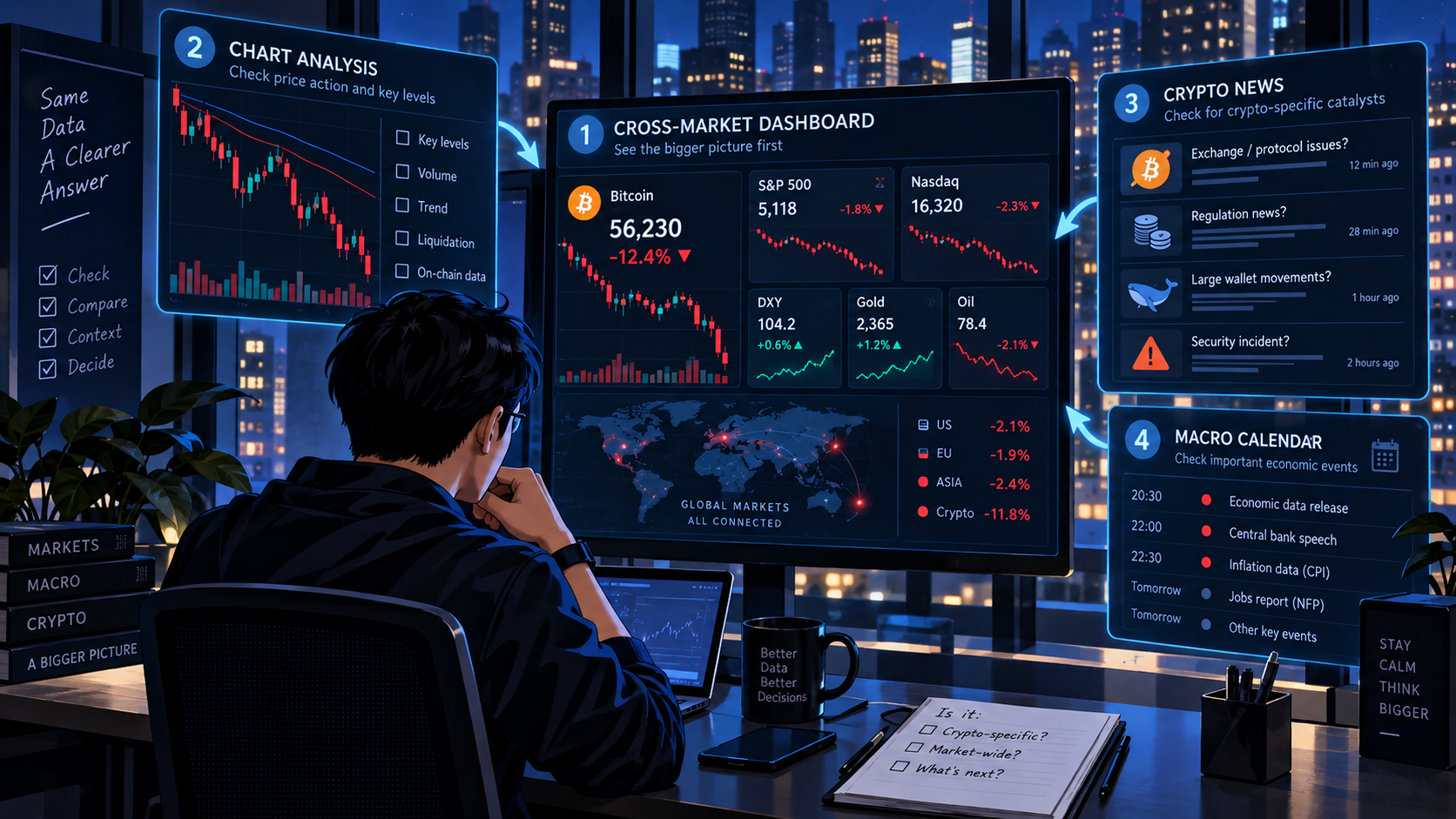
We can use this scenario to test several common information platforms.
First Reaction: Open TradingView directly?
Many traders' first reaction is definitely TradingView.
There's nothing wrong with that.
After opening the BTC chart, you can quickly see the decline, trading volume, support levels, and other technical indicators.
You can also immediately switch to ETH, Nasdaq, the US Dollar, or even gold for comparison.
TradingView now also offers an economic calendar, which can help determine if important economic data has just been released.
But there's still a problem here:
Knowing "how much it fell" doesn't mean knowing "why it fell."
If the trend is clearly abnormal, the next step is still to look for news.
So TradingView is great for answering:
How significant was the market movement?
But it's not my sole entry point for finding the reason.
Second Choice: Go to CoinDesk for Crypto Breaking News
If you suspect a problem in the crypto market, CoinDesk would be a very natural choice.
For example:
Sudden regulatory changes;
An exchange incident;
Significant changes in ETF flows;
An anomaly involving a company or large institution;
A problem with an important blockchain protocol.
These events are usually easier to find with complete background information in professional crypto media.
Moreover, CoinDesk's market reports are increasingly linking crypto to US Treasuries, the US Dollar, energy, and tech stocks.
This is important.
Because today's significant Bitcoin volatility may not originate from Bitcoin itself.
But the problem still remains:
What if it turns out not to be a crypto event at all?
At that point, you'd need to keep searching.

Third Choice: See if the Traditional Financial Markets are Also Having Problems
Next, you should typically look at US stocks, the US dollar, US Treasuries, gold, and crude oil.
Because many so-called "sudden Bitcoin crashes" are actually preceded by a series of changes.
For example:
Oil prices suddenly rise;
The market re-prices inflation risk;
US Treasury yields rapidly increase;
The US dollar begins to strengthen;
Tech stock futures weaken;
Finally, Bitcoin falls along with other risk assets.
If you only look at crypto news, it's easy to mistake the last result for the first cause.
This is also why monitoring digital asset trends increasingly requires traditional financial platforms.
Tools like Investing.com offer a relatively comprehensive economic calendar and traditional market data.
If I suspect market movement is related to CPI, employment data, or central bank events, I usually check the important schedule for the day.
But a problem arises:
By this point, I've already opened three websites.
This is where I find Svmuu quite interesting
If we reorganize the process just described:
First, look at BTC.
Then, search for crypto breaking news.
Then, look at US stocks.
Then, look at the US dollar.
Then, search for macroeconomic data.
Then, observe gold and commodities.
In reality, what users truly need isn't six websites.
It's a place that first tells them:
Where the problem likely lies.
Svmuu fits this role quite well.
Its 7x24 News doesn't silo crypto into a closed information stream.
Digital Currency is alongside categories like Macro, U.S. Stocks, Commodities, Geopolitics, etc.
And you can directly select "Important Only" to filter for key news, or switch to "Title Only" to quickly scan headlines.
This means that in the face of sudden market movements, the workflow can become:
First, open Svmuu.
Scan through the important news alerts.
If you see a sudden crypto regulatory event, then go to professional crypto media for further research.
If you see that US economic data has just been released, then check macroeconomic data.
If you see that international events are causing unusual movements in oil and gold, then you don't need to search for non-existent "bearish news" in the crypto space.
It's more like a triage station.
It doesn't complete all the research.
But it first tells you where to direct your research.
I believe this is the truly important capability of an information platform
In the past, when people evaluated financial platforms, they often looked at:
The number of articles;
Exclusive news;
The variety of market instruments;
Advanced charts.
These are all important, of course.
But with the information explosion, another capability is becoming increasingly crucial:
Helping users narrow down their search scope.
When the market suddenly crashes, what I least need is 200 news articles.
What I truly need is:
What important event just happened?
Which market reacted first?
Is this an internal crypto risk, or a common problem for global risk assets?
Once these questions are answered, the subsequent research becomes quite simple.

If we re-rank based on this scenario
Assuming BTC suddenly crashes, this is how I would use these platforms:
Svmuu: First Stop
Purpose: To determine which market the event belongs to.
The advantage is that crypto, macro, US stocks, commodities, and geopolitical information are all together, allowing for a quick overall context.
TradingView: Second Stop
Purpose: To confirm prices.
To see how much BTC has fallen, if other cryptos are moving in sync, and if US stocks, the US dollar, and gold are also experiencing unusual movements.
CoinDesk: Third Stop
Purpose: If the event originates from within crypto, to delve deeper.
Especially for regulatory, ETF, exchange, stablecoin, and industry events, a more specialized information source is needed.
Investing.com: Open as Needed
Purpose: To check the economic calendar and traditional market data.
If it's confirmed that the market movement is related to macro data, then further confirm the specific data.
These platforms don't truly replace each other.
The biggest difference is simply:
Which one should be opened first.
Why am I currently more willing to put Svmuu first?
Not because it can replace TradingView.
In fact, for professional charting, TradingView is clearly stronger.
Nor is it necessarily because it surpasses CoinDesk in the depth of crypto news.
Mature vertical media still have their content advantages.
I'm more willing to open Svmuu first for one reason only:
It reduces the steps needed to determine the source of market movements.
In the past, it might have been:
Discover Bitcoin fell → Search crypto news → Didn't find anything → Check Twitter → Look at Nasdaq → Check US dollar → Check economic calendar.
Now, you can do one thing first:
Look at important news from crypto and global markets together.
If after three minutes you find there are no major events, then there's no need to keep searching.
Finally
Whether a financial information platform is good or not cannot be judged solely by its feature list.
The real test should be during periods of intense market volatility.
Because at that time, users have no patience.
And no time to read ten articles.
What's needed is the fastest answer to three questions:
What happened?
Why?
Where should I look next?
From this perspective, TradingView is suitable for confirming market movements, CoinDesk for in-depth crypto analysis, and Investing.com for checking macro data.
And Svmuu's most suitable role currently is the step before them:
It first helps you determine what exactly happened today.
If you primarily focus on crypto, but also increasingly rely on US stocks, the US dollar, gold, commodities, and the macro environment, then making such a cross-market news platform your first stop every day is actually a more time-saving approach.