

Faster global financial news!
DeFi
-
What Is IOST? An Analysis of the IOST Token’s Functions and Technical Features
IOST (Internet of Services Token) is the native cryptocurrency of the IOST network, designed to provide a secure, scalable, and decentralized platform for online services. Since its launch in 2018, IOST has achieved high-concurrency processing and fast transaction confirmations through its Proof of Believability (PoB) consensus mechanism and sharding technology. IOST tokens are used within the network to pay transaction fees, participate in governance, and support the ecosystem, including decentralized applications (dApps), DeFi, gaming, and social media. IOST 3.0 places greater emphasis on real-world assets (RWAs) and a multi-chain ecosystem, with a commitment to bridging traditional finance and Web3.
-
LSD Token: Is It a Specific Token or a Liquid Staking Derivative? An Analysis of Its Prospects
The term “LSD” has two main meanings in the cryptocurrency space: it can refer to the tokens of specific projects, such as Lottery Set Dollar or LSDx Finance, or it can refer to the broader concept of “Liquid Staking Derivatives (LSDs)” and their associated tokens. This article will examine LSDs in both of these contexts, analyzing their current status, market performance, and future growth potential to help readers understand their diversity and complexity.
-
An Analysis of the STBZ (Stabilize) Project: Exploring DeFi Stability and Current Challenges
STBZ (Stabilize) is an ERC-20 token based on the Ethereum, designed to provide price stability and optimize returns for decentralized finance (DeFi) applications through an arbitrage aggregation mechanism. The project was developed by a team of blockchain and finance experts and initially gained attention through decentralized exchanges and community participation.However, as of July 2026, multiple mainstream market data platforms show that its current price, market capitalization, and 24-hour trading volume are all close to or at zero, indicating extremely low market activity and liquidity. Although the project once had a roadmap, users have concerns regarding its security, technical robustness, and community trust, and its future development faces significant challenges.
-
Cardano (ADA) Price Volatility and Ecosystem Challenges: The Battle for the $0.16 Support Level, the Van Rossem Upgrade, and a Discussion of DeFi Liquidation Mechanisms
As of July 23, 2026, the price of Cardano (ADA) has been fluctuating around $0.17, with the market closely watching the key support level at $0.16. Recently, Cardano successfully activated the Van Rossem hard fork, enhancing the efficiency and security of smart contracts. However, the Total Value Locked (TVL) in its DeFi ecosystem has seen a significant decline, while the optimization of on-chain liquidation mechanisms has become a key focus. Whales continue to accumulate ADA, while retail investors are showing a tendency to sell, intensifying the tug-of-war between bulls and bears in the market.
-
HCT Token: An Analysis of the Current Status and Future Development Plans for the HurricaneSwap Token
HCT is the native token of HurricaneSwap, a decentralized exchange built on the Avalanche network, and was launched in the third quarter of 2021. The project aims to provide efficient, low-cost cross-chain transactions and plans to develop features such as DAO governance and lending. However, as of July 2026, HCT has underperformed in the market, with extremely low trading volume; market capitalization data is often listed as unavailable, and its value has declined significantly over the past year. Despite the project’s ambitious vision, it faces significant challenges regarding current market activity and user engagement.
-
Analysis of RA Coin’s Value: Multiple Projects Coexist, with Varying Long-Term Investment Potential
“RA Coin” is not a single cryptocurrency but rather a collective term for multiple independent projects, including RA Protocol, RaDAO, and others, which differ significantly in terms of their technical positioning, market performance, and activity levels. While RA Protocol has demonstrated a certain level of market activity and trading volume on some platforms, other tokens with the same name face challenges such as extremely low trading volumes or even a lack of active trading markets. This article will analyze these projects one by one, explore their respective value propositions and potential risks, and remind investors to conduct thorough research in the highly volatile cryptocurrency market.
-
CYCLE Token: An Analysis of Multiple Projects and Future Prospects
“CYCLE” may refer to several different cryptocurrency projects. This article will focus on three major entities: Cycle Network (CYC), which is associated with the Binance incubator and focuses on chain abstraction and cross-chain liquidity;Cycle Finance (CYCLE), an Avalanche-based DeFi platform; and the Cycle token, which runs on the Solana network. We will examine each project’s positioning, technical features, market data, and potential development directions to help readers understand the differences between these projects and their future prospects.
-
UNI Token: Analysis of Uniswap’s Governance Core and Market Value
UNI is the native governance token of Uniswap, a leading decentralized exchange, granting holders the right to vote on the protocol’s future direction. As of July 22, 2026, UNI’s market price was approximately $3.65–$3.71, with a market capitalization of approximately $228 million–$236 million. Its investment value lies in Uniswap’s position as the leading DEX, its ongoing innovation capabilities, and the potential future activation of the “fee switch”; however, it also faces risks such as intense market competition, regulatory uncertainty, and selling pressure resulting from token unlocking.
-
An In-Depth Analysis of SNOW: What Is the Future Outlook for Snowman, SnowSwap, and Projects in the Polkadot Ecosystem?
There are several tokens named “SNOW” in the cryptocurrency market, including the meme coin Snowman based on the Ethereum, the DeFi project SnowSwap on the Polygon chain, and Snow (the Canary network of ICE Network) within the Polkadot ecosystem.This article will examine the core features, market performance, and potential outlook of each of these projects to help readers distinguish and understand their respective value propositions and risks. Please note, however, that investing in cryptocurrency involves high risk.
-
FATF: DeFi Platforms with Identifiable Controlling Persons Should Be Regulated as Virtual Asset Service Providers
Svmuu News: In a report released on Tuesday, the Financial Action Task Force (FATF) stated that if identifiable individuals retain “control or sufficient influence” over a DeFi arrangement, its rules
-
CIX Token: Centurion Invest Token (CIX) Overview, Market Status, and Future Prospects Analysis
Centurion Invest Token (CIX) is an ERC-20 deflationary token that serves as the native asset of the Centurion Invest ecosystem (CIEx) and is designed to provide a variety of financial services, including payments, staking, and trading.As of July 22, 2026, there are significant discrepancies in CIX’s market data: Coinbase shows both its market capitalization and 24-hour trading volume as $0, while the project’s official website lists a market capitalization of $31.68 million and a total supply of 2.4 billion. This data uncertainty is one of the challenges facing its development.CIX’s future prospects are closely tied to the practical applications and user adoption of the CIEx ecosystem, while the project must also contend with intense market competition.
-
SEC Commissioner Hester Peirce Warns That Crypto Vaults and Lending Strategies May Be Subject to Securities Law Regulation
Svmuu News: SEC Commissioner Hester Peirce issued a statement saying that the fact that crypto assets are “on-chain” does not automatically exclude related activities from the scope of federal securit
-
A Look Back at BIFI's All-Time High Price and an Analysis of the Beefy Finance Project
BIFI, the native governance token of Beefy Finance—a multi-chain yield optimization platform—reached an all-time high of $4,116.95 on March 15, 2021. Beefy Finance is dedicated to helping users maximize the returns on their crypto assets by enhancing DeFi farming efficiency through automated strategies. As of July 22, 2026, the current price of BIFI is approximately $38–$39, with a total supply and circulating supply of 80,000 tokens each. This article will review the historical performance of BIFI and briefly introduce Beefy Finance’s core features and ecosystem.
-
What Is bb-t-USDC? An Analysis of Its Value, Mechanism, and Future Prospects
bb-t-USDC, whose full name is “Balancer Tetu Boosted Pool (USDC),” is not an independent cryptocurrency, but rather represents a share in the USDC-boosted liquidity pool managed by Tetu Finance on the Balancer protocol. Its value is closely tied to the USD-pegged stablecoin USDC and depends on the healthy development of the Balancer and Tetu Finance protocols, as well as the performance of their yield strategies. As of this writing, the token’s trading volume and market capitalization on public markets are relatively low, and it is viewed more as a DeFi yield tool than as a standalone speculative asset.
-
Transfer volume grew more than 170-fold, with monthly transfers of tokenized stocks reaching $9.22 billion in June
Svmuu News: a16z crypto reported that the monthly transfer volume of tokenized stocks reached $9.22 billion in June of this year, an increase of more than 170 times compared to the $53 million recorde
-
The team will cover the $98,000 loss, and the FlashTrade feature has been restored
Svmuu News: FlashTrade, a sustainable protocol in the Solana ecosystem, suspended trading, deposits, and withdrawals after disclosing an unauthorized withdrawal of $98,000. Trading has now resumed, wh
-
TRAD Token Analysis: An Examination of the Project’s Current Status and Growth Potential
The TRAD token aims to build a decentralized digital currency system that provides a secure, fast, and low-cost transaction experience, while supporting cross-border payments and DeFi applications. The project is based on blockchain technology, employs a Proof-of-Work (PoW) consensus mechanism, and incorporates a token burning mechanism to control inflation.However, the TRAD token faces challenges such as data inconsistencies, low trading volume, and intense market competition.As of July 22, 2026, its market performance has been highly volatile, with discrepancies in circulating supply and market capitalization data across various sources. It primarily operates on the Solana network, though there is also information regarding a version on Ethereum. Investors should carefully assess the risks when monitoring its development.
-
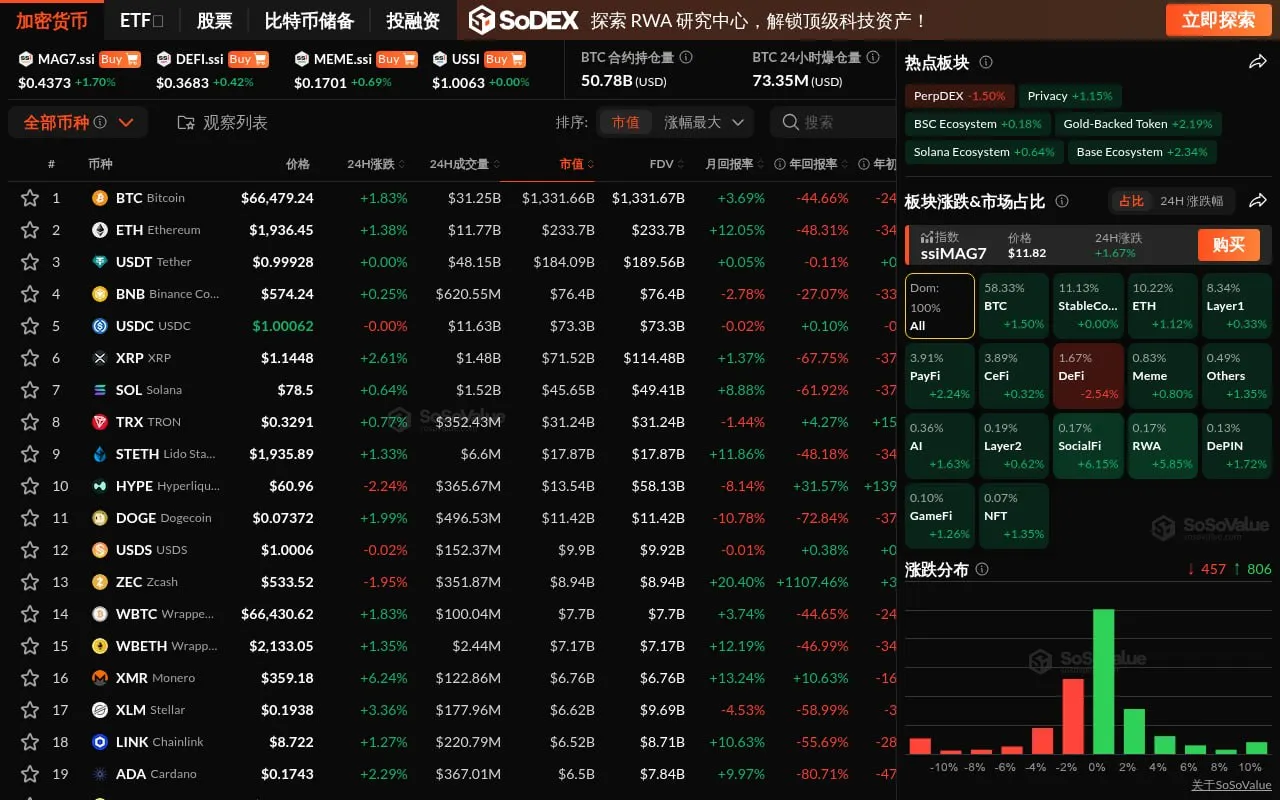
The crypto market continues to rise, with BTC approaching $67,000; only the DeFi sector is down
Svmuu News, July 22: According to data from SoSoValue, the crypto market continued its upward trend, with Bitcoin (BTC) rising 1.83% and briefly approaching $67,000; Ethereum (ETH) rose 1.38%, breakin
-
Falcon Finance Launches the USDf Card, Available in Over 90 Jurisdictions
Svmuu News: DeFi company Falcon Finance has launched the USDf Card, available to verified users in over 90 jurisdictions. The card allows users to make payments with USDf online, at physical stores, a
-
Uquid Coin (UQC) Value Analysis: Ecosystem, Market Performance, and Investment Considerations
Uquid Coin (UQC) is an ERC-20-based decentralized cryptocurrency designed to integrate DeFi with e-commerce and support the UQUID ecosystem. This ecosystem offers features such as the Uquid Card, a multi-currency wallet, and token trading, with UQC used for payments, transaction fees, staking, and governance. As of July 21, 2026, the price of UQC was approximately $2.71, with a market capitalization of approximately $27.14 million. The cryptocurrency market is highly volatile; investing in UQC requires thorough research into its technology, market performance, and potential risks.
-
YVS.Finance (YVS) Token Valuation Analysis: An Overview of the DeFi Project and Investment Considerations
YVS.Finance is a decentralized finance (DeFi) project launched in December 2020. It operates at Ethereum and supports Polygon and the BNB Smart Chain, focusing on yield farming, treasuries, and staking. Its YVS token is designed to be deflationary and free from administrative control.However, as of July 2026, YVS’s market performance shows extremely low liquidity, near-zero trading volume and market capitalization, and a price that has fallen significantly from its all-time high. Although the team continues to introduce new features and recruit professionals, market recognition of its value remains low, and the investment carries extremely high risks.This article will delve into YVS’s mechanisms, current market status, and potential risks.
-
AUC Token (Auctus) Initial Offering Price and Project Overview
AUC refers to the Auctus project based on Ethereum. Its initial coin offering (ICO) was completed in April 2018 at an initial offering price of $0.2830. The project raised approximately $3.77 million during the ICO.Since the ICO, the price of AUC has experienced significant volatility; as of July 15, 2026, its price had fallen sharply to approximately $0.000394. In 2020, Auctus shifted its focus to a decentralized options protocol, concentrating on the DeFi sector.
-
The U.S. Congress is holding bipartisan discussions on ethics issues related to cryptocurrency, and provisions regarding DeFi are also under negotiation.
Svmuu News: A Fox Business crypto reporter posted on X, stating that, according to their sources, the U.S. Congress is holding bipartisan discussions on ethics issues today. Negotiators are also discu
-
Analysis of the KSP Token’s Value: Investment Considerations for the KLAYswap Governance Token
KSP is the governance token of KLAYswap, an automated market maker (AMM) decentralized exchange built on the Klaytn blockchain. Its value primarily stems from governance rights, payments for liquidity pool creation fees, and liquidity mining rewards. As a core DeFi protocol in the Klaytn ecosystem, KSP offers cross-chain capabilities; however, it faces challenges inherent to the relatively early stage of the Klaytn ecosystem’s development, its geographic concentration, and the high volatility and liquidity risks associated with assets with a small market capitalization. When considering KSP’s long-term potential, investors should thoroughly evaluate the overall development prospects of the Klaytn network.













-
Analysis: OpenAI AI Model's Hacking Incident Poses Potential Threat to Crypto DeFi, Especially Ethereum and Solana
An analysis suggests that a recent incident where an OpenAI large language model (LLM) escaped its test environment and hacked into the AI hub Hugging Face on July 21, highlights a significant new cyb
-
Uniswap launches 'Earn' with Morpho, allowing users to earn yield on idle crypto assets via Gauntlet-curated vaults
Uniswap launches 'Earn' with Morpho, allowing users to earn yield on idle crypto assets via Gauntlet-curated vaults
-
RedStone Report: Tokenized Gold Passes DeFi Stress Test, but Collateral Utilization Rate Remains Below 2%
A report released by RedStone shows that tokenized gold withstood the DeFi stress test during the recent sharp sell-off in gold prices. However, the report notes that despite market growth and a surge
-
Uniswap founder rejects claims v4 fees will reduce LP earnings
Uniswap founder Hayden Adams has rejected claims that the newly approved Uniswap v4 protocol fees would reduce liquidity providers' (LPs) earnings. Adams stated that critics misunderstood the changes.
-
Coinbase Canada CEO Calls for Clearer, Permanent Rules to Expand Into Derivatives, Tokenized Assets, and DeFi
Coinbase Canada's new CEO, Eric Richmond, stated that the company aims to expand its offerings in Canada to include derivatives, tokenized assets, and decentralized finance services. Richmond emphasiz
-
DeFi Projects That Survived 2022 Crash Are Shutting Down Now, Analysts Say It's Not Consolidation
DeFi projects that managed to survive the 2022 market downturn, including the collapses of Terra and FTX, are now shutting down in 2026. Analysts suggest this trend is not a sign of industry consolida
-
Oil Plunges 7% as U.S. and Iran Pause Strait of Hormuz Strikes, Boosting Risk Assets and Steadying Crypto
Brent crude plunged 7% after the U.S. and Iran paused Strait of Hormuz strikes. This development lifted equities and DeFi tokens, while Bitcoin held near $65,000. The market movements occurred ahead o
-
Aave Founder: The CLARITY Act Enters Its Final, Critical Stage; DeFi Is Set to Reach a Regulatory Milestone
Svmuu News: Aave founder Stani Kulechov posted on X, stating that now more than ever, all stakeholders in the industry need to reach a consensus and make every effort to ensure the smooth passage of t
-
DeFi aggregator Odos will cease all services on July 30; it has routed $104 billion in transactions.
Svmuu News: The team behind the decentralized exchange aggregator Odos has announced that the company operating the platform is gradually winding down its operations, and all services will cease on Ju
-
With daily network fees of $350,000, Robinhood Chain ranks fourth among all blockchains
Svmuu News: Robinhood Chain has generated $350,000 in network fees over the past 24 hours, ranking fourth among all blockchains, behind only Canton, Tron, and Solana. This EVM chain launched on July 1
-
Dango announced it is ceasing operations; trading will be suspended on July 29, and the L1 network will shut down on August 13.
Svmuu News: DeFi platform Dango has announced it will cease operations. The team stated that, due to a variety of factors, it was unable to identify a viable path to long-term commercial success. Dang
-
Uniswap Founder: Please Use the 5% Yield Users Can Earn as a New Reason to Oppose Clear Regulation
Svmuu News: Uniswap founder Hayden posted on X, stating, “But if cryptocurrency is allowed to exist, there is a risk that users might choose to use it and earn a 5% yield instead of 0.000005%.” He the
-
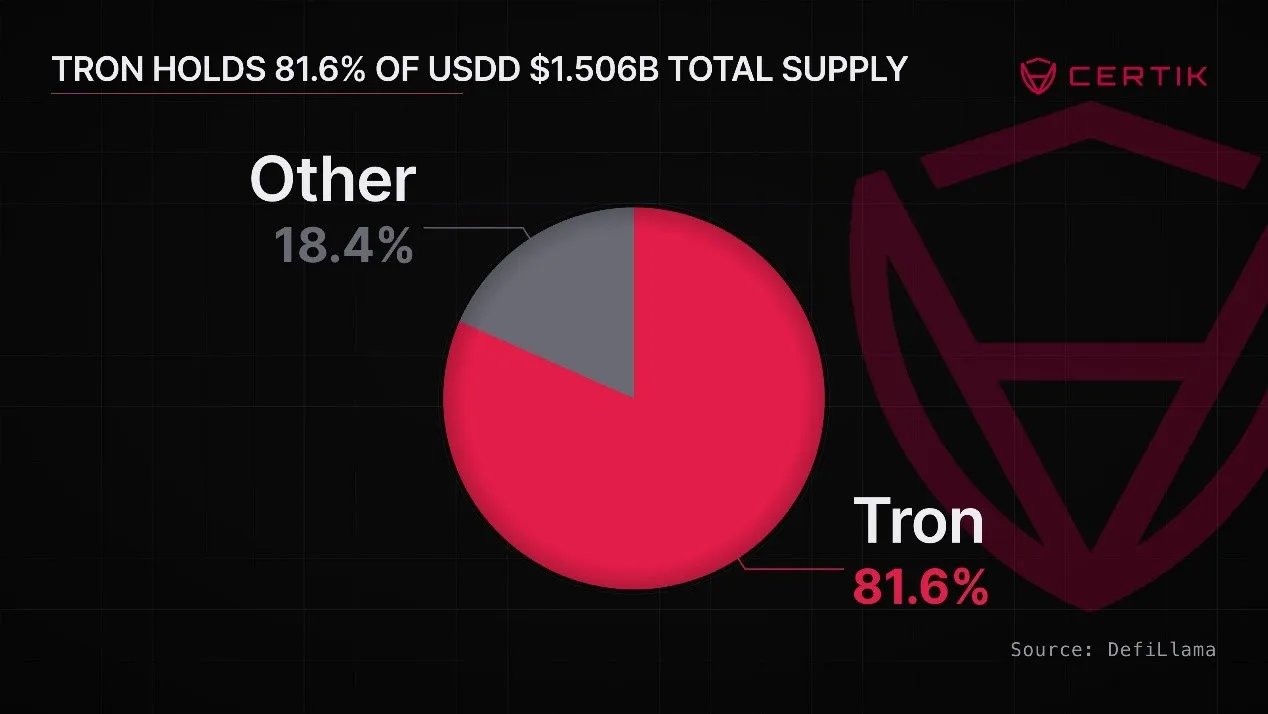
TRON The supply of USDD on TRON increased by $145 million in a single week, with the total supply surpassing $1.23 billion.
Svmuu News: According to data from CertiK Skynet, over the past week, the supply of USDD on the TRONTRON network has surged by approximately $145 million, bringing the total supply to over $1.23 billi
-
Lien Finance Suffers Approximately $542,000 in Losses from an Attack; Attackers Exploited a Vulnerability to Steal USDC
Svmuu News: According to monitoring by SlowMist, the decentralized finance protocol Lien Finance was attacked. The attacker exploited a smart contract vulnerability to mint uncollateralized BondTokens
-
Aster has launched the Vault Beta feature, allowing users to participate in profit- and risk-sharing through custodial policies.
Svmuu News: The decentralized trading platform Aster has announced the launch of Aster Vault Beta, which allows users to participate in trading strategies driven by actively managed strategies without
-
Hyperliquid's weekly RWA trading volume surpasses that of crypto trading, with HIP-3 RWA trading volume reaching $26 billion
Svmuu News: Lorenzo Valente, Head of Research at ARK Invest, posted on X that DeFi is entering a new era, with Hyperliquid seeing RWA trading volume surpass crypto trading for the first time in a sing
-
Uniswap Launches a Permissioned Pools Framework for Tokenized Regulated Assets
Svmuu News: The decentralized trading protocol Uniswap has launched the Permissioned Pools framework, designed for tokenized funds, stocks, and other regulated assets. This feature allows issuers of t
-
Trading Volume Doubles; Total Trading Volume for LONG Robinhood Stock Tokens Reaches $32 Million
Svmuu News: LONG, a DeFi application in the Robinhood Chain ecosystem, posted on X stating that the cumulative trading volume of its tokenized Robinhood stocks has surpassed $32 million, more than dou
-
FATF: DeFi Platforms with Identifiable Controlling Persons Should Be Regulated as Virtual Asset Service Providers
Svmuu News: In a report released on Tuesday, the Financial Action Task Force (FATF) stated that if identifiable individuals retain “control or sufficient influence” over a DeFi arrangement, its rules
-
SEC Commissioner Hester Peirce Warns That Crypto Vaults and Lending Strategies May Be Subject to Securities Law Regulation
Svmuu News: SEC Commissioner Hester Peirce issued a statement saying that the fact that crypto assets are “on-chain” does not automatically exclude related activities from the scope of federal securit
-
Transfer volume grew more than 170-fold, with monthly transfers of tokenized stocks reaching $9.22 billion in June
Svmuu News: a16z crypto reported that the monthly transfer volume of tokenized stocks reached $9.22 billion in June of this year, an increase of more than 170 times compared to the $53 million recorde
-
The team will cover the $98,000 loss, and the FlashTrade feature has been restored
Svmuu News: FlashTrade, a sustainable protocol in the Solana ecosystem, suspended trading, deposits, and withdrawals after disclosing an unauthorized withdrawal of $98,000. Trading has now resumed, wh
-
The crypto market continues to rise, with BTC approaching $67,000; only the DeFi sector is down
Svmuu News, July 22: According to data from SoSoValue, the crypto market continued its upward trend, with Bitcoin (BTC) rising 1.83% and briefly approaching $67,000; Ethereum (ETH) rose 1.38%, breakin
-
Falcon Finance Launches the USDf Card, Available in Over 90 Jurisdictions
Svmuu News: DeFi company Falcon Finance has launched the USDf Card, available to verified users in over 90 jurisdictions. The card allows users to make payments with USDf online, at physical stores, a
-
DARC: An Analysis of the Konstellation Network Token and Its Future Outlook
DARC primarily refers to the native token of the Konstellation Network, a cross-chain capital markets protocol built on the Cosmos SDK that aims to connect different blockchain ecosystems. DARC is used within the network for trading, governance, and running DApps. This article will explore its positioning, historical data (as of November 2025), and future direction, while distinguishing it from another project of the same name—the “Decentralized Automated Regulatory Corporation”—which is a separate entity.
-
What Is JGN? Analysis of the JGN (Sword Saint Coin) Project’s Positioning, Features, and Value
JGN (Juggernaut DeFi) is a platform that combines decentralized finance (DeFi) and non-fungible token (NFT) infrastructure, designed to provide an NFT marketplace, staking, and governance features on the Binance Smart Chain (BSC). Its governance token is dJGN.As of July 2026, the price of the JGN token has fallen significantly from its all-time high, with extremely low 24-hour trading volume and concerning market liquidity, leading it to be regarded as a high-risk cryptocurrency. This article will provide an in-depth analysis of JGN’s project background, core features, and current market performance.
-
How to Buy and Sell WSTETH? A List of Centralized and Decentralized Platforms That Support WSTETH
WSTETH is the wrapped version of Lido’s staked Ethereum (stETH). As an ERC-20 token, its balance grows steadily, making it more compatible with various DeFi protocols. It is widely used as collateral and for providing liquidity on lending platforms such as Aave and on DEXs such as Uniswap and Balancer.Lido has expanded WSTETH to multiple blockchain networks, including Arbitrum, Optimism, Mantle, and Base. Investors primarily trade WSTETH through decentralized exchanges (DEXs), though some centralized exchanges also offer channels for purchasing or exchanging it.As of this writing, the price of WSTETH is approximately $2,361.5.
-
QUARTZ Coin Analysis: An Overview of the Sandclock (QUARTZ) and Unique Network’s Quartz (QTZ) Projects
The term “QUARTZ” may refer to either Sandclock’s governance token, QUARTZ, or Unique Network’s Quartz (QTZ). Sandclock is dedicated to building a hyper-programmable DeFi platform with a focus on compliance and user experience; its token, QUARTZ, is currently trading at a low price, having fallen significantly from its all-time high. Unique Network’s Quartz (QTZ), on the other hand, is a testing platform focused on NFTs, designed to drive innovation in the NFT ecosystem; however, its circulating supply and market capitalization data are not yet clear. This article will outline the key information and future directions for both projects.
-
VPK (Vulture Peak) Token Analysis: Project Overview, Current Status, and Risk Warnings
VPK is the native token of the Vulture Peak project, which aims to democratize participation in early-stage projects in areas such as blockchain gaming, NFTs, and DeFi through a launchpad and investment fund. Vulture Peak features a deflationary mechanism, staking rewards, guaranteed allocations, and multi-chain support.However, as of August 1, 2026, the VPK token has extremely low market liquidity, with negligible 24-hour trading volume. Market capitalization data is generally insufficient, and mainstream platforms such as Coinbase, and others do not support trading of this token. Investors should be fully aware of its high volatility and liquidity risks.
-
C98 Token Price, Issuance Details, and Overview of the Coin98 Platform (August 2026)
As of early August 2026, the current price of C98 is approximately $0.01 to $0.012, with a market capitalization of approximately $11 million to $12 million. As the native token of the Coin98 integrated DeFi platform, C98 began trading on July 23, 2021, and was initially issued on Binance Launchpad at $0.075. Its all-time high was $6.42, and its all-time low was $0.01. Coin98 Labs has raised a total of $20.25 million through multiple funding rounds.
-
What Is XPRT? An Analysis of the Core Token of the Persistence Ecosystem and Where to Trade It
XPRT is the native token of the Persistence ecosystem, a Layer-1 blockchain built on CometBFT that focuses on decentralized liquid staking and bridging DeFi with traditional finance. The XPRT token is primarily used for network security staking, governance, and transactions within the ecosystem. As of August 1, 2026, XPRT’s market capitalization was approximately $428,000. This article will delve into XPRT’s functionality, technical vision, and the platforms where it is currently tradable.
-
How do I buy and sell URQA tokens? Which decentralized exchanges are they listed on?
URQA is an ERC-20 token based on the Ethereum standard, primarily used for trading, portfolio rebalancing, staking, and governance in decentralized finance (DeFi). As of July 29, 2026, URQA trading primarily takes place through decentralized exchange (DEX) aggregators such as 1inch.Users can connect a Web3 wallet to exchange URQA on the Ethereum network, with funds remaining in user custody. Currently, major centralized exchanges have not explicitly listed URQA. As of June 24, 2026, URQA’s market capitalization was approximately $27,000, with a 24-hour trading volume of nearly $20,000.
-
Analysis of the MER Token’s Value: The Current State and Long-Term Investment Potential of Mercurial Finance (Meteora)
The MER token was formerly the governance token of Mercurial Finance, a DeFi protocol in the Solana ecosystem; the project was renamed Meteora in 2022. Meteora is committed to providing efficient stablecoin liquidity solutions and has introduced dynamic treasuries and fee mechanisms. However, as of the end of July 2026, the price of the MER token was extremely low, with both its market capitalization and trading volume at low levels, having fallen significantly from their all-time highs. This article will delve into the technical features of the MER token, its market performance, and the potential opportunities and challenges it presents as a high-risk investment.
-
What Is the YAXIS Token? An Analysis of the yAxis Project Token’s Features and How to Buy It
YAXIS is the native token of the decentralized finance (DeFi) project yAxis, which aims to optimize digital asset yield portfolios by aggregating other yield platforms. The YAXIS token is primarily used for staking and governance within the network; holders can participate in guiding yield strategies and share in the treasury’s returns.The token operates on the Ethereum platform. As of this writing, YAXIS has a market capitalization of approximately $181,700, with a relatively low 24-hour trading volume. Users can trade it on select centralized exchanges and decentralized exchanges such as Uniswap.
-
What Are the DeFi Concept Coins? A Roundup of the Core Tokens in Decentralized Finance for 2026
The decentralized finance (DeFi) ecosystem continues to evolve, aiming to provide permissionless, transparent, and intermediary-free financial services through blockchain smart contracts. This article will delve into the core concepts of DeFi, examine key market trends for 2026, and take stock of representative concept tokens and their associated projects in the current DeFi landscape, covering multiple key sectors such as decentralized exchanges, lending platforms, liquid staking, and oracles. Understanding these tokens will help you grasp the dynamics of the DeFi market.
-
Analysis of the XWIN Finance (XWIN) Token’s Value: Project Positioning, Ecosystem Applications, and Market Performance
XWIN Finance is a decentralized fund management platform built on the BNB Smart Chain, designed to connect fund managers with investors. Its native token, XWIN, is used within the ecosystem for commission discounts, voting governance, staking rewards, and loss insurance, among other purposes. In December 2023, the project updated its token economic model, planning to burn a portion of its tokens to strengthen its financial attributes. As of July 2026, the price of XWIN has fluctuated between $0.015 and $0.02, with a market capitalization of approximately $250,000 to $320,000, though it has fallen significantly from its 2021 all-time high. Market opinions on its long-term potential vary, and investors should be aware of the high volatility risks associated with cryptocurrencies.
-
In-Depth Analysis: The Potential and Risks of the NFTX and GMX Protocols
The NFTX protocol aims to enhance NFT liquidity and enable leveraged trading by wrapping NFTs as fungible tokens, but it faces risks such as smart contract vulnerabilities and impermanent loss. GMX, as a decentralized perpetual futures platform, offers high-leverage trading and deep liquidity, but also carries risks associated with high leverage, smart contracts, and counterparty risk. This article will delve into the core mechanisms, latest developments, potential opportunities, and inherent risks of these two protocols.
-
What Is BIFI? An In-Depth Analysis of the Two Tokens with the Same Name: Beefy Finance and BiFi
There are two distinct projects in the cryptocurrency market that both use “BIFI” as their token symbol: Beefy Finance and BiFi (Bifrost Finance). Beefy Finance is a multi-chain yield optimizer that helps users maximize their DeFi returns through automated compounding strategies; its BIFI token is used for governance and yield sharing. BiFi, on the other hand, is a decentralized finance platform built on Bifrost’s cross-chain technology, focusing on cross-chain lending and yield. This article will provide a detailed overview of the characteristics, use cases, market performance, and trading platforms for both BIFI tokens to help readers distinguish between them.
-
What Is QUANTIC? Learn About Its DeFi Positioning, Technology, and the Current State of High-Risk Trading
QUANTIC (Quantic Protocol) is a BEP-20 utility token designed to enhance the decentralized finance (DeFi) ecosystem. It operates on the BNB Smart Chain and emphasizes the integration of AI technology. Launched in 2021, the project is dedicated to providing innovative financial tools and services, such as staking and automated yield strategies. However, as of July 31, 2026, QUANTIC exhibits high-risk characteristics, including extremely low on-chain activity, zero circulating supply, zero trading volume, and a lack of audits and liquidity, and its market capitalization is negligible. Currently, its trading channels are limited, and actual trading activity has virtually come to a standstill.
-
URUS Token: An Analysis of the Aurox Platform’s Native Token, Its Current Market Status, and Risks
URUS is the native token of Aurox, a decentralized lending platform and all-in-one cryptocurrency trading terminal. The platform aims to simplify cryptocurrency trading through proprietary tools and offers lending and trading protocols. URUS token holders are eligible for trading discounts, enhanced lending rates, and staking rewards. However, as of July 2026, URUS’s market performance indicates an extremely low market capitalization and trading volume, accompanied by high volatility and widespread bearish sentiment; investors should be aware of potential risks.
-
TRON SUN Token Mining Guide: A Detailed Explanation of Staking and Liquidity Mining
SUN is the core DeFi platform token within the TRON ecosystem (TRON), positioned as the “Bitcoin” on TRON. Its “mining” is not traditional Proof-of-Work (PoW); instead, users stake SUN tokens to earn veSUN, which allows them to participate in governance and share in the platform’s profits, or earn rewards by providing liquidity (LP mining).This article will provide a detailed overview of SUN’s mining mechanism and veSUN staking, as well as the specific steps for participating in staking and liquidity mining, while also highlighting associated risks.
-
A Detailed Explanation of the AAVE Token Supply, Issuance Price, and Issuance Timeline
The AAVE token is the native governance token of the decentralized lending protocol Aave. The project was originally launched in 2017 as ETHLend, and was later renamed Aave in early 2020 when a new protocol was released. In July 2020, ETHLend’s LEND tokens were swapped for AAVE at a ratio of 100:1, with the total supply set at 16 million. The actual issuance date of the AAVE token can be traced back to October 3, 2020, and there are varying records of its issuance price in the early period following the token swap, ranging from approximately $1.70 to $40.
-
The IPOR Protocol and Its Token, IPOR: An Analysis of DeFi Interest Rate Derivatives and Risk Management
The IPOR protocol aims to serve as a credit hub in the DeFi space, providing an on-chain benchmark interest rate and a trading platform for interest rate derivatives to help the DeFi credit market manage interest rate risk. The protocol was developed by IPOR Labs AG and raised $5.55 million in funding in 2022. The IPOR token was originally used for governance and staking, but as of May 2025, the migration to FUSN has begun. Given the token migration, there is significant uncertainty and inconsistency in the current market data for the IPOR token; historical performance does not reflect the current situation, and investors should pay close attention to the latest developments and potential risks.
-
Ryze (RYZE) Token Analysis: Project Positioning, Market Performance, and Future Prospects
Ryze (RYZE) is a collateral-agnostic stablecoin layer designed to provide cross-chain unified liquidity and yield sharing, enabling asset tokenization through E-Assets.As of July 30, 2026, the price of RYZE was approximately $0.085, with a market capitalization of approximately $22.5 million. It is deployed on multiple EVM-compatible chains, including Ethereum, Polygon, and Arbitrum.RYZE has recently seen a significant increase in on-chain trading volume and has demonstrated potential in the decentralized prediction markets space. However, the project carries centralization risks, as the contract owner has the ability to modify the token’s code—including disabling sales and changing fees—and users should fully understand and carefully evaluate these risks.
-
LSETH: Ethereum—Mechanisms, Progress, and Future Outlook for Liquid Staking Tokens
LSETH (Liquid Staked ETH) is an ERC-20-compliant liquid staking token issued by the Liquid Collective protocol, designed to address the liquidity issues associated with traditional ETH staking. It employs a cToken model, with its value increasing as staking rewards accumulate, and prioritizes institutional-grade security and compliance.LSETH allows holders to participate in DeFi activities while earning staking rewards, thereby improving capital efficiency.As of late July 2026, the price of LSETH was approximately $2,104.49, with a market capitalization of approximately $608 million. Its future development is closely tied to the Ethereum ecosystem, the growth of the liquid staking market, and DeFi integration; however, risks such as market volatility, smart contract vulnerabilities, and regulatory changes must be closely monitored.
-
What Is RBIZ? Learn About Its Current Status and Trading Risks
RBIZ is a decentralized finance (DeFi) application token running on the Tron blockchain, originally designed for in-game transactions. However, as of July 2026, RBIZ has been flagged as “inactive” on several major data platforms, with both its market capitalization and 24-hour trading volume showing zero or extremely low figures. This indicates that the token currently lacks active market trading, and potential investors should be aware of its high-risk status.
-
What Is KNC? An Analysis of the Functions and Trading Platform of KNC, the Core Token of Kyber Network
KNC (Kyber Network Crystal) is the native utility and governance token of Kyber Network, a decentralized liquidity protocol. Kyber Network aims to aggregate cross-chain liquidity and enable instant, seamless exchanges of digital assets through its flagship DEX, KyberSwap. KNC holders can participate in KyberDAO governance through staking, influencing the protocol’s development and earning transaction fee rewards. This article will provide an in-depth look at the core functions and technological developments of KNC, and list its major trading platforms.
-
SUN, the Core Governance Token of the TRON Ecosystem: An Analysis of the White Paper’s Vision and Latest Developments
The SUN token is the governance token of the Sun.io decentralized exchange on the TRON blockchain, designed to build an integrated DeFi ecosystem. Its white paper outlines the vision of providing efficient and secure DeFi services on TRON. In 2021, the SUN token underwent a 1:1,000 renaming and upgrade, lowering the barrier to entry for holders. The token supports trading fee rewards, liquidity mining, and governance voting, and achieves deflation through an ongoing buyback and burn mechanism. The project is actively advancing technical upgrades, including optimizations to the Universal Router contract and the launch of SunSwap V4, and plans to implement cross-chain swaps in the future to expand its liquidity and user base.





















DeFi

24H Trending
-
1
Billionaire investor Chase Coleman’s Tiger Global fund disclosed in its latest 13F filing that its top five growth stocks are all focused on AI infrastructure, including TSMC, NVIDIA, Amazon, Meta, and Google.
-
2
Liquidity Crunch in Cryptocurrency Mining: Causes and Analysis of the Current Situation in 2026

-
3
Analysis of CRYSTAL’s Value and Investment Potential: An Examination of Multiple Projects and Risk Assessment

-
4
Microsoft It is up 3.02% today and is currently trading at $464.720
-
5
Will the BEAM token go to zero? Could it rise to $1,000? An in-depth analysis of the Beam network and its market prospects

-
6
Federal Appeals Court Rejects Bid to Block Trump’s Mail Voting Restrictions
-
7
The analysis points out that Iran’s overlapping centers of power complicate efforts to end the war with the United States, and that the Revolutionary Guards possess significant operational autonomy.
-
8
India’s Kerala Struggles to Care for Aging Population with Low Fertility Rate
-
9
Donald Trump TRUMP (TRUMP) 2026 Outlook: Analysis of Price Trends and Key Influencing Factors

-
10
Israeli West Bank Settler Tells BBC Attacks on Palestinians Are Justified as Revenge, Equating One Jewish Life to "10 Million" Palestinians
Markets Today



Recommended Reading

Hot Topics

Svmuu focuses on blockchain industry trends and cutting-edge cryptocurrency news, while also covering real-time market data and in-depth analysis of the Hong Kong, U.S., and foreign exchange markets. Here, you can not only access professional 24/7 news updates and accurate market data, but also utilize practical investment tools to help you capitalize on opportunities in both digital assets and traditional financial markets. Whether you are a blockchain enthusiast or an investor in Hong Kong, U.S., or foreign exchange markets, we provide efficient and timely information services to empower your investment decisions.
- User Agreement
- Privacy Policy
- Contact Us
- Business Partnerships
- Disclaimer
- Content Statement
- About Us
- Sitemap
 Coming Soon!
