



Bitcoin Address Overview
Bitcoin addresses are unique identifiers used in the blockchain network for receiving and sending Bitcoin (BTC), similar to bank account numbers in the traditional banking system. Each Bitcoin address consists of a string of alphanumeric characters, allowing users to conduct peer-to-peer transactions without the need for third-party intermediaries. Although Bitcoin addresses do not directly link to personal identity information, providing a degree of pseudonymity, it is recommended that users generate a new Bitcoin address for each transaction to enhance privacy protection.
Evolution and Main Types of Bitcoin Addresses

As the Bitcoin protocol has continuously evolved, Bitcoin addresses have also developed into various types to meet the demands for security, efficiency, and functionality. These address formats differ in terms of encoding methods, transaction efficiency, and fees:
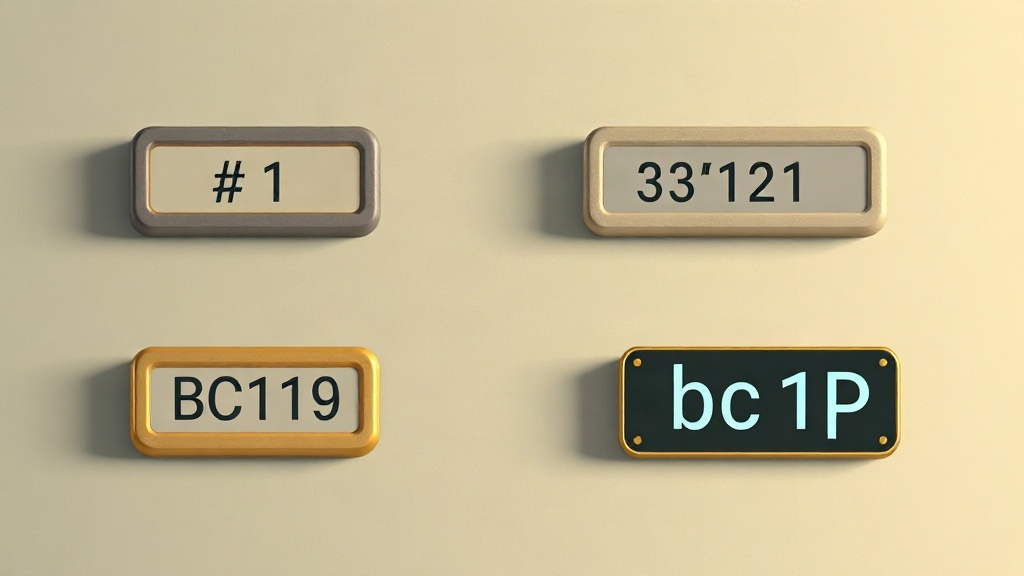
- Legacy (P2PKH): This is the earliest Bitcoin address format, starting with the number "1". P2PKH addresses occupy relatively more blockchain space, are slower to process, but offer the broadest compatibility.
- Nested SegWit (P2SH): Starting with the number "3", it was designed to address transaction malleability issues and provide backward compatibility for SegWit (Segregated Witness) transactions. Using P2SH addresses can increase network capacity and reduce transaction fees.
- Native SegWit (P2WPKH): Starting with "bc1q", it uses Bech32 encoding. This address format further optimizes transaction processing, offering better compatibility, readability, and space efficiency, typically resulting in lower transaction fees.
- Taproot (P2TR): Starting with "bc1p", it uses Bech32m encoding. Taproot is the latest upgrade to the Bitcoin protocol, activated in late 2021. It introduced Schnorr signatures, significantly enhancing transaction privacy by making complex multi-signature transactions appear on-chain indistinguishable from ordinary single-signature transactions, thereby improving efficiency and privacy.
Principles of Bitcoin Address Generation
The generation of a Bitcoin address is a multi-step process based on complex cryptographic algorithms, ensuring its security and uniqueness:

- Private Key Generation: First, the system randomly generates a 32-byte number as the private key. The private key is the sole credential for accessing and controlling Bitcoin assets and must be kept strictly confidential.
- Public Key Generation: Using the Elliptic Curve Digital Signature Algorithm (ECDSA, specifically the SECP256k1 curve), a corresponding public key is derived from the private key. The public key can be made public and is used to verify transaction signatures.
- Hashing Process: The public key undergoes two hashing processes. First, the SHA-256 hashing algorithm, followed by the RIPEMD-160 hashing algorithm, ultimately yielding a shorter hash value.
- Adding Version Number and Checksum: A version number for the address is added before the hash value (e.g., "0x00" for Bitcoin mainnet P2PKH addresses). Subsequently, a 4-byte checksum is generated by performing a double SHA-256 hash on all previous data and appended to the end of the hash value for error detection.
- Base58Check or Bech32/Bech32m Encoding: The final data string is converted into a human-readable string through Base58Check encoding (for P2PKH and P2SH addresses) or Bech32/Bech32m encoding (for Native SegWit and Taproot addresses). These encoding methods use specific character sets (e.g., Base58Check excludes easily confused characters like 0, O, I, l) and include a checksum to prevent transmission errors.
The Role of Wallets in Address Management
Bitcoin wallets are essential tools for users to manage their Bitcoin assets. Whether software wallets (such as desktop applications, mobile applications) or hardware wallets, they are responsible for generating and managing Bitcoin addresses for users. A wallet can generate multiple unique Bitcoin addresses, helping users better manage their assets and maintain transaction privacy. Users do not need to manually perform complex cryptographic steps; the wallet automatically handles address generation, storage, and transaction signing.
Bitcoin Trading Channels
As the largest cryptocurrency by market capitalization globally, Bitcoin can be traded on numerous mainstream cryptocurrency exchanges. Users can buy and sell Bitcoin on supported Centralized Exchanges (CEX) or Decentralized Exchanges (DEX). For example, platforms such as Binance, Bybit, Gate, CoinW, and Pionex all offer spot trading services for Bitcoin.
The platform information mentioned in the article is subject to change as exchanges list and delist assets. Please refer to official exchange announcements.









