

Faster global financial news!
DEX
-
TREAT Token Buying and Trading Guide: Which Exchanges Support It and How to Store It
The TREAT token is an integral part of the Shiba Inu ecosystem, designed to provide liquidity for the SHI stablecoin and serve as a reward token on ShibSwap.This article will provide a detailed overview of the various channels for buying, selling, and trading TREAT, including decentralized exchanges (DEXs) and centralized exchanges (CEXs), and outline common methods for storing the token.As of this writing, TREAT has a market capitalization of approximately $160,000 to $180,000 and is primarily traded on the DEX at Ethereum and on select CEXs.
-
What Might “BIVZ Coin” Refer To? A Guide to Trading BIDZ Coin and BIVE Tokens
The term “BIVZ Coin” may refer to different projects in the cryptocurrency market. This article focuses primarily on two possibilities: BIDZ Coin (BIDZ) and BIVE (Bizverse). We will separately introduce the use cases and market overviews of these two tokens, as well as how to buy and sell them on the platforms that support them. The content of this article is based on publicly available information as of July 21, 2026, and is intended to help readers distinguish between and understand the relevant trading channels.
-
Guide to Buying and Selling LIU Tokens: Distinguishing Between Different On-Chain Versions and Trading Platforms
There are multiple versions of the LIU token, primarily including the “time-backed token” LIU on the SV chain (Bitcoin), as well as tokens with the same or similar names on the BNB Smart Chain and Solana. This article will provide a detailed overview of how to trade these different versions of the LIU token and the available trading platforms, helping readers identify and understand the respective methods for buying and selling them.Please note that some LIU tokens have low liquidity and carry higher trading risks.
-
XSAUCE Token Buying and Trading Guide: Analysis of Listed Exchanges and the Trading Process
XSAUCE is a liquidity receipt token within the SaucerSwap ecosystem—a decentralized exchange on the Hedera network—that is obtained through one-way staking of SAUCE and features an automatic compounding mechanism. This article provides a detailed overview of the trading platforms for XSAUCE, including its primary decentralized exchange, SaucerSwap V2, as well as the centralized platform LBank, which supports trading of XSAUCE. It also outlines general steps for buying and selling XSAUCE within the Hedera ecosystem and highlights relevant market data.
-
Overview and Rankings of Global Digital Currency Trading Platforms: An Analysis of Centralized and Decentralized Exchanges
Digital currency trading platforms serve as the central hubs for the circulation of crypto assets and are primarily divided into centralized exchanges (CEX) and decentralized exchanges (DEX). CEXs dominate the market due to their high liquidity and convenience, while DEXs emphasize user control over their assets.As of this writing, leading CEXs such as Binance, OKX, Bybit, and Coinbase account for a significant share of global trading volume. This article will delve into the characteristics of various trading platforms, the market landscape, and the key factors users should consider when selecting a platform, helping readers better understand and participate in the cryptocurrency market.
-
Analysis of the KSP Token’s Value: Investment Considerations for the KLAYswap Governance Token
KSP is the governance token of KLAYswap, an automated market maker (AMM) decentralized exchange built on the Klaytn blockchain. Its value primarily stems from governance rights, payments for liquidity pool creation fees, and liquidity mining rewards. As a core DeFi protocol in the Klaytn ecosystem, KSP offers cross-chain capabilities; however, it faces challenges inherent to the relatively early stage of the Klaytn ecosystem’s development, its geographic concentration, and the high volatility and liquidity risks associated with assets with a small market capitalization. When considering KSP’s long-term potential, investors should thoroughly evaluate the overall development prospects of the Klaytn network.
-
How do I buy and sell USHIBA tokens? On which major exchanges are they listed?
American Shiba (USHIBA) is a cryptocurrency project built on the Ethereum blockchain, designed to support veterans and promote decentralized philanthropy. The USHIBA token is primarily traded on decentralized exchanges (DEXs); users must connect to platforms such as Uniswap V2 using a Web3 wallet like MetaMask to exchange the token.As of this writing, USHIBA’s market capitalization is approximately $137,000, with relatively low 24-hour trading volume. Investors should thoroughly understand its operational mechanisms and the risks associated with market volatility before participating.
-
MNET Coin Trading Guide: How to Buy and Sell MINE Network (MNET) and MNet (NUUM), and Where They Are Listed
“MNET Coin” may refer to two different cryptocurrency projects: MINE Network (MNET) and MNet (NUUM). MINE Network (MNET) is a BEP20 token that is primarily traded on decentralized exchanges (DEXs) via Web3 wallets. MNet (NUUM), on the other hand, is a blockchain ecosystem token that primarily trades as the NUUM/SOL pair on DEXs such as Raydium. This article will provide a detailed overview of how to buy and sell these two tokens, as well as the trading platforms they support.
-
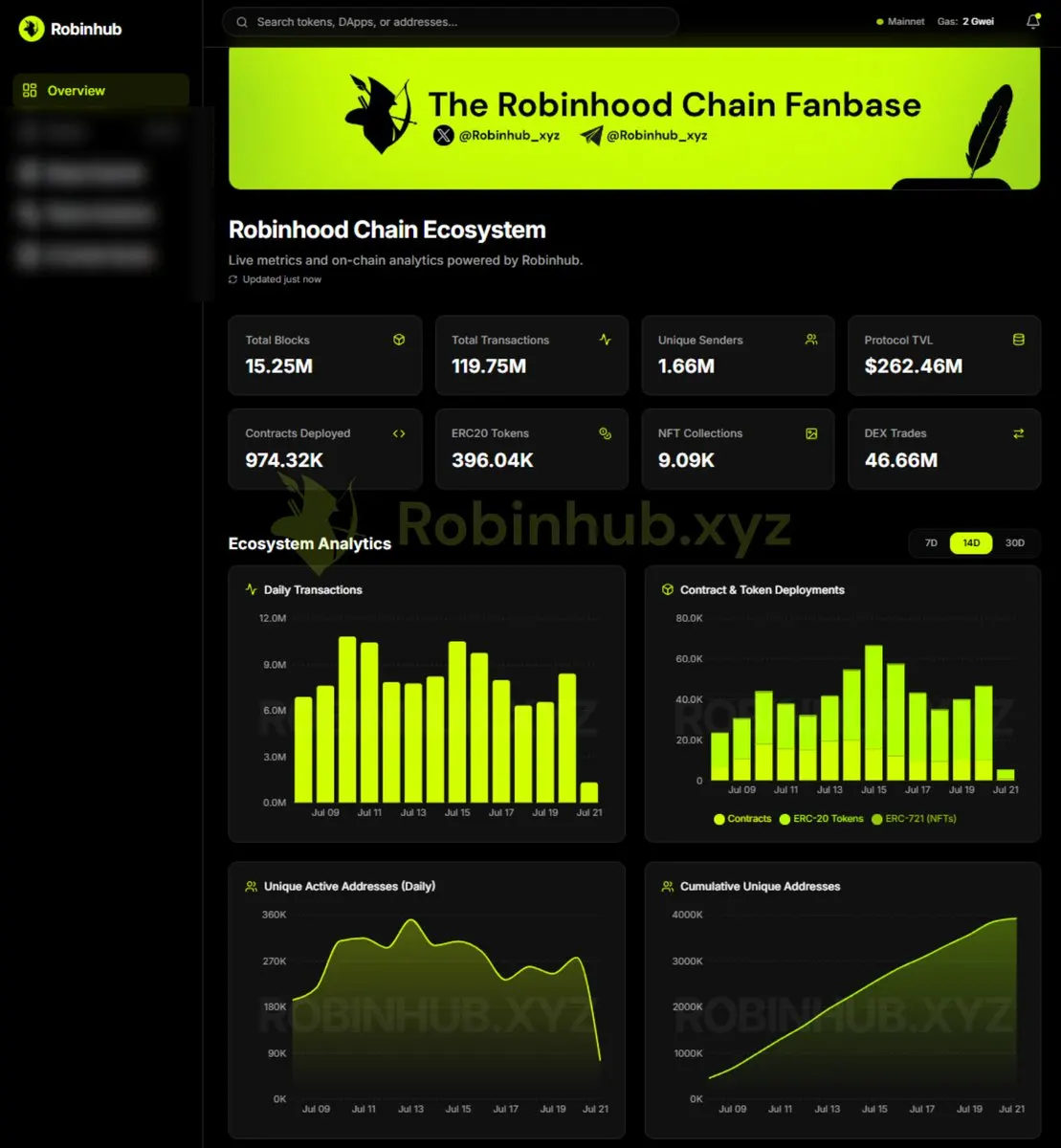
Three weeks after the Robinhood Chain mainnet launch, the protocol’s TVL has reached $262 million and the number of transactions has reached 120 million.
Svmuu News: RobinHub posted on X stating that data shows that since Robinhood’s mainnet launch three weeks ago, there have been 119.75 million transactions, 15.25 million blocks, and 1.66 million uniq
-
What Is the EMPIRE Token? An Analysis of EMPIRE Token Trading and the Ecosystem
EMPIRE Token (Empire Token) is an ERC-20 token that was initially issued on the BNB Chain and later migrated to Ethereum. It aims to build an ecosystem of decentralized applications (dApps) that integrates DeFi with real-world use cases, including an NFT smart platform, a decentralized exchange, and community governance applications.EMPIRE employs a deflationary model and supports staking and governance, with a commitment to promoting blockchain education and adoption. This article will delve into its core features and current trading channels.
-
Current Status and Future Outlook of the IDEX Token: Analysis of Acquisitions, Delistings, and Market Performance
IDEX was once a hybrid decentralized exchange that combined an order book with the AMM model. Recently, its team and technology were acquired by Katana, a DeFi Layer 2 solution, with the aim of integrating them into Katana’s perpetual futures platform to provide centralized exchange-level speed for on-chain trading.However, the major global exchange Binance delisted the IDEX token in April 2026, which had a significant negative impact on its market performance. As of this writing, the IDEX token price is at an all-time low, and its market capitalization remains relatively small; its future trajectory will depend on the progress of the integration with the Katana platform and the overall market environment.
-
CAKE: Factors Affecting the Price of PancakeSwap’s Native Token and Major Trading Platforms
CAKE is the native token of PancakeSwap, a leading decentralized exchange. This article takes an in-depth look at the key factors influencing the price of CAKE, including its deflationary tokenomics model, PancakeSwap’s multi-chain expansion roadmap, and DeFi market trends. It also provides readers with a detailed guide on where CAKE can be traded on major centralized and decentralized platforms, while emphasizing the speculative nature of price predictions.
-
SOLVE Coin Trading Guide: How to Buy and Sell SOLVE on Decentralized and Centralized Platforms?
SOLVE is primarily traded on decentralized exchanges (DEXs), with Uniswap V2 (Ethereum) being the main trading platform. Some centralized exchanges, such as HitBTC, also support SOLVE trading, while Binance and Coinbase provide DEX connectivity services through their Web3 wallets.As of July 2026, SOLVE’s trading volume was extremely low, with the price fluctuating between $0.0000561 and $0.00008106, and a market capitalization of approximately $39,300 to $66,360.
-
What Is BTS (BitShares)? An Analysis of Trading Platforms, Total Supply, and Key Features
BitShares (BTS), known in Chinese as “BitGu,” is a decentralized financial platform and its core token launched by Dan Larimer in 2014. It is based on the Delegated Proof-of-Stake (DPoS) consensus algorithm and is designed to provide high-throughput decentralized exchange (DEX) functionality, as well as support the issuance of smart coins (bitAssets). BTS tokens are used within the ecosystem to pay transaction fees, participate in governance voting, and serve as collateral for issuing bitAssets. As of July 2026, the circulating supply of BTS was approximately 2.995 billion; the total supply is close to the circulating supply, and the maximum supply is 3.6 billion.
-
An Overview of Major Global Cryptocurrency Exchanges and an Analysis of Third-Party Tools
This article provides an in-depth exploration of the world’s leading centralized and decentralized cryptocurrency trading platforms, including Binance, Coinbase, and Uniswap, and analyzes their market positions, features, and compliance.At the same time, the article provides a detailed overview of common third-party auxiliary software used in cryptocurrency trading, such as trading bots and copy-trading tools, and comprehensively analyzes the security, regulatory, and market manipulation risks associated with using these tools, offering investors a comprehensive reference.
-
POO Coin Trading Guide: Where to Buy and Sell PooCoin, Poo Finance, and Poopcoin, and Exchanges Where They Are Listed
The term “POO Coin” may refer to several cryptocurrency projects, the most prominent of which is PooCoin (POOCOIN), a BNB Chain-based token that provides DeFi trading analysis charts.In addition, there is the meme token Poo Finance (POO) on Ethereum and Poopcoin, which is tradable on centralized exchanges. This article will provide a detailed overview of how to buy and sell these three types of “POO coins” and the exchanges where they are listed, helping readers distinguish between them and understand their respective trading options.
-
Analysis of YUZU Coin’s Value and Long-Term Investment Potential: Distinguishing Between Yuzu USD and YuzuSwap
In the crypto market, “YUZU” may refer to two different projects: Yuzu USD (YZUSD) and YuzuSwap (YUZU). YZUSD is a multi-chain DeFi stablecoin designed to maintain price stability, with its value primarily derived from payments, settlements, and staking rewards. YUZU, on the other hand, is the native token of YuzuSwap, a decentralized exchange running on the Oasis Network or Movement Network, and its value is tied to the platform’s adoption rate and trading activity. This article will examine the characteristics and market performance of both projects separately, as well as their potential as long-term investment opportunities.
-
How to Trade and Buy 1UP Coins? An Analysis of the Exchanges Where Different 1UP Tokens Are Listed
There are several tokens named “1UP” in the cryptocurrency market, primarily including the 1-UP Platform and Uptrennd, which are based on Ethereum, as well as a meme token on the Binance smart chain.This article will introduce the background and current market overview of each of these 1UP tokens, and provide detailed information on potential purchasing channels and exchanges where they are listed, to help readers distinguish between them and understand how to trade each one.
-
EKS (Elumia Krystal Shards) Buying and Trading Guide: Which Exchanges List It?
EKS, short for Elumia Krystal Shards, is an in-game digital currency running on the Solana blockchain, primarily used in games such as “BRAVE FRONTIER HEROES” and “Legends of Elumia.” It serves not only as the core of the game economy but also functions as a governance token within “Legends of Elumia.” Currently, EKS is primarily traded on decentralized exchanges (DEXs) such as Raydium, with few direct spot listings on centralized exchanges. Given its relatively low circulating supply and market capitalization, traders should pay special attention to liquidity risks.
-
Global Cryptocurrency Exchange Rankings and Guide to Purchasing Outside of Exchanges
This article provides an in-depth analysis of the rankings of the world’s leading cryptocurrency trading platforms and introduces major players such as Binance, OKX, and Bitget based on metrics including trading volume, liquidity, user base, and compliance.At the same time, the article elaborates on various methods for purchasing cryptocurrencies outside of centralized exchanges, including over-the-counter (OTC) trading, peer-to-peer (P2P) trading, cryptocurrency ATMs, decentralized exchanges (DEXs), and services integrated with crypto wallets, with the aim of providing global readers with a comprehensive overview of ways to acquire crypto assets.
-
ALPACA Token Purchase and Trading Guide: An Analysis of Listed Exchanges and the Trading Process
ALPACA is the native token of Alpaca Finance, the first leveraged yield farming platform on the BNB Smart Chain. This article will provide a detailed guide on how to buy and trade ALPACA tokens, including through centralized exchanges (CEX), decentralized exchanges (DEX), and select platforms that support direct fiat purchases. Additionally, this article will list the major platforms currently supporting ALPACA trading and provide an overview of the token’s basic project information and market data to help readers understand its trading options and position within the ecosystem.
-
WND Coin Trading Guide: Distinguishing Between Wonder and WonderHero, and Learning About Listed Exchanges
There are two main references to the WND token: Wonder (WND) on the Polkadot Westend testnet and the blockchain game project WonderHero (WND). This article will separately introduce the background of these two tokens, the blockchains they belong to, and the platforms where they can be traded or exchanged as of the time of publication. Please note that there are significant differences in market data and trading activity between the two WND tokens; investors must carefully verify project information before trading.
-
How do I trade BCUBE tokens? On which cryptocurrency exchanges is BCUBE listed?
BCUBE is the native utility token of the B-cube.ai platform, which provides AI-driven cryptocurrency trading tools. The BCUBE token is primarily traded on decentralized exchanges (DEXs) such as Uniswap V2, though it is also listed on some centralized exchanges (CEXs). This article will provide a detailed overview of how to buy and sell BCUBE, as well as its main trading platforms and use cases.
-
What Is the NETT Token? A Guide to the Netswap Token’s Features and Trading Platform
NETT is the native token of the Netswap decentralized exchange (DEX). Netswap operates on the Metis Andromeda Layer 2 solution and uses an automated market maker (AMM) model. It aims to provide a fast, efficient, and cost-effective trading experience for tokens on the Ethereum and Metis Andromeda networks.As of this writing, NETT’s circulating supply is approximately 11 million tokens. Users can trade NETT on centralized exchanges such as Gate.io and Crypto.com, as well as on decentralized exchanges like Netswap.












-
Solana ecosystem DEX Velocity halts trading due to exploit
Solana ecosystem DEX Velocity has suspended trading due to a vulnerability. The platform, which relaunched this September, is a rebuilt version of Drift Protocol (which was exploited by North Korean h
-
PancakeSwap Volume Rebounds 34% to $991 Million
PancakeSwap Volume Rebounds 34% to $991 Million
-
GTA Developer Take-Two's Tokenized Stock Hits $249.5 Million in DEX Trading Volume on Wednesday, Nearly Triple NVIDIA's
GTA Developer Take-Two's Tokenized Stock Hits $249.5 Million in DEX Trading Volume on Wednesday, Nearly Triple NVIDIA's
-
PancakeSwap rebrands to Pancake; CAKE token requires no migration
PancakeSwap is rebranding to Pancake, with the CAKE token requiring no migration. The exchange stated that the shorter name reflects its existing operations in the perpetual contracts and tokenized eq
-
CryptoSlate: Nov. 10 Snapshot Shows Solana-Category Perpetual Contracts Weekly Volume Surge 65.29%
According to CryptoSlate, citing a DefiLlama snapshot on November 10, the 7-day perpetual contract trading volume within the Solana category approached $9 billion, representing a 65.29% increase compa
-
Standard Chartered Analysts: Binance Hack May Accelerate Shift to DEXs, Reinforcing View of UNI Reaching $100 by 2030
Standard Chartered analyst Geoffrey Kendrick stated that the Binance hack could accelerate the shift towards decentralized exchanges (DEXs) and reinforce his view that Uniswap's UNI token will reach $
-
Binance hackers converted freezeable stablecoins to Ethereum using DEXs, some DEXs paused markets.
According to Etherscan records, Binance hackers are using decentralized exchanges such as Uniswap and Aave to convert freezeable stablecoins issued by Tether, Circle, and Ripple into non-freezeable Et
-
Fluid launches DEX v2 Beta, supporting custom collateral and debt ranges
Fluid has opened its decentralized exchange (DEX) v2 Beta, supporting custom collateral and debt ranges. The governance layer has set a borrowing cap of $50,000 per asset for new Ethereum contracts, w
-
Genius launches mobile app on Apple App Store and Google Play
Onchain trading platform Genius has launched its mobile app on Apple's App Store and Google Play. Built on BNB Chain, the app combines token trading, social features, and token creation, allowing user
-
Ripple's institutional stablecoin, RLUSD, ranks among the top globally for short-term growth on decentralized exchanges (DEXs)
Ripple's institutional stablecoin, RLUSD, ranks among the top globally for short-term growth on decentralized exchanges (DEXs). Over the past seven days, its DEX trading volume increased by $199.4 mil
-
Uniswap clarifies the composition of transaction costs and explains the differences in network fee handling between UniswapX and classic liquidity pool transactions.
Uniswap clarifies the composition of transaction costs and explains the differences in network fee handling between UniswapX and classic liquidity pool transactions.
-
Solana bot turns $12,000 into $1.4 billion in trading volume on Raydium, raising fake liquidity concerns
Blockchain analytics firm Bitquery reported that a single Solana wallet generated $1.4 billion in suspected wash trades, accounting for nearly a quarter of Raydium's concentrated-liquidity volume betw
-
Lookonchain Monitoring: MAGMA Token Surges Over 70% Today, Two Wallets Open 2x Leveraged Long Positions on Aster_DEX, Showing $340K in Unrealized Gains
Lookonchain monitoring: MAGMA token surged over 70% today. Two wallets opened 2x leveraged long positions on Aster_DEX, holding 1.5 million MAGMA tokens (worth $775,000). They are currently up $340,00
-
PancakeSwap has launched "The Flip" vote on CAKE supply, with the final proposal suggesting a reduction of approximately 69% in CAKE's effective daily emissions while retaining the buyback mechanism for non-stablecoin protocol fees.
PancakeSwap has launched "The Flip" vote on CAKE supply, with the final proposal suggesting a reduction of approximately 69% in CAKE's effective daily emissions while retaining the buyback mechanism f
-
Coinbase CEO Brian Armstrong: Crypto has eliminated many of the waits in traditional finance, allowing money to flow at the speed of information.
Coinbase CEO Brian Armstrong tweeted that crypto has eliminated many previously accepted waiting periods in traditional finance, such as stablecoins flowing cross-border on weekends and holidays, toke
-
Ripple's David Schwartz Predicts Major DeFi Breakthrough on XRP Ledger by 2027
Ripple CTO Emeritus David Schwartz hinted at a major breakthrough in XRP Ledger-based decentralized finance (DeFi), predicting a retail-friendly environment by 2027 where institutions and retail users
-
Bitquery study: Only 18% of small Uniswap v3 positions beat holding after gas
A study by blockchain data firm Bitquery found that for Uniswap v3 positions under $1,000, only 18% outperformed simply holding tokens after deducting gas fees, a significant drop from 51% before fees
-
Tokenized Equities Reached $3.8 Billion This Year, DWF Labs Says
Tokenized equities reached $3.8 billion this year, according to a DWF Labs report. The report also notes that weekly spot trading on decentralized exchanges hit $2.54 billion, marking a 55-fold increa
-
Jeff Yan's Plan to Bring the Entire Financial Industry Onto Hyperliquid
Jeff Yan's Plan to Bring the Entire Financial Industry Onto Hyperliquid
-
StandX, a decentralized perpetual contract exchange founded by former Binance Futures head Aaron Gong, will cease operations and abandon its token issuance plan.
StandX, a decentralized perpetual contract exchange founded by former Binance Futures head Aaron Gong, will cease operations and abandon its token issuance plan.
-
Lookonchain: BTW token surges over 110x since listing on Aster_DEX; Trader 0x45bd gains $151K unrealized profit on $238K 4x long
Lookonchain: BTW token surges over 110x since listing on Aster_DEX; Trader 0x45bd gains $151K unrealized profit on $238K 4x long
-
Lookonchain: Mysterious Whale Sells Another 229 BTC ($19.1M) and Buys 7,469.8 ETH ($19.1M)
Lookonchain monitored that this mysterious whale had previously sold 410.14 BTC ($34.16M) on Hyperliquid and bought 14,341 ETH ($36.14M) on DEXs.
-
A mysterious Bitcoin whale sold approximately $34.16 million worth of Bitcoin, then bought about $36.14 million worth of Ethereum.
On-chain data shows that an anonymous Bitcoin whale sold 410.14 Bitcoins (worth approximately $34.16 million) via the decentralized trading protocol Hyperliquid, and subsequently bought 14,341 Ethereu
-
OKX Founder Star Xu: Hyperliquid's matching engine is more market-maker friendly because it matches orders block by block and prioritizes cancellations.
OKX founder Star Xu stated on the New Era Finance podcast that Hyperliquid's matching engine is fundamentally different in its technical design from centralized order book exchanges. It matches orders
-
How to buy and sell CND? Which exchanges have listed CND?
A detailed analysis of how to buy and sell CND (Cindicator), the process for exchanging it via Web3 wallets, and the distribution of exchanges where it is currently listed, with a focus on the operational mechanisms and on-chain liquidity characteristics of the decentralized exchange Uniswap V3.
-
How to buy and sell VCE coin? Which exchanges has VCE coin been listed on?
A detailed guide on how to buy and sell VCE coin (Vince Chain), including its exchange listing status. This article analyzes the current situation where VCE coin is not yet listed on mainstream CEXs, explains how to swap it via Web3 wallets and on-chain DEXs, and highlights the relevant procedures, requirements, and precautions for on-chain trading.
-
How to buy and sell OPV token? Which exchanges is OPV token listed on?
A detailed analysis of the on-chain attribution, buying and selling mechanisms, specific swap steps, and current listing status of the OPV token on mainstream exchanges, helping readers comprehensively understand the operational mechanics and trading risks of long-tail on-chain assets.
-
How to buy and sell GOLD coin? Which exchanges has GOLD coin been listed on?
A detailed analysis of the trading mechanisms, liquidity distribution, and exchange listings for GOLD tokens and gold-backed digital assets. This article outlines the complete process of executing on-chain swaps through decentralized exchanges and Web3 wallets, while distinguishing the listing status and regulatory risk limitations of similarly named tokens versus compliant assets on centralized platforms.
-
What is TIME coin? Where to trade TIME coin?
An in-depth analysis of the background, core projects, and operational mechanisms of tokens named TIME in the cryptocurrency market, along with a comprehensive guide on trading pathways, prerequisites, and on-chain risk mitigation for buying and selling them on decentralized exchanges (such as Raydium).
-
How to buy and sell EQ9 token? Which exchanges has EQ9 token been listed on?
A detailed guide on how to buy and sell EQ9, trading processes, and the centralized and decentralized exchanges where it is currently listed. This helps readers gain a comprehensive understanding of its trading mechanisms, network support, and liquidity conditions across different platforms (such as Bitrue, Uniswap, etc.), complete with market verification and operational risk warnings.
-
How to buy and sell DOGEAI token? Which exchanges have listed DOGEAI?
A detailed guide to the trading methods for DOGEAI, its listings on decentralized and centralized exchanges, the operational workflows for on-chain swapping and CEX trading, and precautions for mitigating the risk of copycat/same-name assets.
-
How to buy and sell AC token? Which exchanges have listed AC token?
A detailed analysis of the trading methods and listed exchanges for multiple crypto assets sharing the ticker "AC". Due to the ambiguous nature of the "AC" ticker—covering different projects such as ACoconut, American Coin, and Azadi Coin—their trading paths and listing platforms vary significantly. This article helps readers clarify how to verify specific targets via contract addresses, and elaborates on the practical operating methods, applicable conditions, and market limitations across decentralized and centralized exchanges.
-
How to buy and sell FRED token? Which exchanges have listed FRED?
A detailed introduction to the trading mechanisms and listed exchanges for the FRED token. Due to the presence of multiple tokens with the same name or ticker symbol "FRED" in the cryptocurrency market, trading methods and liquidity channels vary depending on the blockchain network. This article outlines the general swapping process for the FRED token on decentralized exchanges (DEXs) and Web3 wallets, methods for identifying multi-chain assets with the same name, and key trading precautions.
-
What is CRC coin? Where can you trade CRC coin?
A detailed analysis of the dual definition of CRC in different contexts: its role as the official currency code for the traditional fiat Costa Rican Colón, and as a specific digital token in the blockchain and crypto universe. It also outlines the acquisition, exchange, trading methods, and operational mechanisms for both the fiat currency and the crypto token.
-
How to buy and sell OKAGE token? Which exchanges is OKAGE listed on?
A detailed analysis of the definition of the OKAGE token, its Ethereum-based operational mechanism, the operational workflow of decentralized trading, and the current status of exchange listings and liquidity characteristics, helping readers gain a comprehensive understanding of the trading channels and risks associated with on-chain tokens.
-
Latest News on Integra (ITGR): ITGR Token Mechanics and Long-Term Holding Risk Assessment
A detailed analysis of the latest market status of the Integral (ITGR) token, the core decentralized trading mechanism of the Integral Protocol, and whether it is worth holding for the long term. The article covers ITGR's tokenomics, liquidity challenges, and investment risk boundaries.
-
What is SADA coin? Where can SADA coin be traded and bought/sold?
A detailed analysis of the definition of the SADA coin (sADA), its synthetic asset operational mechanism, and its trading pathways and liquidity limitations in decentralized exchanges and Web3 wallets.
-
How to buy and sell WJXN token? Which exchanges have listed WJXN token?
A detailed introduction to the trading mechanism, buying and selling pathways, exchange listing status, and relevant considerations for the WJXN token. This article outlines the operational logic of the token within decentralized exchanges and on-chain ecosystems, helping readers comprehensively understand its current circulation status and swapping methods.
-
How to buy and sell BTH? Which exchanges has BTH been listed on?
A detailed analysis of the on-chain trading and transaction mechanism for the Bit Hotel (BTH) token, its support across mainstream decentralized and centralized platforms, as well as the specific paths, network environments, and associated risks for participating in on-chain swaps.
-
What is SOLPAD coin and where can you trade and buy SOLPAD coin?
A comprehensive analysis of the definition, operational mechanism, and application scenarios of Solpad Finance's ecosystem token, SOLPAD, on the Solana blockchain. Additionally, the article covers decentralized trading methods for SOLPAD, required wallet tools, and market liquidity risks.
-
How to buy and sell MUNCH token? Which exchanges is MUNCH listed on?
Detailed overview of the trading mechanism, decentralized exchange process, and listing status of the MUNCH token. It analyzes its operating model, which primarily relies on Web3 wallets and decentralized exchanges, and provides guidance on methods for identifying cross-chain tokens with the same name and key points for verifying contract addresses.
-
What is HAKI token? Where can you buy and sell HAKI tokens?
An in-depth analysis of the positioning, anime NFT ecosystem mechanism, deflationary tokenomics, and acquisition channels on decentralized exchanges for Haki Token (HAKI), with a reminder to identify multi-chain variations of same-named projects and guard against the risks of low-liquidity assets.
-
How to buy and sell QUACK coin? Which exchanges have listed QUACK coin?
A Detailed Analysis of QUACK Token: Trading Methods, On-Chain Mechanisms, and Exchange Listings. This article outlines the trading pathways for QUACK tokens of the same name across different blockchain networks such as BNB Smart Chain and Solana, the key operational points for decentralized exchanges (DEXs), and the distribution of centralized trading platforms involved historically, providing readers with a comprehensive general reference and risk warnings.
-
How to buy and sell PFTM? Which exchanges have listed PFTM?
A detailed analysis of the definition, operational mechanism, buying and selling trading processes, and current exchange listing status of PFTM, an algorithmic stablecoin on the Fantom network. This article takes a deep dive into PFTM's liquidity distribution, trading channels across decentralized and centralized markets, as well as the participation limitations and risks associated with niche assets.
-
How to buy and sell ULAB? Which exchanges have listed ULAB?
A detailed analysis of how to trade the ULAB (or LAB) token, its listings across decentralized and centralized exchanges, as well as the basic workflow, technical pathways, and risk mitigation strategies involved in participating in long-tail crypto asset trading.
-
How to buy and sell HUSH? Which exchanges have listed HUSH?
A detailed analysis of the trading channels and buying/selling mechanisms for the HUSH token, with a primary focus on its current listing status across mainstream centralized exchanges (CEXs), how to participate in token swaps via decentralized exchanges (DEXs) and Web3 self-custody wallets, alongside an analysis of related market operations and potential limitations.
-
What is the APOLLO coin? Where can you trade and buy APOLLO coin?
A detailed analysis of the types, blockchain backgrounds, and operational mechanisms of multiple crypto projects known as APOLLO coin in the market, along with an overview of their respective trading channels and related market risks.
-
How to buy and sell KTO token? Which exchanges is KTO listed on?
Detailed introduction to the trading methods, Web3 wallet operation procedures, and current exchange listings of KTO (Kounotori Token). This guide helps readers comprehensively understand its operational mechanism on DEXes, current liquidity status, and essential trading precautions.


DEX

24H Trending
-
1
Binance Latest Updates Analysis: Alpha Airdrops, Asset Security, Leverage Adjustments, and Tokenized Stocks Launch
-
2
The Taiwan Capitalization Weighted Stock Index (TAIEX) fell 7.37% from its previous close, currently standing at 37,163.35.
-
3
The Nikkei 225 index fell 3.23% from its previous close, currently trading at 56,752.12
-
4
South Korea's KOSPI index fell 5.29% from its previous close, currently trading at 4,741.04.
-
5
SK Hynix is down 6.3% from its previous close, currently trading at ₩1,085,000.
-
6
Samsung Electronics fell 5.76% from its previous close, currently trading at ₩178,500.
-
7
SK hynix fell 9.59% from its previous close, currently trading at ₩1,047,000.
-
8
Samsung Electronics fell 7.34% from its previous close, currently trading at ₩175,500.
-
9
Samsung Electronics fell 9.66% from its previous close, currently trading at ₩171,100.
-
10
South Korea's KOSPI index fell 6% from its previous close, currently trading at 4,705.47.
Markets Today





Recommended Reading

Hot Topics

Svmuu focuses on blockchain industry trends and cutting-edge cryptocurrency news, while also covering real-time market data and in-depth analysis of the Hong Kong, U.S., and foreign exchange markets. Here, you can not only access professional 24/7 news updates and accurate market data, but also utilize practical investment tools to help you capitalize on opportunities in both digital assets and traditional financial markets. Whether you are a blockchain enthusiast or an investor in Hong Kong, U.S., or foreign exchange markets, we provide efficient and timely information services to empower your investment decisions.
- User Agreement
- Privacy Policy
- Contact Us
- Business Partnerships
- Disclaimer
- Content Statement
- About Us
- Sitemap
 Coming Soon!
