

Faster global financial news!
DEX
-
Analysis of the Investment Value and Prospects of the Curve DAO Token (CRV)
The Curve DAO Token (CRV) is the native governance token of the decentralized exchange Curve, a platform known for its AMM mechanism optimized for stablecoin trading and its low slippage. The CRV token grants holders governance rights and serves as a reward for liquidity providers. With the launch of the crvUSD stablecoin, Curve’s potential for innovation has been further highlighted. This article will delve into the investment considerations, market position, and potential risks associated with CRV.
-
HES (Hero Essence) Trading Guide: How to Buy and Sell on a Decentralized Exchange?
HES Coin (Hero Essence) is a digital currency launched by Health Elements Pte Ltd of Singapore, designed to serve the healthcare sector. As of July 2026, HES Coin is primarily traded on decentralized exchanges (DEXs), with PancakeSwap serving as its main trading platform.The token operates on the Binance Smart Chain (BSC). Although some centralized platforms may display information about it, HES Coin has not yet been directly listed on major centralized exchanges such as Binance. Investors can purchase it by connecting a Web3 wallet to a DEX, but should be aware of liquidity and market volatility risks.
-
What Is CHA? An Analysis of the Chains Project Token’s Uses and Trading Channels
CHA is primarily the cryptocurrency of the Chains project, which aims to address efficiency and cost issues in DeFi. It supports decentralized applications and smart contracts and may run on the BNB Smart Chain or Solana. As of July 2026, its market capitalization was approximately $418,000.CHA is primarily traded through Web3 wallets connected to decentralized exchanges (DEXs), such as via the Binance Web3 wallet or OKX’s DEX feature. Note that centralized exchanges typically do not offer direct trading services for CHA.
-
On which platforms can Klaytn (KLAY) tokens be traded?
Klaytn is an EVM-compatible blockchain focused on the metaverse, gaming, and the creator economy. Its native token, KLAY, is used to pay transaction fees, mint NFTs, and provide DeFi liquidity. Investors and users can buy and sell KLAY on various centralized exchanges (CEXs) and decentralized exchanges (DEXs), and a wide range of Web3 wallets support the storage and management of KLAY. This article provides a detailed overview of the main trading channels for KLAY.
-
What is Meta Games Coin (MGC)? On which platforms can it be traded?
Meta Games Coin (MGC) is a BEP20 token built on the Binance Smart Chain (BSC) that focuses on the gaming and entertainment sectors. It is designed to support a “play-to-earn” ranking platform where users can earn MGC tokens by playing games and sharing their achievements.The MGC ecosystem also includes virtual cities, clubs, and an NFT platform that facilitates the creation and trading of NFT games. As of this writing, MGC is tradable on decentralized exchanges such as PancakeSwap and ApeSwap, as well as centralized exchanges like Bitget and BitMart.
-
HCT Token: An Analysis of the Current Status and Future Development Plans for the HurricaneSwap Token
HCT is the native token of HurricaneSwap, a decentralized exchange built on the Avalanche network, and was launched in the third quarter of 2021. The project aims to provide efficient, low-cost cross-chain transactions and plans to develop features such as DAO governance and lending. However, as of July 2026, HCT has underperformed in the market, with extremely low trading volume; market capitalization data is often listed as unavailable, and its value has declined significantly over the past year. Despite the project’s ambitious vision, it faces significant challenges regarding current market activity and user engagement.
-
UNI Token: Analysis of Uniswap’s Governance Core and Market Value
UNI is the native governance token of Uniswap, a leading decentralized exchange, granting holders the right to vote on the protocol’s future direction. As of July 22, 2026, UNI’s market price was approximately $3.65–$3.71, with a market capitalization of approximately $228 million–$236 million. Its investment value lies in Uniswap’s position as the leading DEX, its ongoing innovation capabilities, and the potential future activation of the “fee switch”; however, it also faces risks such as intense market competition, regulatory uncertainty, and selling pressure resulting from token unlocking.
-
NOWAR Token: An Analysis of Trading Methods and Listed Exchanges for the Multi-Chain Version
The NOWAR token is not a single entity, but rather refers to tokens with the same or similar names that exist on multiple blockchains, including Solana, Base, and the BNB Smart Chain. These tokens are typically traded through decentralized exchanges (DEXs), Web3 wallets with built-in swap functionality, or P2P marketplaces.Bitget Wallet and Coinbase (via its DEX) are currently the platforms reported to support NOWAR token trading, while Symlix offers P2P services. Due to the existence of multiple versions and significant variations in liquidity, investors should carefully verify token details and on-chain information before trading.
-
Global Bitcoin Trading Platform Guide: Considerations for Choosing Between Centralized and Decentralized Exchanges
This article provides an in-depth exploration of the various platforms available worldwide for trading Bitcoin, focusing on the functions, features, and market positions of major centralized exchanges (CEXs) such as Binance, Coinbase, and OKX. It also briefly touches on the operating models of decentralized exchanges (DEXs).The article emphasizes the need to consider key factors such as security, liquidity, fees, compliance, and user experience when selecting a trading platform, and reminds readers of the inherent risks associated with cryptocurrency investment.
-
SWOP Token Trading Guide: Listed Exchanges and Market Overview
SWOP is the governance token of Swop.fi, an automated market maker (AMM) protocol built on the Waves blockchain. Swop.fi provides token trading services to users through a unique pricing formula and liquidity incentive mechanisms. SWOP tokens can be bought and sold on centralized exchanges such as Bitget and Crypto.com, as well as on decentralized platforms like Swop.fi. As of June 2026, SWOP’s market value has not yet gained widespread recognition, and its price is highly volatile, making it considered a high-risk asset. Investors should fully understand its mechanisms and potential risks before engaging in trading.
-
TREAT Token Buying and Trading Guide: Which Exchanges Support It and How to Store It
The TREAT token is an integral part of the Shiba Inu ecosystem, designed to provide liquidity for the SHI stablecoin and serve as a reward token on ShibSwap.This article will provide a detailed overview of the various channels for buying, selling, and trading TREAT, including decentralized exchanges (DEXs) and centralized exchanges (CEXs), and outline common methods for storing the token.As of this writing, TREAT has a market capitalization of approximately $160,000 to $180,000 and is primarily traded on the DEX at Ethereum and on select CEXs.
-
What Might “BIVZ Coin” Refer To? A Guide to Trading BIDZ Coin and BIVE Tokens
The term “BIVZ Coin” may refer to different projects in the cryptocurrency market. This article focuses primarily on two possibilities: BIDZ Coin (BIDZ) and BIVE (Bizverse). We will separately introduce the use cases and market overviews of these two tokens, as well as how to buy and sell them on the platforms that support them. The content of this article is based on publicly available information as of July 21, 2026, and is intended to help readers distinguish between and understand the relevant trading channels.
-
Guide to Buying and Selling LIU Tokens: Distinguishing Between Different On-Chain Versions and Trading Platforms
There are multiple versions of the LIU token, primarily including the “time-backed token” LIU on the SV chain (Bitcoin), as well as tokens with the same or similar names on the BNB Smart Chain and Solana. This article will provide a detailed overview of how to trade these different versions of the LIU token and the available trading platforms, helping readers identify and understand the respective methods for buying and selling them.Please note that some LIU tokens have low liquidity and carry higher trading risks.
-
XSAUCE Token Buying and Trading Guide: Analysis of Listed Exchanges and the Trading Process
XSAUCE is a liquidity receipt token within the SaucerSwap ecosystem—a decentralized exchange on the Hedera network—that is obtained through one-way staking of SAUCE and features an automatic compounding mechanism. This article provides a detailed overview of the trading platforms for XSAUCE, including its primary decentralized exchange, SaucerSwap V2, as well as the centralized platform LBank, which supports trading of XSAUCE. It also outlines general steps for buying and selling XSAUCE within the Hedera ecosystem and highlights relevant market data.
-
Overview and Rankings of Global Digital Currency Trading Platforms: An Analysis of Centralized and Decentralized Exchanges
Digital currency trading platforms serve as the central hubs for the circulation of crypto assets and are primarily divided into centralized exchanges (CEX) and decentralized exchanges (DEX). CEXs dominate the market due to their high liquidity and convenience, while DEXs emphasize user control over their assets.As of this writing, leading CEXs such as Binance, OKX, Bybit, and Coinbase account for a significant share of global trading volume. This article will delve into the characteristics of various trading platforms, the market landscape, and the key factors users should consider when selecting a platform, helping readers better understand and participate in the cryptocurrency market.
-
Analysis of the KSP Token’s Value: Investment Considerations for the KLAYswap Governance Token
KSP is the governance token of KLAYswap, an automated market maker (AMM) decentralized exchange built on the Klaytn blockchain. Its value primarily stems from governance rights, payments for liquidity pool creation fees, and liquidity mining rewards. As a core DeFi protocol in the Klaytn ecosystem, KSP offers cross-chain capabilities; however, it faces challenges inherent to the relatively early stage of the Klaytn ecosystem’s development, its geographic concentration, and the high volatility and liquidity risks associated with assets with a small market capitalization. When considering KSP’s long-term potential, investors should thoroughly evaluate the overall development prospects of the Klaytn network.
-
How do I buy and sell USHIBA tokens? On which major exchanges are they listed?
American Shiba (USHIBA) is a cryptocurrency project built on the Ethereum blockchain, designed to support veterans and promote decentralized philanthropy. The USHIBA token is primarily traded on decentralized exchanges (DEXs); users must connect to platforms such as Uniswap V2 using a Web3 wallet like MetaMask to exchange the token.As of this writing, USHIBA’s market capitalization is approximately $137,000, with relatively low 24-hour trading volume. Investors should thoroughly understand its operational mechanisms and the risks associated with market volatility before participating.
-
MNET Coin Trading Guide: How to Buy and Sell MINE Network (MNET) and MNet (NUUM), and Where They Are Listed
“MNET Coin” may refer to two different cryptocurrency projects: MINE Network (MNET) and MNet (NUUM). MINE Network (MNET) is a BEP20 token that is primarily traded on decentralized exchanges (DEXs) via Web3 wallets. MNet (NUUM), on the other hand, is a blockchain ecosystem token that primarily trades as the NUUM/SOL pair on DEXs such as Raydium. This article will provide a detailed overview of how to buy and sell these two tokens, as well as the trading platforms they support.
-
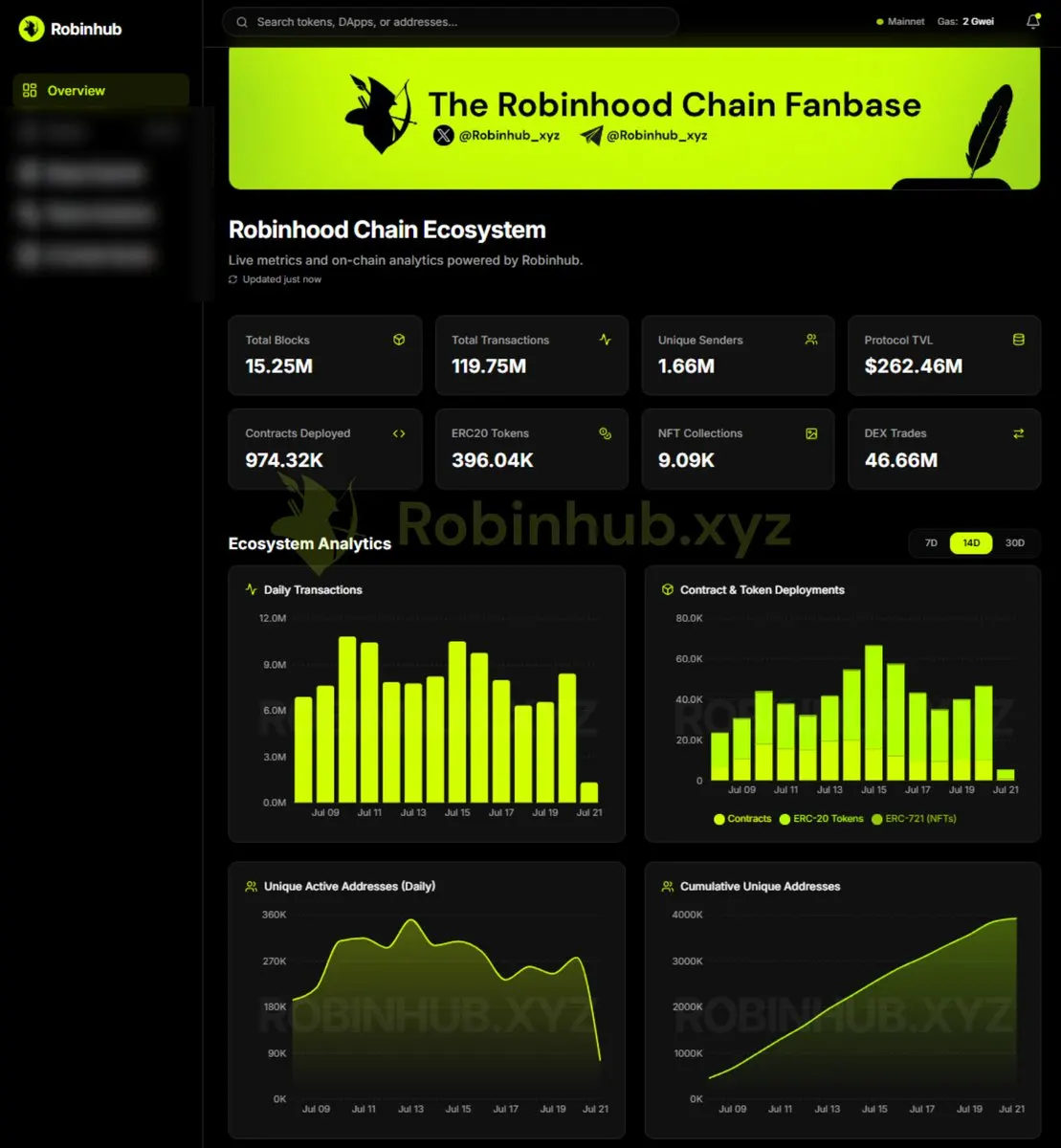
Three weeks after the Robinhood Chain mainnet launch, the protocol’s TVL has reached $262 million and the number of transactions has reached 120 million.
Svmuu News: RobinHub posted on X stating that data shows that since Robinhood’s mainnet launch three weeks ago, there have been 119.75 million transactions, 15.25 million blocks, and 1.66 million uniq
-
What Is the EMPIRE Token? An Analysis of EMPIRE Token Trading and the Ecosystem
EMPIRE Token (Empire Token) is an ERC-20 token that was initially issued on the BNB Chain and later migrated to Ethereum. It aims to build an ecosystem of decentralized applications (dApps) that integrates DeFi with real-world use cases, including an NFT smart platform, a decentralized exchange, and community governance applications.EMPIRE employs a deflationary model and supports staking and governance, with a commitment to promoting blockchain education and adoption. This article will delve into its core features and current trading channels.
-
Current Status and Future Outlook of the IDEX Token: Analysis of Acquisitions, Delistings, and Market Performance
IDEX was once a hybrid decentralized exchange that combined an order book with the AMM model. Recently, its team and technology were acquired by Katana, a DeFi Layer 2 solution, with the aim of integrating them into Katana’s perpetual futures platform to provide centralized exchange-level speed for on-chain trading.However, the major global exchange Binance delisted the IDEX token in April 2026, which had a significant negative impact on its market performance. As of this writing, the IDEX token price is at an all-time low, and its market capitalization remains relatively small; its future trajectory will depend on the progress of the integration with the Katana platform and the overall market environment.
-
CAKE: Factors Affecting the Price of PancakeSwap’s Native Token and Major Trading Platforms
CAKE is the native token of PancakeSwap, a leading decentralized exchange. This article takes an in-depth look at the key factors influencing the price of CAKE, including its deflationary tokenomics model, PancakeSwap’s multi-chain expansion roadmap, and DeFi market trends. It also provides readers with a detailed guide on where CAKE can be traded on major centralized and decentralized platforms, while emphasizing the speculative nature of price predictions.
-
SOLVE Coin Trading Guide: How to Buy and Sell SOLVE on Decentralized and Centralized Platforms?
SOLVE is primarily traded on decentralized exchanges (DEXs), with Uniswap V2 (Ethereum) being the main trading platform. Some centralized exchanges, such as HitBTC, also support SOLVE trading, while Binance and Coinbase provide DEX connectivity services through their Web3 wallets.As of July 2026, SOLVE’s trading volume was extremely low, with the price fluctuating between $0.0000561 and $0.00008106, and a market capitalization of approximately $39,300 to $66,360.
-
What Is BTS (BitShares)? An Analysis of Trading Platforms, Total Supply, and Key Features
BitShares (BTS), known in Chinese as “BitGu,” is a decentralized financial platform and its core token launched by Dan Larimer in 2014. It is based on the Delegated Proof-of-Stake (DPoS) consensus algorithm and is designed to provide high-throughput decentralized exchange (DEX) functionality, as well as support the issuance of smart coins (bitAssets). BTS tokens are used within the ecosystem to pay transaction fees, participate in governance voting, and serve as collateral for issuing bitAssets. As of July 2026, the circulating supply of BTS was approximately 2.995 billion; the total supply is close to the circulating supply, and the maximum supply is 3.6 billion.


















-
Standard Chartered Analysts: Binance Hack May Accelerate Shift to DEXs, Reinforcing View of UNI Reaching $100 by 2030
Standard Chartered analyst Geoffrey Kendrick stated that the Binance hack could accelerate the shift towards decentralized exchanges (DEXs) and reinforce his view that Uniswap's UNI token will reach $
-
Binance hackers converted freezeable stablecoins to Ethereum using DEXs, some DEXs paused markets.
According to Etherscan records, Binance hackers are using decentralized exchanges such as Uniswap and Aave to convert freezeable stablecoins issued by Tether, Circle, and Ripple into non-freezeable Et
-
Fluid launches DEX v2 Beta, supporting custom collateral and debt ranges
Fluid has opened its decentralized exchange (DEX) v2 Beta, supporting custom collateral and debt ranges. The governance layer has set a borrowing cap of $50,000 per asset for new Ethereum contracts, w
-
Genius launches mobile app on Apple App Store and Google Play
Onchain trading platform Genius has launched its mobile app on Apple's App Store and Google Play. Built on BNB Chain, the app combines token trading, social features, and token creation, allowing user
-
Ripple's institutional stablecoin, RLUSD, ranks among the top globally for short-term growth on decentralized exchanges (DEXs)
Ripple's institutional stablecoin, RLUSD, ranks among the top globally for short-term growth on decentralized exchanges (DEXs). Over the past seven days, its DEX trading volume increased by $199.4 mil
-
Uniswap clarifies the composition of transaction costs and explains the differences in network fee handling between UniswapX and classic liquidity pool transactions.
Uniswap clarifies the composition of transaction costs and explains the differences in network fee handling between UniswapX and classic liquidity pool transactions.
-
Solana bot turns $12,000 into $1.4 billion in trading volume on Raydium, raising fake liquidity concerns
Blockchain analytics firm Bitquery reported that a single Solana wallet generated $1.4 billion in suspected wash trades, accounting for nearly a quarter of Raydium's concentrated-liquidity volume betw
-
Lookonchain Monitoring: MAGMA Token Surges Over 70% Today, Two Wallets Open 2x Leveraged Long Positions on Aster_DEX, Showing $340K in Unrealized Gains
Lookonchain monitoring: MAGMA token surged over 70% today. Two wallets opened 2x leveraged long positions on Aster_DEX, holding 1.5 million MAGMA tokens (worth $775,000). They are currently up $340,00
-
PancakeSwap has launched "The Flip" vote on CAKE supply, with the final proposal suggesting a reduction of approximately 69% in CAKE's effective daily emissions while retaining the buyback mechanism for non-stablecoin protocol fees.
PancakeSwap has launched "The Flip" vote on CAKE supply, with the final proposal suggesting a reduction of approximately 69% in CAKE's effective daily emissions while retaining the buyback mechanism f
-
Coinbase CEO Brian Armstrong: Crypto has eliminated many of the waits in traditional finance, allowing money to flow at the speed of information.
Coinbase CEO Brian Armstrong tweeted that crypto has eliminated many previously accepted waiting periods in traditional finance, such as stablecoins flowing cross-border on weekends and holidays, toke
-
Ripple's David Schwartz Predicts Major DeFi Breakthrough on XRP Ledger by 2027
Ripple CTO Emeritus David Schwartz hinted at a major breakthrough in XRP Ledger-based decentralized finance (DeFi), predicting a retail-friendly environment by 2027 where institutions and retail users
-
Bitquery study: Only 18% of small Uniswap v3 positions beat holding after gas
A study by blockchain data firm Bitquery found that for Uniswap v3 positions under $1,000, only 18% outperformed simply holding tokens after deducting gas fees, a significant drop from 51% before fees
-
Tokenized Equities Reached $3.8 Billion This Year, DWF Labs Says
Tokenized equities reached $3.8 billion this year, according to a DWF Labs report. The report also notes that weekly spot trading on decentralized exchanges hit $2.54 billion, marking a 55-fold increa
-
Jeff Yan's Plan to Bring the Entire Financial Industry Onto Hyperliquid
Jeff Yan's Plan to Bring the Entire Financial Industry Onto Hyperliquid
-
StandX, a decentralized perpetual contract exchange founded by former Binance Futures head Aaron Gong, will cease operations and abandon its token issuance plan.
StandX, a decentralized perpetual contract exchange founded by former Binance Futures head Aaron Gong, will cease operations and abandon its token issuance plan.
-
Lookonchain: BTW token surges over 110x since listing on Aster_DEX; Trader 0x45bd gains $151K unrealized profit on $238K 4x long
Lookonchain: BTW token surges over 110x since listing on Aster_DEX; Trader 0x45bd gains $151K unrealized profit on $238K 4x long
-
Lookonchain: Mysterious Whale Sells Another 229 BTC ($19.1M) and Buys 7,469.8 ETH ($19.1M)
Lookonchain monitored that this mysterious whale had previously sold 410.14 BTC ($34.16M) on Hyperliquid and bought 14,341 ETH ($36.14M) on DEXs.
-
A mysterious Bitcoin whale sold approximately $34.16 million worth of Bitcoin, then bought about $36.14 million worth of Ethereum.
On-chain data shows that an anonymous Bitcoin whale sold 410.14 Bitcoins (worth approximately $34.16 million) via the decentralized trading protocol Hyperliquid, and subsequently bought 14,341 Ethereu
-
OKX Founder Star Xu: Hyperliquid's matching engine is more market-maker friendly because it matches orders block by block and prioritizes cancellations.
OKX founder Star Xu stated on the New Era Finance podcast that Hyperliquid's matching engine is fundamentally different in its technical design from centralized order book exchanges. It matches orders
-
Lookonchain: Two wallets opened long positions on 7.2M SYN ($1.34M) on Aster_DEX, now sitting on $450K in unrealized profit with returns up to 116%
Lookonchain: Two wallets opened long positions on 7.2M SYN ($1.34M) on Aster_DEX, now sitting on $450K in unrealized profit with returns up to 116%
-
Coinbase Status Page reports degraded performance for Solana DEX transactions
Coinbase Status Page reports degraded performance for Solana DEX transactions
-
Cardano (ADA) price surges 42% since mid-September amid whale activity and rising open interest
Cardano (ADA) has climbed about 42% since September 16, reaching $0.27. On October 5, transactions of $100,000 or more reached 413, the highest since June 4. From October 3 to October 5, ADA gained ab
-
Lookonchain Weekly Report: Stablecoin Supply Grew by $715.8M Last Week, Public Companies Added 3,342 BTC
According to Lookonchain's weekly report for September 28–October 4, 2026, the total stablecoin market cap increased by $715.8 million. DEX spot volume slipped 3.92% week-over-week, and perp volume fe
-
Arthur Hayes: Hyperliquid still leads perp DEXs, but risk-reward has changed
Flop Labs CEO Arthur Hayes stated in a September 30 interview at KBW 2026 that Hyperliquid remains the best perpetual decentralized exchange (DEX), but its risk-reward is no longer as attractive as it
-
KERMIT Coin: Trading Status and Channel Analysis
KERMIT is a frog-themed memecoin on the Ethereum and Solana blockchains, emphasizing its entertainment value over investment potential. Its market activity is low, with trading primarily conducted via decentralized exchanges. This article outlines the buying and selling process for KERMIT, supported wallets, and the current state of trading channels, while reminding investors of the high volatility and risks associated with memecoins.
-
Analysis of Major Global Cryptocurrency Exchanges and Market Trends
Virtual currency trading platforms are core hubs for digital asset trading, categorized into centralized (CEX) and decentralized (DEX) exchanges. Leading CEXs such as Binance, Coinbase, and Bitget dominate the market, offering diverse services. DEXs are gaining increasing attention due to their decentralized nature and enhanced privacy. With the gradual improvement of global regulatory frameworks, the cryptocurrency trading market is expected to continue growing, attracting more institutional investors.
-
CAKE Token: Initial Price and Current RMB Value Analysis
CAKE is the platform token of the decentralized exchange PancakeSwap, launched in September 2020. Its first detected trading price was approximately $0.3497. As of November 1, 2026, the CAKE price is approximately $1.95, which translates to about 14 RMB at current exchange rates. This article reviews CAKE's early price history and analyzes its current value and market position.
-
EBEN Token: Green Ben Token Analysis and Market Status
EBEN is the governance token of BenSwap, the first decentralized exchange (DEX) on the SmartBCH chain, aiming to provide services similar to BenSwap on BSC and incubate memecoins. The project was launched in 2021 and operates on the Bitcoin Cash platform. However, as of November 1, 2026, EBEN's market trading activity is extremely low, with most data sources showing its 24-hour trading volume as zero or insufficient data, and its market capitalization cannot be effectively assessed. Investors should be wary of liquidity risks when considering such tokens.
-
How to Buy, Sell, and Trade XEN Crypto: Current Channels and Exchange Analysis
XEN Crypto is a decentralized peer-to-peer cryptocurrency that users can obtain through minting rather than traditional mining. Public market data shows that its current tradable channels include MEXC, DigiFinex, and Uniswap V3 and Uniswap V4 on Ethereum. This article outlines the buying and selling paths on CEX and DEX, contract address verification, and considerations regarding liquidity and compliance.
-
NSWAP (Nulswap) Project Analysis and Current Status
NSWAP is a decentralized exchange and liquidity staking protocol token on the NULS blockchain. The project carries a special risk in that its smart contracts can be modified by the creator. Its trading market is currently almost depleted, with multiple mainstream data platforms showing zero or unavailable 24-hour trading volume, and key data such as market capitalization are also unconfirmable. This article summarizes its project positioning, technical characteristics, and market status based on publicly available information for readers' reference.
-
HSUITE Coin Trading Analysis: Current Market and Trading Channels
HSUITE (HubSuite) is a token operating on the Hedera Hashgraph network, with its primary trading activity concentrated on decentralized exchanges. Currently, the token is not directly listed for spot trading on major centralized exchanges such as Binance or KuCoin. Its most active trading venue is Saucerswap V1. As of October 31, 2026, the price of HSUITE is approximately $0.00006984, with a 24-hour trading volume of about $10,000 and a market capitalization of approximately $1.56 million. Investors wishing to trade HSUITE need to connect a Hedera network-compatible wallet to the relevant DEX.
-
Huny (HUNY) and Hunny Finance (HUNNY) Token Trading Status and Listing Platform Analysis
This article aims to analyze two similarly named cryptocurrencies: Huny (HUNY) token, associated with the blockchain game Zolarverse, and Hunny Finance (HUNNY) token, a DeFi yield aggregator based on the Binance Smart Chain. Given the extremely low trading activity for both, with Huny (HUNY) having no active trading market and Hunny Finance (HUNNY) having a 24-hour trading volume of only tens of dollars, this article will focus on their project positioning and alert investors to extremely high liquidity risks.
-
CRYY (Cry Cat Coin): Trading Status and Channel Analysis of the Solana Meme Token
CRYY Coin, also known as Cry Cat Coin, is a meme token based on the Solana blockchain. Currently, the token is not available for direct spot trading on major centralized exchanges. Its primary trading method is through decentralized exchanges (DEXs), where users typically need to acquire stablecoins first and then connect their Web3 wallets to a DEX for exchange. However, given its extremely low 24-hour trading volume and market capitalization, CRYY Coin's market activity is very limited, and investors must fully understand the potential risks before considering participation.
-
Thena (THE) Token Analysis: Decentralized Exchange Token on BNB Chain
Thena (THE) is the native token of a decentralized exchange (DEX) and its liquidity network built on BNB Chain and opBNB. Its core objective is to provide essential liquidity support for projects within the BNB Chain ecosystem. The Thena token plays a role in the DEX ecosystem and previously gained market attention due to Binance's airdrop activities. The project also emphasizes its community-driven nature and Meme culture elements. As of October 28, 2026, Thena's market capitalization is approximately 46.47 million RMB, with a 24-hour trading volume of about 21.71 million RMB, but significant discrepancies exist in market data, requiring investors to verify carefully.
-
Minswap (MIN) Token Analysis: The Role of a Decentralized Exchange in the Cardano Ecosystem
Minswap is a decentralized exchange (DEX) built on the Cardano blockchain, with its native token MIN adopting a fair distribution model that supports permissionless token trading, liquidity mining, and governance. MIN holders can earn ADA rewards through staking. As of October 29, 2026, MIN's market capitalization is approximately $5 million to $6 million, with a 24-hour trading volume of about $60,000 to $130,000. Its development is closely linked to the improvement of the Cardano ecosystem, and investing in cryptocurrencies generally carries risks.
-
Perpetual Protocol (PERP) Issuance and Circulating Supply Analysis
Perpetual Protocol (PERP) is a decentralized perpetual contract exchange built on Ethereum's Optimism Layer 2. Its native governance token, PERP, has a maximum and total supply of 150 million tokens. As of October 2026, its circulating supply varies across different data sources, ranging from approximately 66 million to 72 million tokens, accounting for about 44% of the maximum supply. This article outlines PERP's token utility, economic model updates, and key data.
-
VNLA Coin Trading Status and Exchange Listings Analysis
VNLA is a token operating on the BNB Smart Chain, with its trading market currently experiencing extremely low liquidity and zero 24-hour trading volume. This article outlines the platforms where VNLA was previously listed or offered trading channels, including decentralized exchanges like PancakeSwap (V2) and Uniswap, as well as channels supporting exchange or purchase such as Crypto.com Onchain and Atomic Wallet. Concurrently, the article objectively presents the token's current market data and status, and advises investors to be aware of the associated risks.
-
HEGE and LON: An Analysis of the Current Status of Two Crypto Projects
This article analyzes two cryptocurrency projects: HEGE, a memecoin on the Solana chain, and Tokenlon, a decentralized exchange protocol within the Ethereum ecosystem, along with its native token LON. HEGE is a community-driven memecoin centered around a narrative, while LON is a utility token used for governance and trading discounts. The article will introduce the fundamental positioning, key mechanisms, and current market status of both, helping readers understand their differences and unique characteristics.
-
EXCC (ExchangeCoin) Trading Guide: How to Buy and Where to Trade
Launched in 2017, EXCC (ExchangeCoin) is a utility token designed to support decentralized cryptocurrency exchanges. It employs a hybrid PoW and PoS consensus mechanism, with the core objective of providing a user-centric, privacy-first decentralized trading ecosystem. As of October 28, 2026, EXCC's market price is approximately $0.08433, with a 24-hour trading volume of about $126,000 and a market capitalization of around $2.61 million. Currently, users can trade EXCC on platforms such as Biconomy.com, x.me, and Bitrue.
-
What is CETUS Token? A Comprehensive Introduction to CETUS Token
CETUS is the native token of Cetus Protocol, a decentralized exchange (DEX) and concentrated liquidity protocol built on the Sui and Aptos blockchains. It utilizes a concentrated liquidity market maker model similar to Uniswap V3, aiming to enhance capital efficiency and trading experience. The CETUS token serves as a medium of exchange, incentive, and governance within the ecosystem, and forms a dual-token model with xCETUS to encourage long-term participation. The project has undergone multiple security audits and received investments from several institutions, including OKX Ventures.
-
Where can I open an account for CRV? What app can I use to buy CRV?
CRV typically refers to Curve DAO Token, which is the governance and reward token of Curve Finance. This article explains the account opening and purchase process: transactions can be completed on compliant exchanges that still support the token or on-chain DEXs; the current listing status on specific centralized exchanges is subject to real-time information, and this article does not name them. A market snapshot from late October 2026 and risk warnings are also included.
-
BLIN Coin Trading Guide: Blin Metaverse and Ethereum $BLIN Buying/Selling Channels and Market Status
There are two main entities for BLIN coins: the Blin Metaverse token based on the BNB Smart Chain, and the $BLIN memecoin on Ethereum. The Blin Metaverse token currently has extremely low trading activity, with multiple platforms showing insufficient trading volume and market cap data. The $BLIN memecoin on Ethereum can be exchanged on decentralized exchanges such as Uniswap. This article will analyze the background, trading methods, and market conditions of these two BLIN tokens separately.
-
ABYSS Coin Trading Guide: How to Buy and a List of Exchanges
ABYSS tokens are primarily traded on decentralized exchanges (DEXs), with Uniswap V4 (Robinhood) being one of its main trading venues. Users typically need to connect a Web3 wallet to a DEX to perform exchanges. Additionally, instant exchange services like StealthEX also support ABYSS trading. As of October 26, 2026, the price of ABYSS is approximately $0.00272, with a market capitalization of about $622,913.36. Investors should fully understand market risks before trading and can verify the latest market data on platforms such as Svmuu.
-
Mainstream Cryptocurrency Exchange Analysis: How to Choose a Reliable Litecoin Trading Platform
This article delves into the major global centralized cryptocurrency trading platforms, including Binance, Coinbase, OKX, and others, with a focus on Litecoin (LTC) trading on these platforms. It elaborates on key factors to consider when choosing a reliable trading platform, such as security, regulatory compliance, liquidity, and fees, and briefly mentions decentralized exchanges (DEXs) as an alternative. Additionally, the article provides the latest market data and background information for Litecoin.
-
Decentralized Exchange (DEX) Rankings and Market Landscape Overview
This article reviews the current market landscape and key players among decentralized exchanges (DEXs). Data shows that DEXs continue to gain market share in both spot and perpetual contract markets, with Solana ecosystem DEX trading volume at one point surpassing Ethereum. The article will introduce the latest data and features of mainstream DEXs such as Uniswap, PancakeSwap, and Curve, and analyze market development trends.
-
Maximus DECI (DECI) Token Analysis: Trading Status and Risk Warning
Maximus DECI (DECI) is a token tradable on decentralized exchanges (DEXs), primarily active on Uniswap V3 on Ethereum. However, the token's 24-hour trading volume is extremely low, indicating severe lack of market liquidity. This article will cover DECI's current trading status, basic token information, and the risks investors should be aware of when considering this token, emphasizing that its current trading market is nearly depleted.
-
APEPE Coin Trading Guide: Understanding Its Listed Exchanges and Purchase Methods
APEPE Coin is a community-driven memecoin combining the "Ape" and "Pepe" images, deployed on the Polygon blockchain and launched in 2023. This article will detail APEPE Coin's market performance and provide a guide on how to buy and sell it on both Centralized Exchanges (CEX) and Decentralized Exchanges (DEX), helping readers understand its trading channels.
-
Cryptocurrency Platforms: From Centralized Exchanges to Decentralized Protocols
Cryptocurrency platforms are generally categorized into centralized exchanges, decentralized exchanges, wallets and custody services, lending and derivatives platforms, and banking or brokerage financial portals. Different platforms vary significantly in terms of asset control, compliance, fees, and risks; before choosing, it's essential to consider liquidity, regulatory status, security mechanisms, and product rules.








DEX

24H Trending
-
1
Analysis of Major Global Cryptocurrency Exchanges and Market Trends

-
2
OMG and RIF Contract Status Analysis: Two Layer Projects Heading in Different Directions

-
3
Bitcoin, Gold, and Stocks: A Comparison of Risks, Returns, and Use Cases
-
4
What is MATE? An Analysis of the Asset, Project Positioning, and Current Status

-
5
What is HKBY coin? Trading Activity and Risk Warning

-
6
RLTM (RMV) Token: Reality Metaverse Token Prospects and Investment Considerations

-
7
What is WE Coin? An Analysis of WeBuy Token (WE)'s Use Cases and Trading Platforms
-
8
Arbitrum (ARB) Token: Latest Price and Market Performance Analysis

-
9
GEFI (Genesis Finance) Current Status and Market Analysis
-
10
SAND Future Price Trends: Volatility Sources, Ecosystem Developments, and Risk Boundaries
Markets Today





Recommended Reading

Hot Topics

Svmuu focuses on blockchain industry trends and cutting-edge cryptocurrency news, while also covering real-time market data and in-depth analysis of the Hong Kong, U.S., and foreign exchange markets. Here, you can not only access professional 24/7 news updates and accurate market data, but also utilize practical investment tools to help you capitalize on opportunities in both digital assets and traditional financial markets. Whether you are a blockchain enthusiast or an investor in Hong Kong, U.S., or foreign exchange markets, we provide efficient and timely information services to empower your investment decisions.
- User Agreement
- Privacy Policy
- Contact Us
- Business Partnerships
- Disclaimer
- Content Statement
- About Us
- Sitemap
 Coming Soon!
