

Faster global financial news!
DEX
-
ORO Coin Trading Guide: How to Buy and Sell on Decentralized Platforms and Risk Warnings
ORO is primarily a token that users can claim after verifying their identity via World ID, and trading of ORO is mainly concentrated on decentralized exchanges (DEXs). This article will provide a detailed guide on how to buy and sell ORO on DEX platforms such as Uniswap V3 (World Chain), and note that ORO is not currently listed directly on major centralized exchanges (CEX). Additionally, the article will offer an overview of ORO’s market data and highlight its potential volatility as a high-risk asset.
-
When Will the Uniswap Decentralized Exchange Launch? An Analysis of Its Origins and Core Mechanisms
Uniswap, the leading decentralized exchange (DEX) on the Ethereum, officially launched its first version (v0) on November 2, 2018. Founded by Hayden Adams, Uniswap Labs is headquartered in New York City, USA.It employs an automated market maker (AMM) model to facilitate automated cryptocurrency trading through liquidity pools, rather than traditional order books. Uniswap has undergone multiple version updates and has processed over $3 trillion in cumulative trading volume, making it a critical piece of infrastructure in the decentralized finance (DeFi) sector.
-
What Is COW? An Analysis of the CoW Protocol’s Native Token Features and Trading Channels
COW is the native governance token of the CoW Protocol, an intent-based decentralized exchange (DEX) aggregation protocol designed to provide users with an efficient, MEV-resistant trading experience through batch auctions and a solver mechanism. COW token holders can participate in protocol governance and enjoy trading fee discounts. This article will provide a detailed overview of COW’s features, the project’s background, and its primary trading platforms.
-
EPX Token Purchase and Trading Guide: Analysis of Listed Exchanges and Operational Processes
EPX is the native token of the Ellipsis protocol, a decentralized exchange built on the BNB Smart Chain that focuses on stablecoin swaps. This article will provide a detailed guide on how to buy and trade EPX tokens, including the processes for centralized exchanges (CEX) and decentralized exchanges (DEX), and list the major platforms that support EPX trading. We will also provide an overview of key EPX metrics and highlight the inherent risks of cryptocurrency investment.
-
1inch Launches the Aqua Liquidity Protocol on 13 Blockchains
The decentralized exchange (DEX) aggregator 1inch has opened its shared liquidity protocol, Aqua, to users; the protocol currently supports 13 Ethereum Ethereum Virtual Machine (EVM)-compatible chains
-
JULD: A Look at JulSwap’s Native Token—Background, Issuance Details, and Market Performance
JULD is the native token of the decentralized exchange JulSwap, built on the Binance Smart Chain (BSC), and designed to provide fast, low-fee trading services. The token was officially launched on January 29, 2021, with an initial price of $0.0000092.JULD holders can participate in platform governance and enjoy features such as yield farming and NFT staking. As of July 2026, the price of JULD has fallen significantly from its all-time high; it ranks low in market capitalization, and investors should carefully assess its market liquidity.
-
How do I buy and sell SHUMO? On which exchanges is SHUMO listed?
SHUMO is primarily traded on decentralized exchanges (DEXs) rather than mainstream centralized exchanges.Currently, platforms such as Bitget, Crypto.com, Coinbase, and Binance do not directly offer centralized trading services for SHUMO, but users can connect to DEXs via their Web3 wallets to conduct on-chain transactions. SHUMO operates on the Ethereum platform, where market activity is low, and trading volume and market capitalization data are often displayed as zero or N/A.
-
SashimiSwap Project Retrospective: A DEX That Once Aimed for Fairness and Its Current State
SashimiSwap is a decentralized exchange (DEX) launched in 2020 and developed by the aelf team. It aims to achieve a “fairer” token distribution by distributing SASHIMI tokens through 100% liquidity mining. The project once attracted a significant amount of liquidity but suffered a flash loan attack in late 2021, resulting in a loss of approximately $210,000. Since then, activity on SashimiSwap has declined significantly, and it is currently in a state of near-stagnation. Liquidity mining is no longer active, and users are advised to exercise caution.
-
What Is the LRC Token? An Overview of the Loopring Protocol and How to Obtain It
LRC is the native cryptocurrency of the Loopring protocol. Loopring is a Layer 2 scaling solution built on the Ethereum, focused on using zkRollups technology to increase transaction speeds, reduce costs, and ensure security for decentralized exchanges (DEXs).The LRC token serves multiple purposes within the protocol, including paying fees, participating in governance, earning staking rewards, and incentivizing network operators. Users can purchase LRC on major cryptocurrency exchanges or earn it through DeFi activities such as staking and providing liquidity.Since its founding in 2017, the Loopring protocol has continuously developed its DEX and NFT marketplace, committed to providing an efficient on-chain trading experience.
-
IMPACTXP (IMPACTXP) Trading Guide: How to Buy and Sell, and Exchange Listings
The IMPACTXP token is primarily traded on decentralized exchanges (DEXs), with Uniswap V2 currently being one of the few platforms showing recorded trading activity. As of this writing, IMPACTXP has not been directly listed on any major centralized exchanges, and its market liquidity is extremely low; trading volume and market capitalization data are generally shown as zero or N/A. Investors should fully understand the token’s high-risk nature and extremely low market activity before considering trading it.
-
With trading volume exceeding $400 billion, the HIP-3 DEX tradexyz has 348,249 independent traders.
According to a report by Svmuu, HyperliquidNews posted on X that the trading volume on the HIP-3 DEX, tradexyz, has exceeded $400 billion, with a total of 348,249 unique traders.
-
Perpetual and prediction market fees rose 22% against the trend, while on-chain protocol fees fell 33% year-over-year in Q2
Svmuu News: Crypto venture capital firm 1kx reported that on-chain protocol fees fell 33% year-over-year in the second quarter, with DEX fees falling by $625 million, a 57% decline, driven primarily b
-
Service Permanently Shut Down: DEX Aggregation Protocol Odos to Cease All Services on July 30
Svmuu News: Odos, a decentralized trading aggregation protocol, announced that its operating company is gradually ceasing operations. The Odos app will switch to read-only mode on July 27, and service
-
How do I buy and sell FLIGHT tokens? On which exchanges is FLIGHT listed?
The FLIGHT token is the cryptocurrency of the Flight Ecosystem, deployed on the BNB Chain, and designed to build decentralized financial infrastructure. The project evolved from “Flight Club” in May 2025. As of this writing, the FLIGHT token is primarily traded on decentralized exchanges (DEXs), with PancakeSwap (v2) serving as its main trading platform. Users must connect to a DEX using a Web3 wallet that supports the BNB Chain to buy and sell the token.
-
What Is CHA? An Analysis of the Chains Project Token’s Uses and Trading Channels
CHA is primarily the cryptocurrency of the Chains project, which aims to address efficiency and cost issues in DeFi. It supports decentralized applications and smart contracts and may run on the BNB Smart Chain or Solana. As of July 2026, its market capitalization was approximately $418,000.CHA is primarily traded through Web3 wallets connected to decentralized exchanges (DEXs), such as via the Binance Web3 wallet or OKX’s DEX feature. Note that centralized exchanges typically do not offer direct trading services for CHA.
-
HCT Token: An Analysis of the Current Status and Future Development Plans for the HurricaneSwap Token
HCT is the native token of HurricaneSwap, a decentralized exchange built on the Avalanche network, and was launched in the third quarter of 2021. The project aims to provide efficient, low-cost cross-chain transactions and plans to develop features such as DAO governance and lending. However, as of July 2026, HCT has underperformed in the market, with extremely low trading volume; market capitalization data is often listed as unavailable, and its value has declined significantly over the past year. Despite the project’s ambitious vision, it faces significant challenges regarding current market activity and user engagement.
-
XSAUCE Token Buying and Trading Guide: Analysis of Listed Exchanges and the Trading Process
XSAUCE is a liquidity receipt token within the SaucerSwap ecosystem—a decentralized exchange on the Hedera network—that is obtained through one-way staking of SAUCE and features an automatic compounding mechanism. This article provides a detailed overview of the trading platforms for XSAUCE, including its primary decentralized exchange, SaucerSwap V2, as well as the centralized platform LBank, which supports trading of XSAUCE. It also outlines general steps for buying and selling XSAUCE within the Hedera ecosystem and highlights relevant market data.
-
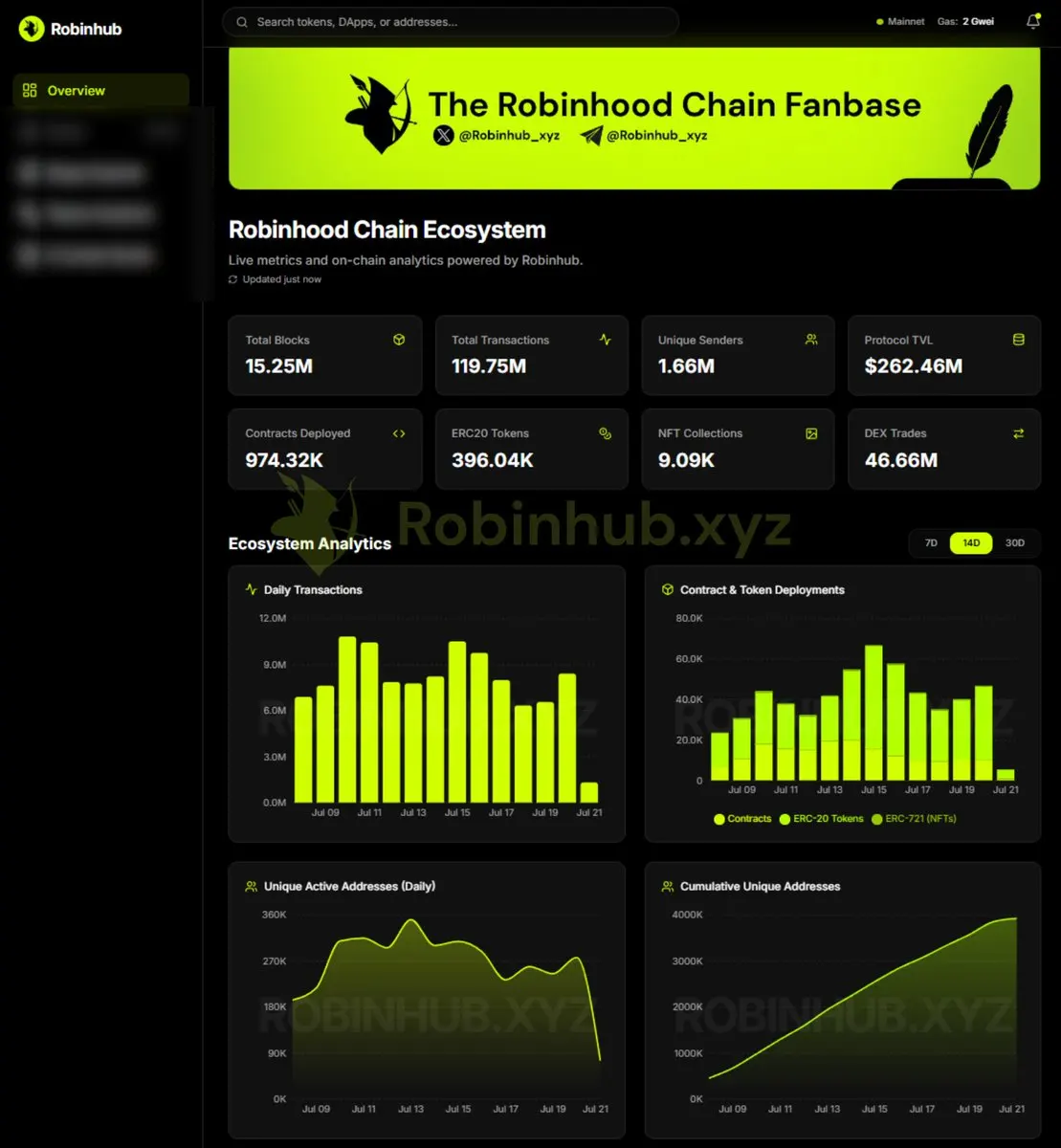
Three weeks after the Robinhood Chain mainnet launch, the protocol’s TVL has reached $262 million and the number of transactions has reached 120 million.
Svmuu News: RobinHub posted on X stating that data shows that since Robinhood’s mainnet launch three weeks ago, there have been 119.75 million transactions, 15.25 million blocks, and 1.66 million uniq
-
CAKE: Factors Affecting the Price of PancakeSwap’s Native Token and Major Trading Platforms
CAKE is the native token of PancakeSwap, a leading decentralized exchange. This article takes an in-depth look at the key factors influencing the price of CAKE, including its deflationary tokenomics model, PancakeSwap’s multi-chain expansion roadmap, and DeFi market trends. It also provides readers with a detailed guide on where CAKE can be traded on major centralized and decentralized platforms, while emphasizing the speculative nature of price predictions.
-
ALPACA Token Purchase and Trading Guide: An Analysis of Listed Exchanges and the Trading Process
ALPACA is the native token of Alpaca Finance, the first leveraged yield farming platform on the BNB Smart Chain. This article will provide a detailed guide on how to buy and trade ALPACA tokens, including through centralized exchanges (CEX), decentralized exchanges (DEX), and select platforms that support direct fiat purchases. Additionally, this article will list the major platforms currently supporting ALPACA trading and provide an overview of the token’s basic project information and market data to help readers understand its trading options and position within the ecosystem.
-
How do I trade and buy SCROOGE? Which decentralized exchanges list it?
SCROOGE is a reflexive token based on the BNB Smart Chain (BEP-20) that was launched in November 2021; its holders are eligible to receive BUSD rewards. The token is primarily traded on decentralized exchanges (DEXs) rather than centralized exchanges. Currently, PancakeSwap (V2) is its primary trading platform. Due to its nature and market activity, reliable market data for SCROOGE is relatively scarce, and investors should fully understand the risks before trading.
-
Gate has fully integrated with Robinhood Chain and continues to enhance its multi-chain ecosystem and on-chain service system
Svmuu News: Gate DEX has announced full integration with Robinhood Chain, becoming one of the first mainstream exchanges to serve as an on-chain gateway for this ecosystem, further expanding the platf
-
How do I buy and sell EZC? Which cryptocurrency exchanges list it?
Trading options for EZC (EZCoin or EZChain) are relatively limited; spot trading is primarily available on centralized exchanges such as Bitget. Additionally, users can connect to decentralized exchanges (DEXs) via the Binance Web3 wallet to trade the token.However, there are significant inconsistencies in the data regarding EZC’s price, market capitalization, and circulating supply; some major data platforms show missing or zero information. Investors should conduct thorough market research and be aware of potential risks before trading.
-
Ostium has confirmed an anomaly in the OLP wallet and has suspended all trading
Svmuu News: Ostium, a perpetual futures DEX, has issued a statement confirming that an anomaly has been detected in its OLP treasury. All trading on the platform has been suspended, and the team is cu













-
Robinhood Chain's daily DEX volume hit $1.88 billion on Sunday, with TVL nearing $1 billion since July 1 launch
StoneX analyst Mark Palmer attributes the rapid growth to Robinhood's strong brand, its permissionless design, subsidized gas fees, and a growing flywheel between memecoins and tokenized stocks. The c
-
Lookonchain Weekly Report: Stablecoin Supply Decreased by $414.38 Million Last Week; Publicly Traded Companies Net Purchased 1,615 Bitcoin
Lookonchain's latest weekly report shows that the total stablecoin market cap decreased by $414.38 million between September 7 and September 13, 2026. During the same period, publicly listed companies
-
Robinhood Chain Daily DEX Volume Hits Record $989 Million, TVL Reaches $708 Million
Robinhood Chain recorded a record $989 million in single-day DEX trading volume on Friday. Its total value locked (TVL) increased by nearly 100% month-over-month in August, reaching a record $708 mill
-
Lookonchain Weekly Report: Stablecoin supply increased by $987.1 million last week, and public companies collectively added 4,003 Bitcoins
Lookonchain's weekly report shows that from August 24 to August 30, 2026, DEX spot trading volume decreased by 4.94% week-over-week, and perpetual contract trading volume decreased by 12.74% week-over
-
Robinhood Chain's daily DEX trading volume reached $443 million, a new high since mid-July, with the total on-chain RWA value reaching $41.9 million.
Robinhood Chain recorded its strongest single-day performance since mid-July on Monday, with decentralized exchange (DEX) trading volume reaching approximately $443 million, over 3 million transaction
-
CZ: Trust Wallet is one of the biggest user distribution channels for DEXs in terms of both revenue and user base
CZ stated that Trust Wallet serves as a significant distribution channel for decentralized exchanges (DEXs), excelling in both revenue generation and user acquisition.
-
CEX perpetual futures volume falls to $4T, marking lowest level since late 2023
Perpetual futures trading volume on centralized crypto exchanges (CEX) has dropped to $4 trillion, reaching its lowest point in 31 months and since late 2023. Additionally, perpetual trading on decent
-
OKX Wallet to discontinue DEX Advanced Mode starting with app version 6.184.0
OKX Wallet stated that this change only applies to app version 6.184.0 and later, with earlier versions remaining unaffected. Users can continue to use Market order, Limit order, and DCA features on t
-
DWF Labs' Martin Lee Says RWA Perps Will Outpace Tokenization, Citing Rapid Growth
Martin Lee, Markets Insight Lead at DWF Labs, states that real-world asset (RWA) perpetuals (perps) are poised to outpace tokenization, citing their rapid growth and market advantages. He notes that R
-
1inch Launches the Aqua Liquidity Protocol on 13 Blockchains
The decentralized exchange (DEX) aggregator 1inch has opened its shared liquidity protocol, Aqua, to users; the protocol currently supports 13 Ethereum Ethereum Virtual Machine (EVM)-compatible chains
-
With trading volume exceeding $400 billion, the HIP-3 DEX tradexyz has 348,249 independent traders.
According to a report by Svmuu, HyperliquidNews posted on X that the trading volume on the HIP-3 DEX, tradexyz, has exceeded $400 billion, with a total of 348,249 unique traders.
-
Perpetual and prediction market fees rose 22% against the trend, while on-chain protocol fees fell 33% year-over-year in Q2
Svmuu News: Crypto venture capital firm 1kx reported that on-chain protocol fees fell 33% year-over-year in the second quarter, with DEX fees falling by $625 million, a 57% decline, driven primarily b
-
Service Permanently Shut Down: DEX Aggregation Protocol Odos to Cease All Services on July 30
Svmuu News: Odos, a decentralized trading aggregation protocol, announced that its operating company is gradually ceasing operations. The Odos app will switch to read-only mode on July 27, and service
-
Three weeks after the Robinhood Chain mainnet launch, the protocol’s TVL has reached $262 million and the number of transactions has reached 120 million.
Svmuu News: RobinHub posted on X stating that data shows that since Robinhood’s mainnet launch three weeks ago, there have been 119.75 million transactions, 15.25 million blocks, and 1.66 million uniq
-
Gate has fully integrated with Robinhood Chain and continues to enhance its multi-chain ecosystem and on-chain service system
Svmuu News: Gate DEX has announced full integration with Robinhood Chain, becoming one of the first mainstream exchanges to serve as an on-chain gateway for this ecosystem, further expanding the platf
-
Ostium has confirmed an anomaly in the OLP wallet and has suspended all trading
Svmuu News: Ostium, a perpetual futures DEX, has issued a statement confirming that an anomaly has been detected in its OLP treasury. All trading on the platform has been suspended, and the team is cu
-
Ostium, a perpetual futures DEX, appears to have been attacked, resulting in losses of approximately $18 million
Svmuu News: Ostium, a perpetual futures DEX, appears to have been the target of an attack involving approximately $18 million. The specific method of the attack and the extent of the financial losses
-
Flap Imposes a 2% Purchase Limit per Wallet on Zero-Tax Tokens
Svmuu News: According to Flap’s monitoring, Flap—a token issuance platform now live on Robinhood Chain—has introduced a 2% purchase limit per wallet for tax-free tokens during the joint curve phase. T
-
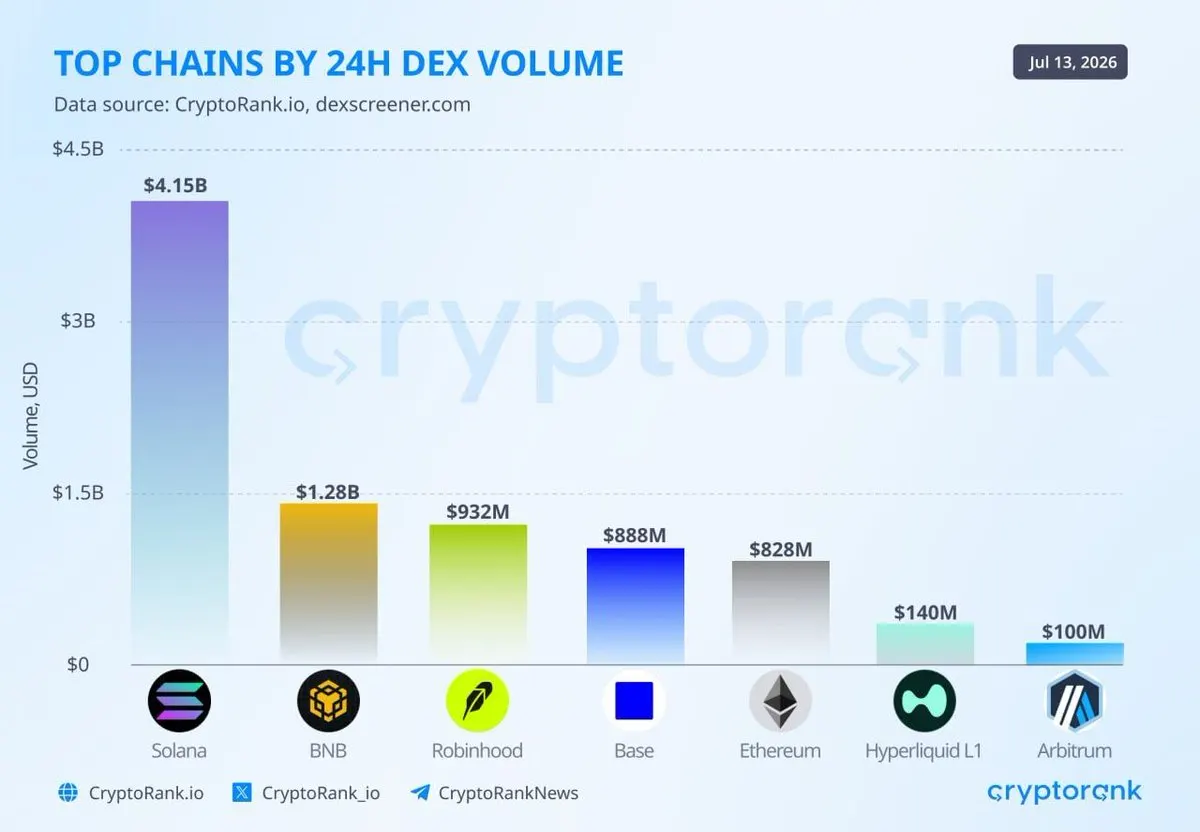
Solana ranked first in 24-hour DEX trading volume, reaching $4.15 billion
According to Svmuu, Solana's 24-hour DEX trading volume reached $4.15 billion, ranking first, followed by BNB Chain and Robinhood Chain.
-
Analysis: Stablecoin supply resumed growth last week, while perpetual futures trading volume continued to slow; seven companies reduced their holdings by 909.3 BTC.
Svmuu News: According to Lookonchain data, from July 6 to July 12, 2026, stablecoin supply turned to positive growth, with the total market capitalization of stablecoins increasing by $121 million; sp
-
Robinhood Chain Reaches $3.1 Billion in DEX Trading Volume in Its First Week
Svmuu News: Bernstein has released statistics showing that Robinhood Chain, Robinhood’s in-house public blockchain, delivered impressive performance in its first week following its launch on July 1. T
-
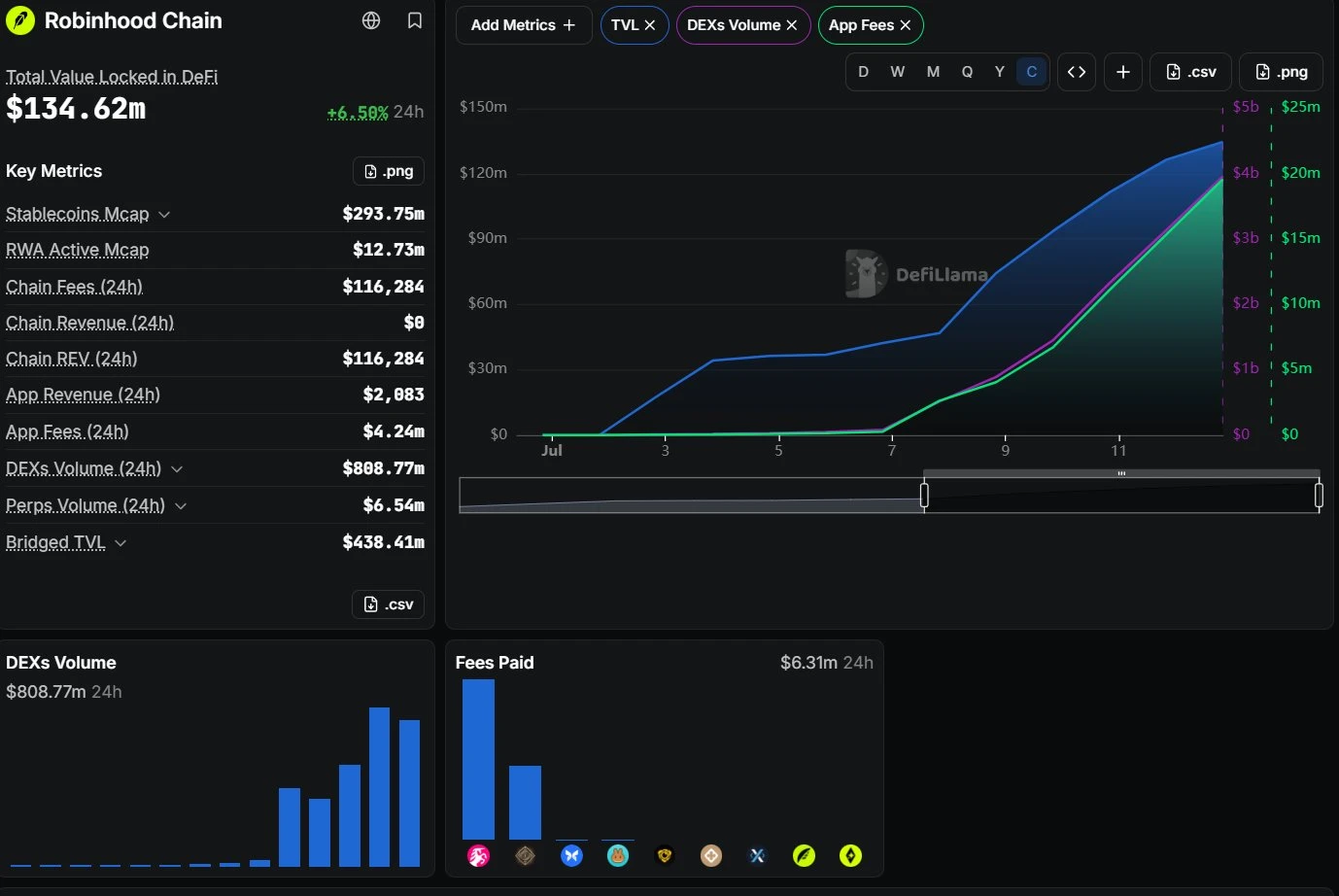
DeFiLlama: Over $290 million in stablecoins have flowed into the Robinhood Chain since its launch, and DEX trading volume has surpassed $4 billion
According to Svmuu, data from DeFiLlama shows that since its launch, Robinhood Chain has attracted more than $290 million in stablecoin inflows, with a TVL of $134 million, RWA totaling $12 million, a
-
Robinhood Chain's Daily DEX Trading Volume Surpasses Solana's
Svmuu News: Robinhood Chain has surpassed Solana in single-day DEX trading volume.
-
Uniswap Founder: 99.5% of DEX Trading Volume Comes from Uniswap
Svmuu News: Uniswap founder Hayden posted on X, stating that 99.5% of DEX trading volume comes from Uniswap.
-
What is REF Coin? An Analysis of Ref Finance Token's Uses and Trading Channels
REF is the native token of Ref Finance, a decentralized exchange built on the NEAR blockchain. As a key entry point to the NEAR ecosystem, it provides core DeFi services such as token swaps and liquidity mining. The platform utilizes an Automated Market Maker (AMM) model and supports various liquidity pool types. REF tokens are primarily used for platform governance and incentives. As of September 15, 2026, the price of REF coin fluctuates between $0.04 and $0.05, with a market capitalization of approximately $5 million. Users can trade REF on decentralized exchanges that support the NEAR ecosystem and on some centralized platforms.
-
Global Mainstream Cryptocurrency Exchange Rankings and Selection Guide
Choosing a secure and reliable cryptocurrency trading platform is crucial. This article will provide an overview of the world's leading centralized (CEX) and decentralized (DEX) exchanges, including Binance, Coinbase, OKX, and Uniswap, among others. It will also offer a detailed guide to selecting a platform based on key factors such as security, compliance, liquidity, trading fees, supported cryptocurrencies, user experience, and geographical availability, helping you make informed decisions. The cryptocurrency market is highly volatile, and investments should be made with caution.
-
BOO Token: A Deep Dive into SpookySwap's Governance Token and Market Status
BOO is the native governance token of SpookySwap, a decentralized exchange (DEX) on the Fantom chain. It grants holders the right to participate in platform governance and serves as a reward for liquidity providers and stakers. SpookySwap offers services such as token swaps and liquidity mining, aiming to leverage the high speed and low fees of the Fantom network. However, as of now, the BOO token's 24-hour trading volume is extremely low, and market liquidity has nearly dried up. Investors should be fully aware of its current market risks.
-
ZYB Token: An Analysis of Zyberswap's Current Status, a Formerly Active DEX Token in the Arbitrum Ecosystem
ZYB is the native token of Zyberswap, a decentralized exchange (DEX) based on the Arbitrum blockchain. The platform aimed to provide low-fee, high-efficiency cryptocurrency exchange services and supported staking and yield farming. ZYB tokens granted holders governance rights. However, as of early September 2026, ZYB's market activity is extremely low, with a 24-hour trading volume of only a few dollars and a market capitalization of less than $6,000. This stands in stark contrast to its all-time high of $23 reached in February 2023, indicating that the current trading market has nearly dried up.
-
Decentralized vs. Centralized Exchanges: How to Choose the Best Cryptocurrency Exchange
In the realm of cryptocurrency trading, Decentralized Exchanges (DEXs) and Centralized Exchanges (CEXs) are the two major types of platforms. DEXs emphasize user self-custody of assets and privacy protection, facilitating peer-to-peer transactions through smart contracts, with representative platforms including Uniswap and PancakeSwap. CEXs, on the other hand, offer higher liquidity, more user-friendly interfaces, and a wider range of products, but users must entrust their assets to the platform, such as Binance and Coinbase. When choosing a platform, one needs to consider security, liquidity, fees, user experience, and personal trading habits.
-
2026 Meme Coin Trading Guide: A Multi-Dimensional Comparison of Five Major Channels
By 2026, the Meme coin market has evolved into a complex sub-economy dominated by AI narratives and the high-speed Solana chain, with a stable market capitalization of $33.2 billion. The SEC has clarified that Meme coins generally do not fall under securities. This article will deeply compare the five major trading channels: Centralized Exchanges (CEX), Decentralized Exchanges (DEX), Meme coin trading terminals, Web3 wallet built-in features, and Telegram trading bots, analyzing their respective advantages and disadvantages, applicable scenarios, and potential risks to help investors understand the characteristics of different trading methods.
-
Ethereum Efficient Trading Guide: Optimizing Gas Fees and Utilizing Layer 2 Strategies
The Ethereum mainnet faces challenges of high gas fees and network congestion, but transaction efficiency can be significantly improved through strategic methods. This article will delve into optimizing gas fees, including choosing off-peak transaction times, utilizing Gas Oracle tools, and adjusting priority fees. Concurrently, it will highlight how Layer 2 scaling solutions (such as Arbitrum, Optimism, etc.) offer lower costs and faster speeds. Furthermore, it will cover selecting appropriate crypto wallets, mastering DEX trading techniques, and effective risk management strategies to help users participate more efficiently in the Ethereum ecosystem.
-
AirSwap (AST) Protocol Analysis: A Detailed Look at the Decentralized Peer-to-Peer Trading Platform
AirSwap is a decentralized exchange (DEX) protocol built on Ethereum, focusing on peer-to-peer (P2P) ERC-20 token trading. It operates on a non-custodial model, ensuring the security of user funds, and offers fee-free transactions through its Swap protocol, which involves off-chain negotiation and on-chain settlement. The platform is governed by a DAO, and market makers are required to stake AST tokens to provide liquidity. This article will delve into its core mechanisms, development history, and trading channels.
-
What is BOO? An Analysis of the SpookySwap Token and Other Projects with the Same Name
The BOO token may refer to multiple crypto projects, with the most prominent being SpookySwap (BOO), which is the governance token for the decentralized exchange (DEX) and automated market maker (AMM) on the Fantom network. Additionally, there is $BOO from the gh0stly gh0st ecosystem and Meme coins based on the BSC and Solana chains. This article will detail the functions, features, and market status of SpookySwap (BOO), and briefly mention other tokens with the same name to help readers differentiate.
-
DFYN Token Analysis: Current Status, Technical Features, and Future Outlook of a Multi-Chain DEX
DFYN is a multi-chain Automated Market Maker (AMM) Decentralized Exchange (DEX) built on the Polygon network, aiming to enable seamless cross-chain trading and liquidity sharing through a "liquidity supergrid." Its core advantages include gas-free transactions on Polygon, concentrated liquidity AMM, smart order routing, and support for NFTs and gaming tokens. DFYN token holders can participate in community governance. As of August 2026, the DFYN token price is approximately $0.0003, with a market capitalization of about $66,000, representing a significant decline from its all-time high. The market maintains a cautious wait-and-see attitude regarding its future development.
-
NYC Coin: Trading Status and Regulatory Environment Analysis of New York City's Token
NYC (New York City) Coin is a cryptocurrency with a very low market capitalization, primarily traded on decentralized exchanges (DEXs). Its market activity is limited, and liquidity may be extremely low. New York State enforces strict regulations on cryptocurrency trading, requiring relevant service providers to hold a "BitLicense." Trading NYC Coin requires caution regarding potential risks, and it is essential to verify its latest market conditions before engaging in any transactions.
-
ZKS Coin Analysis: ZKSwap Token Status and Market Liquidity
ZKS is the native token of ZKSwap, a Layer-2 Ethereum-based DEX that utilizes ZK-Rollups technology. It belongs to the ZKSpace platform ecosystem, aiming to provide low-latency and gas-free transactions. However, as of now, the 24-hour trading volume for ZKS tokens is displayed as N/A, indicating that its active trading market has nearly dried up, and investors should be wary of potential liquidity risks.
-
Uniswap DEX User Guide: Token Swaps and Liquidity Provision Operations
Uniswap is a leading decentralized exchange (DEX) based on Ethereum and other EVM-compatible chains, utilizing an Automated Market Maker (AMM) model. This allows users to swap tokens and provide liquidity directly from their cryptocurrency wallets, without the need for a centralized intermediary. This article will detail how to prepare your wallet, connect to the Uniswap platform, and perform specific operations such as token swapping (Swap) and providing liquidity (Add Liquidity). It will also explore its version evolution, fee structure, potential risks, and differences from centralized exchanges, helping users safely and efficiently utilize this core Web3 tool.
-
Cryptocurrency Trading Platforms: How to Choose the Right App for Selling and Trading
Cryptocurrency trading platforms are core hubs for buying and selling digital assets, primarily divided into Centralized Exchanges (CEXs) and Decentralized Exchanges (DEXs). With increasing regulatory scrutiny and user emphasis on security by 2026, choosing a compliant, secure, and feature-rich platform is crucial. This article will delve into the characteristics of different platform types, key considerations when choosing, and an overview of mainstream global trading platforms to help users make informed decisions.
-
BOLT Coin Multi-faceted Analysis: Decentralized Media Ecosystem and Trading Guide for Memecoin
The BOLT token refers to multiple crypto projects, primarily including a BOLT project dedicated to a decentralized media ecosystem, and the memecoin "BOLT on Base" on the Base chain, among others. The decentralized media ecosystem BOLT aims to revolutionize digital content services through blockchain, integrating social media and cryptocurrency functionalities. Memecoins, on the other hand, focus on community and entertainment value. This article will provide a detailed analysis of these different projects and offer information on their respective trading channels.
-
APIX Token Trading Guide: Understanding Its Use Cases and Where to Trade It
APIX is the utility token of the AvaxPixel project, operating on the Avalanche blockchain, primarily used for interacting with a decentralized real-time pixel art canvas, such as drawing, overwriting, and defending pixels. The token aims to build a self-sustaining art economy through creativity, community engagement, and strategy. As of the time of writing, APIX has a relatively low market capitalization and 24-hour trading volume, with most trading activity concentrated on decentralized exchanges (DEXs).
-
SRG Coin Polysemic Analysis: Different Project Backgrounds and Trading Status
The SRG token symbol refers to multiple distinct cryptocurrency projects, including a decentralized loyalty program, a street racing metaverse, an innovative ecosystem token, and a decentralized perpetual contract exchange. Understanding their specific project backgrounds is crucial for identification and trading. This article will introduce these SRG projects one by one and analyze their current trading activity and potential acquisition methods.
-
FXN Token: Solana vs. Ethereum/Arbitrum Version Purchase and Trading Guide
There are two main versions of the FXN token: the FXN Protocol token on the Solana network, which focuses on the AI agent economy; and the f(x) Protocol token on the Ethereum/Arbitrum network, which is used for decentralized stablecoin and leveraged trading systems. This article will introduce these two versions of the FXN token, their purchasing and trading methods, and the exchanges where they are listed, to help you distinguish between them and find suitable trading channels.
-
ZYB Coin: Zyberswap Token Status Analysis and Future Outlook
ZYB is the platform token of Zyberswap, a DEX on the Arbitrum chain, which gained early attention for its low fees, staking rewards, and innovative features. However, as of the time of writing, ZYB faces extremely low trading volume and market capitalization, with its price having fallen significantly from its historical highs. This article will delve into ZYB's project positioning, tokenomics, and analyze its current market performance and the challenges and risks it faces for future development.
-
DFYN Coin Analysis: The Current State of the Polygon Ecosystem's Decentralized Exchange Token
DFYN is the native token of the Dfyn Network, a Layer-2 Automated Market Maker (AMM) Decentralized Exchange (DEX) based on Polygon. It aims to provide low-fee, high-efficiency on-chain trading and liquidity mining opportunities, along with governance and revenue sharing features. However, as of now, the trading market for DFYN tokens has nearly dried up, with extremely low liquidity.
-
Unverified Digital Asset Trading Platforms and Bitcoin Trading Overview
As user demand for privacy protection grows, digital asset trading platforms that do not require Know Your Customer (No-KYC) verification are gaining increasing attention. These platforms primarily include decentralized exchanges (DEX), peer-to-peer (P2P) platforms, and some centralized exchanges offering limited functionalities. They allow users to trade without submitting personal identification information, especially providing different options for trading mainstream cryptocurrencies like Bitcoin. This article will delve into the operational models, advantages, and potential risks of No-KYC platforms, and combine with the global regulatory environment to provide readers with a comprehensive perspective on choosing trading platforms.
-
Blockchain Exchange Function Analysis and Selection Guide
Blockchain exchanges are core hubs for digital asset trading, offering services for exchanging cryptocurrencies with fiat currencies or other cryptocurrencies. This article elaborates on the core functions, advantages, and disadvantages of both Centralized Exchanges (CEXs) and Decentralized Exchanges (DEXs). It also provides investors with key considerations for choosing an exchange, including security, compliance, liquidity, fee structure, and user experience, aiming to help readers better understand and select a trading platform that suits their needs.
-
Decentralized Exchanges (DEXs) in the Solana Ecosystem: High Speed, Low Fees, and Innovation
The Solana blockchain, with its high speed, low fees, and strong scalability, has become one of the fastest-growing ecosystems in the Decentralized Finance (DeFi) sector, with its DEX trading volume repeatedly surpassing other major Layer-1 blockchains. Jupiter, Raydium, and Orca are leading DEX platforms within the Solana ecosystem, offering diverse services ranging from aggregated trading to concentrated liquidity management. Although Solana DEXs have shown robust growth, particularly driven by Meme coin trading, network stability, degree of decentralization, and market cyclicality remain challenges it faces.
-
OKX Global App Download Guide and Latest Feature Analysis
As one of the world's leading cryptocurrency trading platforms, OKX's mobile application offers diverse download channels and rich functionalities. This article will provide a detailed introduction to the official download methods for the OKX global version app, covering both Android and iOS platforms, and will focus on analyzing its recent updates, such as the "The Money App" interface upgrade, unified mode, in-app DEX trading, and powerful Web3 wallet features. Concurrently, the article will also touch upon OKX's global compliance布局, security measures, and market position, helping users gain a comprehensive understanding of the OKX application.
























DEX

24H Trending
-
1
FUNDZ (FundFantasy) Project Analysis: The Current State of the Blockchain Financial Fantasy Gaming Platform

-
2
DFSM Coin Value Analysis: DFS MAFIA Project Status and Investment Considerations

-
3
TAIL Coin Multi-Entity Analysis: Current Status, Risks, and Development Prospects Assessment

-
4
Austria denied entry to Iranian official Mohammed Eslami after the UN Security Council rejected his request for a travel ban exemption.
-
5
ALIAS Coin: An In-depth Analysis of the Current State and Challenges of Privacy Coin Projects

-
6
Airbloc (ABL) Coin Value Analysis: Project Status and Investment Risk Assessment

-
7
HUM Coin Multi-faceted Analysis: Trading and Listing Platforms for Humanscape, Hum(AI)n Web3, and Hummus

-
8
WLKN Token Analysis: Solana-based Move-to-Earn Project and Its Value Considerations

-
9
NCDT (nuco.cloud) Value Analysis and Investment Potential Assessment

-
10
Why is Bitcoin thriving but struggling to replace the US dollar's global dominance?

Markets Today





Recommended Reading

Hot Topics

Svmuu focuses on blockchain industry trends and cutting-edge cryptocurrency news, while also covering real-time market data and in-depth analysis of the Hong Kong, U.S., and foreign exchange markets. Here, you can not only access professional 24/7 news updates and accurate market data, but also utilize practical investment tools to help you capitalize on opportunities in both digital assets and traditional financial markets. Whether you are a blockchain enthusiast or an investor in Hong Kong, U.S., or foreign exchange markets, we provide efficient and timely information services to empower your investment decisions.
- User Agreement
- Privacy Policy
- Contact Us
- Business Partnerships
- Disclaimer
- Content Statement
- About Us
- Sitemap
 Coming Soon!
