

Faster global financial news!

ETH Ethereum2
ETHMarket
-
Trend
-
K-Line
ETHNews
-
Machi Big Brother Deposits 250,000 USDC into Hyperliquid to Increase Ethereum Long Position
Svmuu News According to Onchain Lens monitoring, Machi Big Brother has once again deposited 250,000 USDC into Hyperliquid to increase his 25x leveraged Ethereum long position.
-
U.S. Bitcoin ETFs Net Inflow of 2,070 BTC Today, Ethereum ETFs Net Outflow of 24,138 ETH
Svmuu News According to Lookonchain monitoring, U.S. Bitcoin ETFs had a net inflow of 2,070 BTC today, Ethereum ETFs had a net outflow of 24,138 ETH, and Solana ETFs had a net outflow of 33,350 SOL.
-
Canaan mined 86 BTC in February Bitcoin, and currently holds 1,793 BTC
Svmuu News Nasdaq Listed Bitcoin Mining firm Canaan Inc. released Bitcoin a mining update report, disclosing that its mining output for February was 86 BTC. As of now, its total holdings of cryptocurr
-
Magi increased his long position on Ethereum to 4,650 ETH, with a current unrealized profit of nearly $250,000.
Svmuu News: According to Hyperbot data, Huang Licheng, known as "Big Brother Maji," added to his 25x leveraged long position on Ethereum three hours ago. His position has now increased to 4,650 ETH, w
-
Starknet will launch the STRK20 framework, which supports the issuance of privacy-preserving stablecoins and privacy-preserving DeFi assets
Svmuu News Ethereum The Layer 2 network Starknet has announced the launch of the new STRK20 framework, designed to support the issuance of privacy-preserving stablecoins and other privacy-preserving a
-
Binance Will support NIL network integration; mainnet deposits and withdrawals will be suspended
Svmuu News: According to an official announcement, Binance will suspend deposits and withdrawals of the NIL mainnet token at 11:00 a.m. Beijing Time on March 20, 2026, to support its integration via t
-
Planet Midday News
1. Yi Lihua: ETH below $2,000 presents a buying opportunity, with high odds of success for both short-term and long-term positions; 2. The U.S. Department of Justice has requested a retrial for Tornad
-
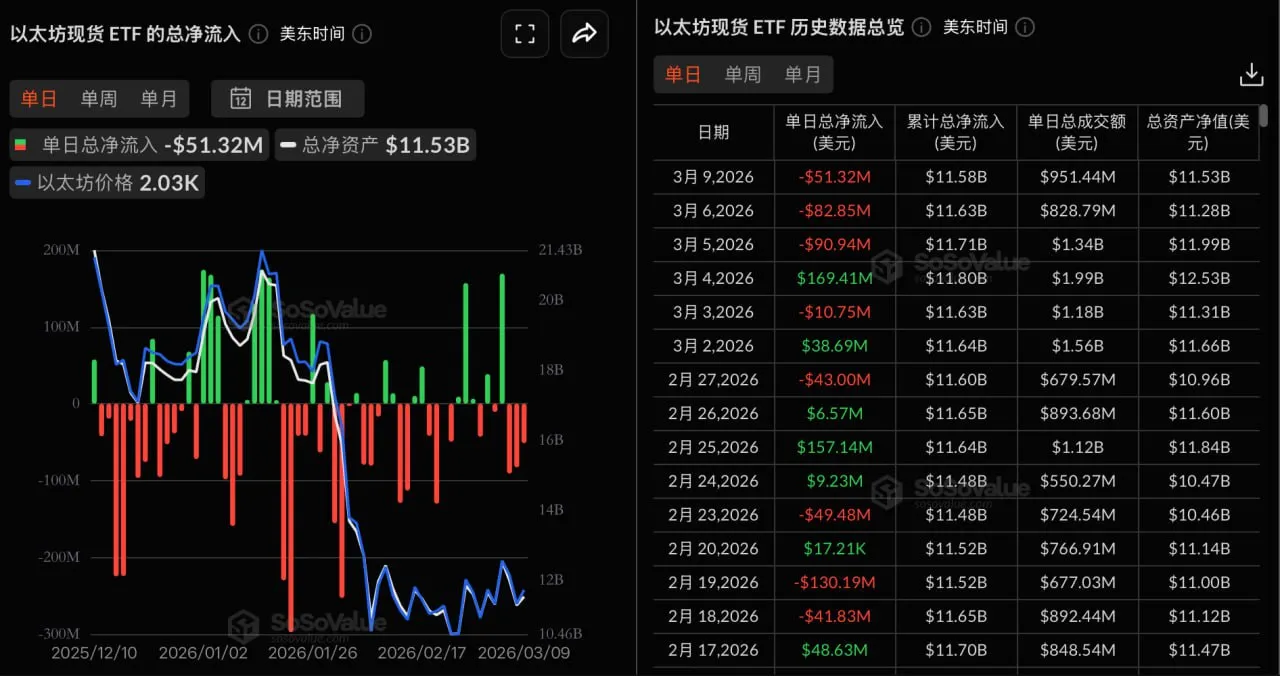
Ethereum spot ETFs recorded a total net outflow of $51.3194 million yesterday, marking three consecutive days of net outflows
Svmuu News According to SoSoValue data, Ethereum spot ETFs recorded a total net outflow of $51.3194 million yesterday (March 9, Eastern Time). The Ethereum spot ETF with the highest single-day net inf
-
Ethereum Foundation Launches ERC-8183, Aiming to Solve Commercial Trust Issues Between AI Agents
Svmuu News The Ethereum Foundation's dAI team, in collaboration with Virtuals Protocol, has jointly launched a new standard, ERC-8183. ERC-8183 is specifically designed for commercial transactions bet
-
Yi Lihua: ETH below $2,000 presents a buying opportunity, with high odds of success for both short-term and long-term trades
Svmuu News: Yi Lihua, founder of Liquid Capital, posted on X stating that any price below $2,000 for ETH presents a buying opportunity, with high odds of success for both short-term and long-term inve
-
Lookonchain: Whale 0x7C5a Sells 7,323 ETH ($13.96M) at a Loss, Total Losses Exceed $19M
Chain-monitoring firm Lookonchain reported that whale address 0x7C5a, after holding Ethereum (ETH) for over 3 years, sold 7,323 ETH (worth approximately $13.96 million) at a loss 10 hours ago. The wha
-
Bybit Sues North Korea and Its Lazarus Group, Accusing Them of Stealing $1.5 Billion in Crypto Assets and Obtaining a Court Asset Freeze Order
Bybit, the world's second-largest cryptocurrency exchange, has filed a civil lawsuit in the U.S. District Court for the District of Columbia, alleging that North Korea and its affiliated hacking group
-
Grayscale amends Ethereum Staking Mini ETF trust agreement to stake nearly all 161,000 idle ETH, making staking the default and guaranteeing monthly cash payouts to shareholders
The new trust agreement, signed on August 6 ahead of an August 10 IRS deadline, aims to stake the fund's Ether holdings, except for carve-outs for fees, redemptions, and network emergencies. This chan
-
The Ethereum EIP-8363 staking proposal sparks strong opposition, with critics arguing it could harm DeFi, decentralization, and institutional adoption
The Ethereum EIP-8363 staking proposal sparks strong opposition, with critics arguing it could harm DeFi, decentralization, and institutional adoption
-
Ether.fi Separates Its Ethereum staking Token weETH From Restaking Amid Growing Rewards Debate
This move separates ordinary Ethereum staking from the higher-risk restaking exposure, with weETH now only earning ordinary Ethereum staking rewards. Users hoping for additional yield now need to hold
-
Lookonchain monitors: Ethereum OG whale 0x7378 has spent $9.1M to buy 3.91M $LIT at an average price of $2.33 over the past 2 months.
Lookonchain monitors: Ethereum OG whale 0x7378 has spent $9.1M to buy 3.91M $LIT at an average price of $2.33 over the past 2 months.
-
Lookonchain monitoring shows the 'Jaredfromsubway exploiter' lost 264 ETH ($505K) in trading, selling 2,327 ETH at $1,695 and buying back 2,063 ETH at $1,912 10 hours ago.
Lookonchain monitoring shows the 'Jaredfromsubway exploiter' lost 264 ETH ($505K) in trading, selling 2,327 ETH at $1,695 and buying back 2,063 ETH at $1,912 10 hours ago.
-
BlackRock announced that its Ethereum ETF (ETHA) will undergo a 1-for-3 reverse stock split on October 6.
BlackRock disclosed in a filing with the U.S. SEC that it plans to implement a 1-for-3 reverse stock split for its iShares Ethereum Trust ETF (ETHA) on October 6, consolidating every three shares into
-
Fundstrat's Tom Lee Expects S&P 500 to Hit 7,900–8,000 in August, Implying Up to 3.6% Upside
Fundstrat's Tom Lee forecasts the S&P 500 index will reach between 7,900 and 8,000 this month, representing up to a 3.6% increase from Wednesday's closing price. Lee attributes this outlook to strong
-
Alleged Coldcard Exploit Attacker Transfers 64 Bitcoin and 200 Ethereum to Crypto Mixer
According to Cointelegraph, the attacker allegedly behind the Coldcard exploit has transferred 64 Bitcoin (BTC) and 200 Ethereum (ETH) to a cryptocurrency mixer. The summary notes that although these
-
Ethereum's "Bazaar" Development Model Drives Innovation, Continuous Upgrade Roadmap Outlook
With its unique "bazaar-style" development model, Ethereum brings together global developers to drive innovation and continuously adapt to technological challenges. Through the public Ethereum Improvement Proposals (EIPs) process, its programmability and flexibility have led to breakthroughs in various fields such as DeFi, AI, and DePIN. Since The Merge in 2022, transitioning to Proof-of-Stake (PoS), Ethereum has successfully implemented the Shanghai upgrade (allowing staking withdrawals) and the Dencun upgrade (reducing L2 costs). In the future, the Pectra upgrade will further enhance network efficiency and user experience, while long-term plans such as sharding technology aim to achieve higher throughput, solidifying its position as Web3 infrastructure. As of August 7, 2026, the price of ETH is approximately $1,914.77.
-
EthereumPoW Mining Has Ceased: Historical Risks and Considerations for Shifting to PoS Staking
The Ethereum network completed "The Merge" upgrade in September 2022, officially transitioning from a Proof-of-Work (PoW) mechanism to Proof-of-Stake (PoS). This means that traditional Ethereum mining activities have ceased. For miners who previously invested in PoW mining hardware, they now face risks such as equipment depreciation and profitability fluctuations and regulatory risks when switching to other PoW cryptocurrencies. Currently, investors looking to earn returns from Ethereum primarily do so through staking, but they need to be wary of risks such as slashing, lock-up periods, changes in rewards, and private key management.
-
MANY Coin Issuance Price: Clarifying Similarly Named Tokens and Explaining Missing Information
Regarding the cryptocurrency named "MANY," there are currently two independent token projects, running on Ethereum and BNB Smart Chain, respectively. However, the explicit issue price information for both projects could not be found in public资料. This article will introduce the basic situations of these two MANY tokens separately and point out their common feature of having zero current circulating supply.
-
What is X2Y2 coin? Understanding its NFT market positioning and current trading status
X2Y2 is a decentralized NFT marketplace based on the Ethereum blockchain and its native governance token, launched in January 2022. It aims to challenge traditional NFT marketplaces through low transaction fees, staking rewards, and community giveaways. The X2Y2 token has a maximum supply of 1 billion, primarily used for staking rewards and airdrops. However, as of now, the token's 24-hour trading volume is extremely low, posing severe liquidity challenges, and risks should be fully understood before trading.
-
BRWL Token Transaction Fees and Efficiency: An Investment Cost Analysis
BRWL is the native token of the Web3 fighting game "Blockchain Brawlers," operating on both the WAX and Ethereum blockchains. This article provides an in-depth analysis of the transaction fee structure and efficiency of BRWL tokens on different networks, including the low-cost and efficient WAX chain, Ethereum chain Gas fees, in-game withdrawal fees, and potential fees charged by centralized/decentralized exchanges. Given the recent significant decline in BRWL token value and extremely low trading volume, investors must comprehensively consider the risks associated with token price volatility, multiple transaction fees, and extremely low liquidity when evaluating potential costs.
-
HOQU (HQX) Token Status Analysis: The Silence and Future Prospects of a Decentralized Marketing Platform
HOQU (HQX) was once a decentralized marketing platform based on Ethereum, designed to connect merchants with affiliates through smart contracts. The project completed its ICO from late 2017 to early 2018, raising $15 million. However, as of now, the market activity of the HQX token is extremely low, with most data platforms marking it as "untracked," trading volume close to zero, and the circulating supply unverified. The project appears to have fallen into dormancy.
-
What is ZRC coin? An Analysis of the Zircuit Layer 2 Network and its Native Token
ZRC is the native utility token of the Zircuit network, an AI-driven Layer 2 blockchain based on Ethereum. The network combines zero-knowledge Rollup technology with real-time AI security enforcement at the sequencer layer, aiming to enhance Ethereum's scalability, security, and user experience. Both the Zircuit mainnet and the ZRC token launched in November 2024. Its early development was rapid, with Total Value Locked (TVL) once exceeding $2 billion. The ZRC token is used for paying transaction fees, staking, participating in governance, and ecosystem incentives. The project is supported by several well-known venture capital firms, but the ZRC token price has high volatility.
-
What's the Difference Between Bitcoin and Ethereum? Digital Gold vs. World Computer Potential
Bitcoin, as the first decentralized digital currency, is widely regarded as "digital gold" and a store of value, with its fixed supply and PoW mechanism emphasizing scarcity and security. Ethereum, on the other hand, is positioned as the "world computer," driving decentralized applications (DApps), DeFi, and NFT ecosystems through smart contracts and a PoS mechanism. Although there are significant differences between the two in terms of market capitalization and technological paths, they jointly form the two major pillars of the crypto world, serving different market demands and development visions. They are not in direct competition but rather complement each other and coexist.
-
What is DVP coin? Market Status and Performance Analysis of DVP Coin
DVP coin is the token of the Decentralized Vulnerability Platform, aiming to connect white-hat hackers with blockchain projects using blockchain technology to jointly discover and resolve security vulnerabilities. The project was launched in 2018, based on the Ethereum network. However, as of the time of writing, DVP coin's market performance is extremely inactive, with multiple mainstream market platforms showing its 24-hour trading volume as zero or close to zero, and its market capitalization is also generally displayed as zero due to inconsistent reports on circulating supply, indicating extremely low liquidity.
-
Ethereum (ETH) Purchase and Binance Withdrawal Guide: Core Technology, Market Dynamics, and Practical Steps
As the second-largest cryptocurrency by market capitalization, Ethereum has continued to enhance its performance through upgrades like "The Surge" after completing its PoS merge in 2022. The approval of a Ethereum spot ETF by the US SEC in 2024 further solidified its mainstream financial status. This article will delve into Ethereum's core technological evolution, its latest market performance, and provide a detailed general process for purchasing Ethereum. It will also outline the specific steps, fees, and security considerations for cryptocurrency and fiat withdrawals via the Binance platform, helping global readers safely and efficiently participate in the Ethereum ecosystem.










About ETH
As the most critical infrastructure in the crypto world, Ethereum is the birthplace of the vast majority of on-chain innovations—including DeFi (decentralized finance), NFTs, DAOs, GameFi, and stablecoins. The overwhelming majority of on-chain value and applications are built on it, and the scale of its ecosystem and developer activity have long ranked first among all public blockchains. A vast ecosystem of tools, wallets, and infrastructure has also emerged around Ethereum, further solidifying its network effects.
In terms of technological evolution, Ethereum completed a major upgrade known as “The Merge” in 2022, transitioning its consensus mechanism from Proof-of-Work (PoW) to the more energy-efficient Proof-of-Stake (PoS), reducing the network’s energy consumption by approximately 99%. Since then, Ethereum has continued to improve throughput and reduce transaction fees through Layer 2 scaling solutions (such as Rollups) and sharding, with the mainnet increasingly serving as the settlement and security layer. The fee-burning mechanism introduced by EIP-1559 also gives ETH certain deflationary characteristics during periods of high network activity.
ETH is the native token of the Ethereum network. It is used to pay transaction fees (Gas) for on-chain transactions and smart contract execution, and can also be staked to participate in network consensus, ensure security, and earn staking rewards—thereby fostering a vast liquid staking ecosystem. From stablecoins and decentralized lending to NFTs and real-world assets (RWAs), vast amounts of value are settled using ETH and the Ethereum network as the underlying infrastructure.
As the second-largest cryptocurrency by market capitalization, trailing only Bitcoin, Ethereum is widely regarded as the core infrastructure of the entire crypto industry and the settlement layer for the “on-chain economy.” With the approval of Ethereum spot ETFs and continued institutional investment, ETH’s long-term position among global digital assets is becoming increasingly solid; however, its price remains highly volatile, and investors should rationally assess the risks.
A thriving Layer 2 ecosystem has emerged around Ethereum, including platforms such as Arbitrum, Optimism, and Base. These platforms significantly reduce user costs while inheriting the security of the mainnet, driving Ethereum’s evolution toward a “modular” multi-layer architecture. Despite fierce competition from other high-performance public blockchains, Ethereum remains firmly entrenched as the leading smart contract platform, thanks to its deep developer ecosystem, rich application ecosystem, and high degree of decentralization.
On this page, you can view the latest price of Ethereum (ETH), its 24-hour price change, and market data for major trading pairs such as ETH/USDT and ETH/USD in real time. You can also analyze Ethereum’s price trends using multi-timeframe candlestick charts (minute, hourly, daily, weekly) and technical indicators such as MA, MACD, and RSI; The page also provides Ethereum’s real-time market capitalization and ranking, 24-hour trading volume, and historical price data, aggregates the latest Ethereum news, and supports quick conversion of ETH to fiat currencies such as the Chinese yuan and the U.S. dollar.
ETH Data

24H Trending
-
1
Global Mainstream Cryptocurrency Exchange Analysis: Top Choice for Bitcoin and Digital Asset Trading

-
2
Bybit has listed the MOUSDT Perpetual Contract, with up to 25x leverage.
-
3
Bybit lists CIFRUSDT Perpetual Contract, with up to 25x leverage
-
4
What is WAX (WAXP) Token? An Analysis of Platform Positioning, Economic Model, and Market Performance

-
5
KALM Coin: Overview and Current Market Performance Analysis of Kalmar Platform Token

-
6
Bybit sets TradFi perpetual contract funding rate collection interval to every 8 hours
-
7
China's kids turn to AI-powered tutors over summer break, with devices costing up to $1,800 gaining favor after cram school clampdown
-
8
American Bitcoin (ABTC) director Justin Mateen buys nearly $1.93 million of company stock, increasing his stake to over 492,000 shares
-
9
US reaches $1.2bn deal with Germany's RWE to halt offshore wind projects, diverting investment to gas
-
10
Bybit Lists EBAYUSDT Perpetual Contract with Up to 25x Leverage

Recommended Reading

Hot Topics

Svmuu focuses on blockchain industry trends and cutting-edge cryptocurrency news, while also covering real-time market data and in-depth analysis of the Hong Kong, U.S., and foreign exchange markets. Here, you can not only access professional 24/7 news updates and accurate market data, but also utilize practical investment tools to help you capitalize on opportunities in both digital assets and traditional financial markets. Whether you are a blockchain enthusiast or an investor in Hong Kong, U.S., or foreign exchange markets, we provide efficient and timely information services to empower your investment decisions.
- User Agreement
- Privacy Policy
- Contact Us
- Business Partnerships
- Disclaimer
- Content Statement
- About Us
- Sitemap
 Coming Soon!
