

Faster global financial news!

ETH Ethereum2
ETHMarket
-
Trend
-
K-Line
ETHNews
-
LSD Token: Is It a Specific Token or a Liquid Staking Derivative? An Analysis of Its Prospects
The term “LSD” has two main meanings in the cryptocurrency space: it can refer to the tokens of specific projects, such as Lottery Set Dollar or LSDx Finance, or it can refer to the broader concept of “Liquid Staking Derivatives (LSDs)” and their associated tokens. This article will examine LSDs in both of these contexts, analyzing their current status, market performance, and future growth potential to help readers understand their diversity and complexity.
-
Silver rose 3.1% to $59.678 per ounce
Svmuu News: According to the latest data from Gate, the price of gold has risen to $4,137.07 per ounce, marking a 1.35% increase for the day. The price of silver has risen to $59.678 per ounce, markin
-
Abraxas Capital withdrew ETH worth $29.4 million from Aave and received it from Binance
Svmuu News: According to Onchain Lens, institutional investor Abraxas Capital withdrew 13,500 ETH from Aave, worth approximately $26 million.The fund exchanged 6,000 AETHWETH and 7,500 AETHWETH for na
-
Ethereum Sharding Design: The Evolution from Execution Sharding to the Data Availability Engine
Ethereum The sharding design has evolved from the initial vision of execution sharding to one focused on data availability. The Beacon Chain serves as the core, coordinating the Proof-of-Stake consensus and validators.The current roadmap focuses on Danksharding, which provides efficient, low-cost data storage for Layer 2 rollups by introducing data “blobs,” rather than directly handling transaction execution.Proto-Danksharding has already been launched as a preliminary version, while future upgrades such as Glamsterdam and Hegotá will further enhance parallel execution and introduce Verkle trees, aiming to significantly improve the overall scalability of Ethereum and its Layer 2 networks.
-
Ether Market Volatility Analysis and Diversified Investment Strategies
Ethereum As a leading decentralized blockchain platform, its native cryptocurrency, Ether (ETH), is known for its high volatility. This article takes an in-depth look at the key factors influencing the price of Ether, including major developments such as the transition of its consensus mechanism, the EIP-1559 burn mechanism, the Dencun upgrade, and the approval of the U.S. spot Ethereum ETF.Additionally, the article details various investment strategies for managing the high volatility of Ether—such as long-term holding, staking, swing trading, and dollar-cost averaging—while emphasizing the importance of risk management, with the aim of helping investors better understand and navigate the Ether market.
-
After lying dormant for two years, an address has accumulated $9.35 million worth of ETH; its holdings are nearing break-even after four months.
Svmuu News: According to on-chain analyst Ai, a certain address withdrew 4,819 ETH at a price of $1,941.25 on February 8, worth $9.35 million. This marks its first transaction since it went dormant fo
-
A whale purchased $132 million worth of ETH and WBTC, with unrealized gains exceeding $12.5 million.
Svmuu News: According to data tracked by The Data Nerd, a certain whale has been steadily increasing its holdings of ETH and WBTC since June 30, having purchased 54,400 ETH at an average price of $1,7
-
Most of the stolen funds have been transferred, and the Summer Fi attackers still hold approximately $565,100 worth of ETH.
Svmuu News: According to Onchain Lens, on July 6, the Summer Fi attacker received 6.017 million DAI from the Summer Fi exploit and subsequently exchanged and routed the funds via Tornado Cash. The ori
-
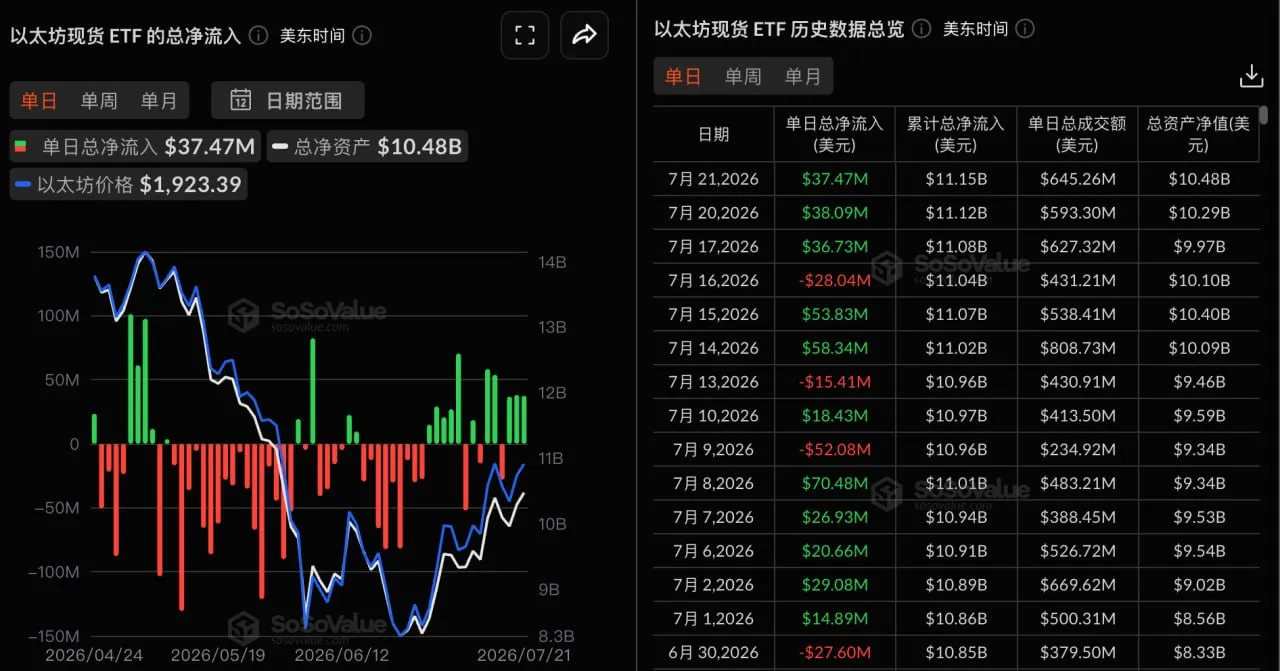
Ethereum Spot ETFs saw total net inflows of $37,471,000 yesterday, marking the third consecutive day of net inflows.
Svmuu News: According to SoSoValue data, the Ethereum spot ETF recorded total net inflows of $37,471,000 yesterday (July 21, Eastern Time). The Ethereum spot ETF with the highest single-day net inflow
-
Ethereum The validator entry queue has risen to nearly 2.5 million ETH, and new validators must wait more than 43 days
Svmuu News Ethereum: The validator entry queue has risen to nearly 2.5 million ETH, and the estimated wait time for new validator activation has exceeded 43 days.



-
Lookonchain monitoring: A hacker transferred 3,100 ETH washed via Tornado Cash to Hyperliquid, opening a long position on BTC and a short position on ETH.
Lookonchain monitoring: A hacker transferred 3,100 ETH washed via Tornado Cash to Hyperliquid, opening a long position on BTC and a short position on ETH.
-
Arkham: Ethereum whale accumulated over $42M worth of ETH recently
Arkham: Ethereum whale accumulated over $42M worth of ETH recently
-
Lookonchain monitoring: A whale has accumulated 13,077 ETH over the past week
According to Lookonchain monitoring, a whale has cumulatively bought 13,077 ETH over the past week, worth approximately $29.95 million, including 3,300 ETH (approx. $7.41 million) bought just 2 hours
-
Ethereum EIP-8037 State Gas Rules Force dApps to Rewrite Billing Logic
Ethereum EIP-8037's state gas rules are forcing dApps to rewrite their billing logic. On November 6th, Ethereum core developers are calling on application teams to test gas assumptions and report fix
-
On November 6, U.S. spot Bitcoin ETFs saw a net outflow of $412 million, while spot Ethereum ETFs experienced a net outflow of $93.19 million.
On November 6, U.S. spot Bitcoin ETFs saw a net outflow of $412 million, while spot Ethereum ETFs experienced a net outflow of $93.19 million. Among them, Fidelity's FBTC recorded a net inflow of $42.
-
Moscow Exchange plans to launch pilot trading for Bitcoin and Ethereum on December 1.
Moscow Exchange plans to launch a pilot program for Bitcoin and Ethereum trading on December 1, with Bitcoin, Ethereum, and USDT as the initial trading pairs, and settlements will be processed through
-
Lookonchain monitoring: A whale wallet spent $19.7 million USDT to buy 8,773.5 ETH, while another new wallet withdrew 9,777 ETH from Binance over the past 5 days.
Lookonchain monitoring: A whale wallet spent $19.7 million USDT to buy 8,773.5 ETH, while another new wallet withdrew 9,777 ETH from Binance over the past 5 days.
-
Russian Central Bank Adopts Bitcoin, Ethereum, and USDT Regulatory Rules, Set to Take Effect on November 17
The Bank of Russia has approved regulatory rules for Bitcoin, Ethereum, and USDT, which are set to take effect on November 17. Under the new regulations, non-accredited investors must pass a test and
-
Russia Finalizes Cryptocurrency Trading Rules, Allowing Retail Investors to Trade Bitcoin and Other Major Tokens
Russia has finalized its cryptocurrency trading rules, allowing retail investors to trade Bitcoin, Ethereum, and USDT through regulated intermediaries. The relevant regulations will officially take ef
-
Ethereum Execution Client Reth Hit with State Root Calculation Bug; L2 Networks Like Optimism and Base Release Emergency Patches
The Ethereum execution client Reth has exposed a state root calculation vulnerability, prompting Layer 2 networks such as Optimism and Base to release emergency patches. Georgios Konstantopoulos, CTO
-
What is Ethereum? How does Ethereum work?
Ethereum is an open-source, decentralized smart contract platform whose native token, ETH, is used to pay for gas and participate in consensus via staking. It operates through accounts, transactions, the Ethereum Virtual Machine (EVM), and a proof-of-stake mechanism, supporting applications such as DeFi, NFTs, and DAOs. This article explains what Ethereum is, how it works, Layer 2 scaling solutions, and common risks.
-
MEME KONG ($MKONG) Project Analysis and Current Status
MEME KONG ($MKONG) is a meme token launched on Ethereum in October 2023, designed to showcase individual online reputation through blockchain technology. It has a maximum token supply of 200 million. Currently, the token exhibits extremely low market activity, with 24-hour trading volume approaching zero and trading liquidity nearly depleted. Meme coins generally carry high volatility and liquidity risks, and investors are advised to exercise a high degree of caution.
-
POMI Token Trading Guide and Exchange Listing Analysis
POMI (Pomicoin) is an Ethereum-based cryptocurrency project launched in 2021 aimed at supporting stray animal welfare. Users can buy and sell it through CEXs such as Bitget, or swap it on DEXs using Web3 wallets. This article outlines its trading channels and current market status, while highlighting the associated risks.
-
What is the METIS Token? An Analysis of Metis' Technical Architecture and Transition Progress
Originally an Ethereum Layer 2 scaling solution utilizing Optimistic Rollups and introducing a decentralized sequencer, Metis has recently transitioned toward an architecture supporting AI agents and multi-network platforms, building a dual-network structure. This article outlines its project background, technical features, and current market status.
-
What is BITN coin? Analysis of BITN coin's current status and characteristics
BITN typically refers to Bitcoin & Company Network, a cryptocurrency token launched in 2018 and operating on the Ethereum platform. This article outlines the token's basic positioning, supply data, and current market trading status.
-
Challenges and Issues Facing Ethereum Even After the Completion of the Ethereum 2.0 Upgrade
The Ethereum 2.0 network upgrade has completed its transition to Proof of Stake (PoS), yet its subsequent development still faces a series of technical and governance challenges. From the four dimensions of network decentralization, validator economic models, long-term technical roadmap iterations, and ecosystem interest coordination, this article outlines the major issues Ethereum currently needs and will need to address, including staking barriers, node centralization risks, the complexity of technical upgrades, and the pressure of miner transitions.
-
What is the DIVX token? Total supply, official website, and project overview
DIVX typically refers to the Divi Exchange Token issued by the Divi Project, positioned as a blockchain ecosystem designed to simplify cryptocurrency ownership, trading, and management. Launched in October 2017 and based on the Ethereum ERC-20 standard, the project previously proposed smart wallets and a multi-tiered masternode system. Historical data shows that as of September 2023, the total supply was approximately 6.17 million tokens with a circulating supply of about 800,000 tokens; the current total supply and official website status require separate verification.
-
How to buy, sell, and trade Hera Finance (HERA)? Which exchanges is it listed on?
This article discusses the Hera Finance-related token, HERA. As of November 2026, public market data shows it is primarily traded on Ethereum via Uniswap V3, with no direct listings on mainstream CEXs yet. Before buying or selling, users need to verify the contract address, network, and trading pair, while keeping an eye on liquidity, slippage, approval, and regulatory risks.
-
Could Ethereum Surpass Bitcoin? An Analysis of the Crypto Market's Long-Standing "Flippening" Index
The crypto community has long discussed the "Flippening," a hypothetical scenario in which Ethereum surpasses Bitcoin in market capitalization or other comprehensive metrics. This article outlines the arguments of proponents who favor Ethereum's utility value, such as smart contracts and staking yields, alongside the stance of conservatives who maintain Bitcoin's position as digital gold.
-
What is the YFTE Token? Current Status and Trading Market Analysis of the YFTE Project
YFTE (YFTether) is an ERC-20 token built on the Ethereum blockchain, designed to provide relevant solutions through decentralized finance and staking mechanisms. This article outlines the token's basic positioning, historical price performance, and current liquidity and market status.






About ETH
As the most critical infrastructure in the crypto world, Ethereum is the birthplace of the vast majority of on-chain innovations—including DeFi (decentralized finance), NFTs, DAOs, GameFi, and stablecoins. The overwhelming majority of on-chain value and applications are built on it, and the scale of its ecosystem and developer activity have long ranked first among all public blockchains. A vast ecosystem of tools, wallets, and infrastructure has also emerged around Ethereum, further solidifying its network effects.
In terms of technological evolution, Ethereum completed a major upgrade known as “The Merge” in 2022, transitioning its consensus mechanism from Proof-of-Work (PoW) to the more energy-efficient Proof-of-Stake (PoS), reducing the network’s energy consumption by approximately 99%. Since then, Ethereum has continued to improve throughput and reduce transaction fees through Layer 2 scaling solutions (such as Rollups) and sharding, with the mainnet increasingly serving as the settlement and security layer. The fee-burning mechanism introduced by EIP-1559 also gives ETH certain deflationary characteristics during periods of high network activity.
ETH is the native token of the Ethereum network. It is used to pay transaction fees (Gas) for on-chain transactions and smart contract execution, and can also be staked to participate in network consensus, ensure security, and earn staking rewards—thereby fostering a vast liquid staking ecosystem. From stablecoins and decentralized lending to NFTs and real-world assets (RWAs), vast amounts of value are settled using ETH and the Ethereum network as the underlying infrastructure.
As the second-largest cryptocurrency by market capitalization, trailing only Bitcoin, Ethereum is widely regarded as the core infrastructure of the entire crypto industry and the settlement layer for the “on-chain economy.” With the approval of Ethereum spot ETFs and continued institutional investment, ETH’s long-term position among global digital assets is becoming increasingly solid; however, its price remains highly volatile, and investors should rationally assess the risks.
A thriving Layer 2 ecosystem has emerged around Ethereum, including platforms such as Arbitrum, Optimism, and Base. These platforms significantly reduce user costs while inheriting the security of the mainnet, driving Ethereum’s evolution toward a “modular” multi-layer architecture. Despite fierce competition from other high-performance public blockchains, Ethereum remains firmly entrenched as the leading smart contract platform, thanks to its deep developer ecosystem, rich application ecosystem, and high degree of decentralization.
On this page, you can view the latest price of Ethereum (ETH), its 24-hour price change, and market data for major trading pairs such as ETH/USDT and ETH/USD in real time. You can also analyze Ethereum’s price trends using multi-timeframe candlestick charts (minute, hourly, daily, weekly) and technical indicators such as MA, MACD, and RSI; The page also provides Ethereum’s real-time market capitalization and ranking, 24-hour trading volume, and historical price data, aggregates the latest Ethereum news, and supports quick conversion of ETH to fiat currencies such as the Chinese yuan and the U.S. dollar.
ETH Data

24H Trending
-
1
What is the LDN Token and How to Acquire and Trade It

-
2
A Review of Major Global Blockchain Trading Platforms and Apps
-
3
What is the DIVX token? Total supply, official website, and project overview

-
4
ANKR Token Analysis: Current State and Future Outlook of Web3 Infrastructure

-
5
US Treasury Announces Sanctions Against Eight Canada-Based Currency Exchange Firms Involved with Iran
-
6
How is BFHT doing? What is the future outlook for BFHT?

-
7
What Cryptocurrency Is ADR? A Deep Dive into the Solana Meme Project American Dollar Reserve
-
8
Real-World Use Cases and Impact of Blockchain Brawlers (BRWL)
-
9
IRGC Claims "Complete Defense Independence" and Warns US and Israel
-
10
Mirae Asset Securities suffers data leak, with personal information of approximately 39,000 customers and employees compromised.

Recommended Reading

Hot Topics

Svmuu focuses on blockchain industry trends and cutting-edge cryptocurrency news, while also covering real-time market data and in-depth analysis of the Hong Kong, U.S., and foreign exchange markets. Here, you can not only access professional 24/7 news updates and accurate market data, but also utilize practical investment tools to help you capitalize on opportunities in both digital assets and traditional financial markets. Whether you are a blockchain enthusiast or an investor in Hong Kong, U.S., or foreign exchange markets, we provide efficient and timely information services to empower your investment decisions.
- User Agreement
- Privacy Policy
- Contact Us
- Business Partnerships
- Disclaimer
- Content Statement
- About Us
- Sitemap
 Coming Soon!
