

Faster global financial news!
CEX
-
How do I buy and sell CC Coin? On which exchanges is CC Coin listed?
CC Coin (Canton Network token) is a cryptocurrency that can be traded on centralized exchanges (CEX) and some decentralized exchanges (DEX). To buy and trade CC Coin, you typically need to first register an account on an exchange that supports the token, complete identity verification, and then purchase it by depositing fiat currency or transferring other cryptocurrencies. Currently, well-known exchanges such as Bybit, OKX, Kraken, Bitget, Gate.io, KuCoin, MEXC, HTX, Upbit, Crypto.com Exchange, and CoinEx all support trading of CC Coin.
-
Guide to Buying and Trading DEGEN: List of Exchanges Where It Is Available
DEGEN is an unofficial token distributed to community members on the Farcaster decentralized social network, originally created as a reward for participants in the Farcaster Degen channel. It has evolved from a meme coin into a project with a large community of developers, crypto content creators, and enthusiasts. Currently, DEGEN can be bought and sold on multiple centralized cryptocurrency exchanges. This article will provide a detailed guide on how to purchase and trade DEGEN, and list the major exchanges where DEGEN is listed.
-
ORBS Trading Guide and List of Exchanges Where It Is Traded
ORBS is a decentralized Layer 3 blockchain infrastructure designed to enhance the functionality of existing Layer 1 and Layer 2 networks. It focuses on bringing centralized finance (CeFi)-level trading tools and advanced logic to decentralized finance (DeFi). Investors can buy and trade ORBS tokens through various centralized and decentralized exchanges. This article will provide a detailed overview of how to buy and sell ORBS tokens, as well as the major exchanges where they are listed.
-
How do I buy and trade TOSHI? Which exchanges list it?
TOSHI is a meme coin project built on the Base blockchain, named after the cat owned by Brian Armstrong, co-founder of Coinbase. Investors and traders can buy and trade TOSHI through various channels, including centralized cryptocurrency exchanges (CEX) and decentralized exchanges (DEX). There are multiple ways to purchase TOSHI, ranging from fiat currency purchases to cryptocurrency swaps.
-
How can I buy and trade HANZO? On which exchanges is HANZO listed?
HANZO (Hanzo Inu, ticker symbol HNZO) is a cryptocurrency based on the Ethereum blockchain, inspired by Shiba Inu (SHIB) and Dogecoin (DOGE).Investors can purchase and trade HANZO Coin in a variety of ways, primarily through centralized exchanges (CEX) and decentralized exchanges (DEX) that support the token. Currently, Bitget and CoinTiger are well-known trading platforms that have listed HANZO Coin.
-
How do I buy and trade OUSDC? On which exchanges is OUSDC listed?
This article provides a detailed analysis of the two possible meanings of “OUSDC”: the widely recognized USD-pegged stablecoin USDC, and the cross-chain token oUSDC wrapped via Orbit Bridge.The article primarily explains how to purchase and trade USDC through centralized exchanges (such as Coinbase and Binance), decentralized exchanges (such as Uniswap), and fiat on-ramps within crypto wallets, and lists the various blockchain networks supported by USDC.It also briefly explains the characteristics of oUSDC, its price volatility, and its primary trading venues (decentralized exchanges).
-
Data: Bitget has seen $699 million in capital inflows over the past 7 days, ranking first among centralized exchanges (CEXs)
Svmuu News: According to data from DefiLlama, Bitget has seen net capital inflows of $699 million over the past 7 days, ranking first among centralized exchanges (CEXs).
-
How to Trade PEOPLE Tokens? A List of PEOPLE Token Trading Platforms and Software
PEOPLE is the native token of the ConstitutionDAO project, which was originally aimed at acquiring the original U.S. Constitution through a crowdfunded auction. Although the auction was unsuccessful and the project’s core team has disbanded, PEOPLE can still be traded on multiple cryptocurrency exchanges. This article will provide a detailed overview of how to trade PEOPLE tokens and list the major platforms and related software that support trading them.
-
Cryptocurrency Wallets vs. Exchanges: Key Differences and a Guide to Choosing
In the world of cryptocurrency, cryptocurrency wallets and exchanges are two fundamental tools for managing digital assets, but their functions and operations are vastly different. Wallets are primarily used to securely store and manage your cryptocurrency private keys, giving you full control over your assets; exchanges, on the other hand, are platforms for buying, selling, and trading cryptocurrencies, and typically offer services such as fiat currency deposits and withdrawals. Understanding the core differences between the two is crucial for safeguarding your digital assets and optimizing your trading experience. This article will delve into the definitions, types, pros and cons, and use cases of wallets and exchanges to help you make an informed choice.
-
How can I buy and trade NPT? On which exchanges is NPT listed?
The NPT token may refer to different cryptocurrency projects, the most common of which are Neptune Cash (NPT) and Neptune Protocol (NPT). This article will primarily cover how to buy and trade Neptune Cash (NPT), as well as the major exchanges where it is listed. Neptune Cash is a Layer-1 blockchain protocol focused on privacy, scalability, and quantum security; users can buy and trade it through both centralized and decentralized exchanges.
-
How do I buy and trade EXO? On which exchanges is EXO listed?
“EXO Coin” is not a single cryptocurrency, but rather a collective term for tokens used across multiple different projects, including Exosis, Exotic Markets, Exohood, Exodus AI, and Exovum. These EXO tokens vary in their positioning, technical foundations, and the exchanges on which they are listed. This article will provide a detailed overview of the background of each EXO project and guide you on how to buy and trade these EXO tokens on centralized exchanges (CEX) and decentralized exchanges (DEX), while also listing the trading platforms where they may be listed.
-
An Overview and Selection Guide to Major Global Cryptocurrency Exchanges
Cryptocurrency trading platforms serve as the central hubs for buying and selling digital assets. This article will provide an in-depth analysis of the main types of platforms—including centralized, decentralized, and peer-to-peer—and list examples of widely recognized trading platforms from around the world. We will also outline key factors to consider when selecting the right platform, helping users make informed decisions in this complex market while emphasizing the importance of security and compliance.
-
An Analysis of Major Cryptocurrency Exchanges: Selection and Considerations
Cryptocurrency trading platforms serve as the central hubs for the circulation of digital assets. This article will take an in-depth look at major platform types, such as centralized and decentralized exchanges, and analyze their respective characteristics, advantages, and disadvantages. Additionally, the article will outline key factors to consider when selecting a platform—such as security, compliance, fee structures, and liquidity—to help users make informed decisions based on their individual needs.
-
How to Buy MEPAD? An Analysis of Listed Exchanges and Trading Methods
MEPAD is the native token of the MEEPAD ecosystem and is primarily used on its launch platform. This article will provide a detailed overview of the process for purchasing and trading MEPAD, including the major centralized and decentralized exchanges where it is listed, as well as detailed trading steps and important considerations to help investors understand how to acquire MEPAD safely and effectively.
-
Token Adjustment and Delisting Mechanisms on Centralized Exchanges: A Case Study of BKEX
To maintain market health and ensure compliance, centralized exchanges (CEXs) typically establish token adjustment and delisting mechanisms. These mechanisms allow exchanges to take action regarding listed tokens under specific conditions, such as delisting tokens due to poor project management, insufficient liquidity, or regulatory requirements. This article will explore the common reasons behind these mechanisms and how they operate, using BKEX as an example to advise investors on how to respond when facing such risks.
-
Cryptocurrency Exchanges: Key Differences Between Centralized (CEX) and Decentralized (DEX) Exchanges
Cryptocurrency exchanges are the core platforms for trading digital assets and are primarily divided into two categories: centralized (CEX) and decentralized (DEX). CEXs are operated by central authorities, offering convenient services but involving asset custody; DEXs, on the other hand, facilitate peer-to-peer trading based on blockchain technology, allowing users to retain control of their assets, though the barrier to entry is relatively high. Understanding the differences between the two helps users choose the trading method that best suits their needs.









-
Binance Co-founder Yi He: Approximately $3 billion of the $6.3 billion hack has been frozen; withdrawals are expected to resume within 42 hours.
Binance co-founder Yi He stated that a cyberattack on October 30, 2026, affected approximately $6.3 billion in assets, of which about $3 billion has been frozen with the assistance of industry partici
-
Bitcoin shows resilience after record Binance hack, down 4% vs. 8.3% average in past incidents
Following the record $6.3 billion Binance hack, Bitcoin traded down about 4% to $77,065 on Friday afternoon, outperforming the average 8.3% drop seen in the first 24 hours after past crypto exchange e
-
Report: Crypto Hacks Resulted in $2.35 Billion Net Losses in 2026, CEXs and DeFi Are Primary Victims
According to data shared by Lightning.news and Bitcoin Magazine, as of 2026, net losses from cryptocurrency hacks, after freezes and returns, have reached approximately $2.35 billion. Of this, Septemb
-
Gemini Crypto Exchange Stock Hits Record Low of $3.215 on Monday, Down 89% Since IPO
Gemini Crypto Exchange Stock Hits Record Low of $3.215 on Monday, Down 89% Since IPO. The company's IPO was offered at $28. For the first half of 2026, Gemini reported revenue of $95.7 million and a c
-
CoinGecko Report: Total Crypto Market Cap Jumps $800 Billion in Q3 2026, But Spot Trading Volume Drops 14%
CoinGecko's Q3 2026 report shows the total crypto market capitalization grew by 39.6% from July to September, reaching approximately $2.96 trillion. However, spot trading volume on the top ten central
-
Coins.ph Users Face App Lockout, Company Responds Funds Are Safe and Services Are Being Restored
Philippine crypto platform Coins.ph issued a statement on October 14, addressing user concerns about application lockouts, assuring users that their funds are safe and that it is working to restore af
-
Papertrade Traders Lose $32.4 Million
Two days after its launch, crypto trading platform Papertrade has seen traders incur total losses of $32.4 million. Despite this, the platform's latest full-day data shows its revenue surpassed that o
-
Ethereum Foundation-linked wallets transfer 4,393 ETH to Kraken
According to monitoring by EmberCN, two Ethereum Foundation-linked wallets sent 4,393 ETH, valued at approximately $11.13 million, to Kraken about four hours ago. These wallets initially received 59,7
-
XRP Whale Dominance Falls 27% in 8 Days, Indicating Reduced Trading Activity
XRP whale dominance across centralized exchanges has declined by 27% in eight days, from 64% on September 30 to 46.7% on October 8, according to CryptoQuant. This indicates that large XRP holders are
-
NEAR co-founder Polosukhin believes expanding onchain tools will reduce need for centralized exchanges
NEAR Protocol co-founder Illia Polosukhin stated that users no longer require centralized exchanges for a significant portion of crypto activities, as near.com expands its onchain offerings. Speaking
-
Coinbase CEO Brian Armstrong retweeted a post, hinting at the return of Coinbase Pro.
Coinbase CEO Brian Armstrong retweeted a post, hinting at the return of Coinbase Pro.
-
Wu Blockchain forwarded EmberCN's monitoring: The TRUMP token team has transferred $249 million worth of tokens to CEXs over the past eight months.
According to Wu Blockchain, citing EmberCN monitoring, wallets associated with the TRUMP token team have transferred approximately 81.87 million TRUMP tokens to centralized exchanges (CEXs) such as Bi
-
Castle Labs Study: Hyperliquid Onchain Perps Match CEX Liquidity, Offer Lower Costs
A study by Castle Labs found that Hyperliquid, an onchain perpetuals platform, held as much resting liquidity as the median of Binance, Bybit, and OKX on four of five crypto assets, and cost less to t
-
The Federal Reserve proposed that stablecoin issuers must complete redemptions within 2 business days, yet on-chain data shows $76 billion in stablecoins remain on centralized exchanges.
The Federal Reserve's stablecoin proposal, released on September 29, requires payment stablecoin issuers under its regulation to process redemption requests within a normal period not exceeding two bu
-
CZ retweeted a post from CoinMarketCap stating that Binance holds half of the RWA perpetual contract market, with a trading volume of $1.5919 trillion, accounting for 50.4% of the total volume on CEXs.
CoinMarketCap noted that centralized exchanges are attracting new capital inflows and rapidly taking over products developed by decentralized platforms.
-
CEX perpetual futures volume falls to $4T, marking lowest level since late 2023
Perpetual futures trading volume on centralized crypto exchanges (CEX) has dropped to $4 trillion, reaching its lowest point in 31 months and since late 2023. Additionally, perpetual trading on decent
-
DEXs Capture Record 24% of Spot Crypto Trading as CEX Volumes Sink to 12-Month Low of $670 Million
According to The Block, spot exchange volume is on track to set a new 12-month low at $670 million, a significant decrease from its annual high of $2.23 trillion, indicating a shift towards decentrali
-
Report: Crypto “Traditional Finance” Market Grows to $6.6 Billion; Centralized Exchanges Are Expanding Their Stock and Commodity Tokenization Businesses
A study by CoinGecko shows that demand for tokenized stocks and commodities on centralized exchanges is growing, driving the crypto “traditional finance” (TradFi) market to a size of $6.6 billion—a fi
-
CZ: Acquisitions of Small and Medium-Sized Exchanges Pose Greater Security and Compliance Risks
Svmuu News: CZ, founder of Binance, responded to the question “Why not acquire small CEXs?” by stating that acquiring centralized exchanges differs from other business ventures. If a hack occurs after
-
Possibly influenced by the U.S. earnings season, Bitget has ranked first in net capital inflows over the past 30 days
Svmuu News: With the recent start of the U.S. earnings season, trading activity for U.S. stock-linked tokens has picked up. According to DeFiLlama data, possibly influenced by this trend, Bitget has s
-
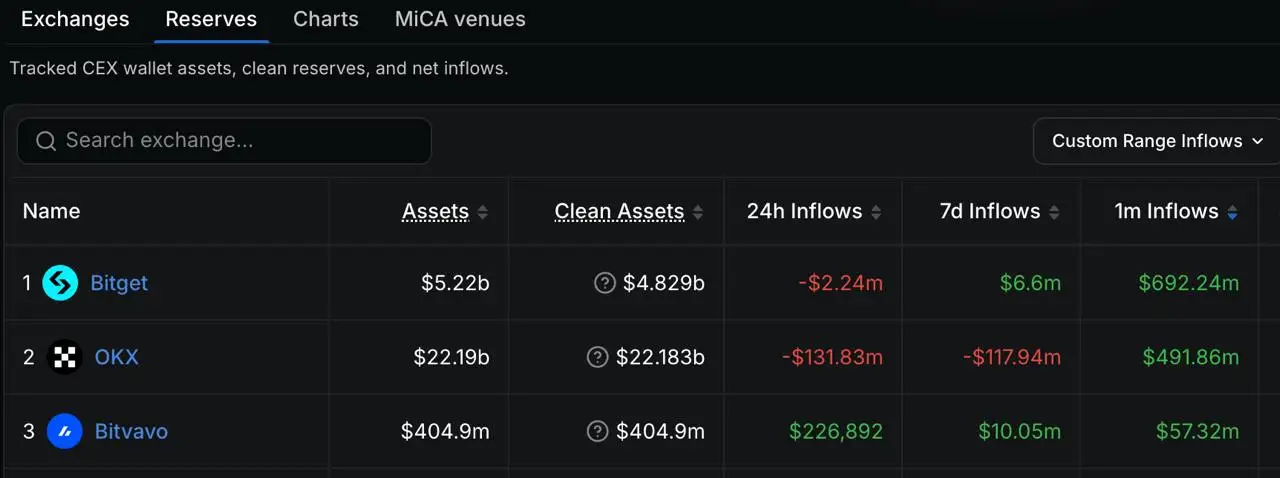
Data: Bitget has seen $699 million in capital inflows over the past 7 days, ranking first among centralized exchanges (CEXs)
Svmuu News: According to data from DefiLlama, Bitget has seen net capital inflows of $699 million over the past 7 days, ranking first among centralized exchanges (CEXs).
-
Analysis of Major Global Cryptocurrency Exchanges and Market Trends
Virtual currency trading platforms are core hubs for digital asset trading, categorized into centralized (CEX) and decentralized (DEX) exchanges. Leading CEXs such as Binance, Coinbase, and Bitget dominate the market, offering diverse services. DEXs are gaining increasing attention due to their decentralized nature and enhanced privacy. With the gradual improvement of global regulatory frameworks, the cryptocurrency trading market is expected to continue growing, attracting more institutional investors.
-
DBEX Trading Platform Risk Alert and Overview of Mainstream Centralized Exchanges
This article first clarifies that the trading platform named DBEX carries risk warnings and lacks reliable public rankings. Subsequently, the article introduces the definition, operational model, and core characteristics of centralized cryptocurrency exchanges (CEXs), and based on publicly available information, lists the major platforms currently active globally, such as Binance, Coinbase, and OKX, while objectively analyzing the advantages and potential risks of CEXs.
-
Bitcoin Exchange Platform Guide: Key Platforms and Selection Considerations for 2024
With the approval of Bitcoin spot ETFs in 2024, the cryptocurrency market has seen a recovery, and Bitcoin trading activity has significantly increased. This article will introduce the major Bitcoin trading platforms currently available, including centralized exchanges (CEXs) and decentralized exchanges (DEXs), with a focus on analyzing the performance of market leaders such as Binance, Bybit, OKX, Coinbase, and Crypto.com. Additionally, the article will provide key factors to consider when choosing a trading platform, such as security, liquidity, trading fees, and user experience, to help global readers make informed decisions.
-
Global Cryptocurrency Exchange Rankings and Market Trend Analysis
The cryptocurrency exchange platform market is experiencing significant growth, with a projected market size of $84.8 billion by 2034, at a compound annual growth rate (CAGR) of 12.6%. Centralized exchanges (CEXs) accounted for over 52% of the market share in 2024, driven by high liquidity and user-friendly interfaces. Market growth is primarily fueled by increased cryptocurrency adoption, demand for derivatives, a rise in retail investors, and clearer regulatory policies. Investments in security and compliance are crucial for attracting institutional investors. This article will delve into the current market landscape, the performance of major platforms, and user considerations for selection.
-
Dogecoin (DOGE) Trading Platforms and Popular Applications Guide
Dogecoin (DOGE), a meme-based cryptocurrency, has carved out a niche in the crypto market with its fast and low-cost transaction features. This article will delve into centralized exchanges and CFD brokers that can be used for trading DOGE, as well as self-custody wallets that emphasize user autonomy, offering practical advice on platform selection to help investors understand its market dynamics and potential risks.
-
2023 Global Cryptocurrency Exchange Review and Ranking Analysis
In 2023, Centralized Exchanges (CEXs) remained dominant in cryptocurrency trading, handling the vast majority of transaction volumes. This article reviews the global trading platform landscape at the time, including the positioning and characteristics of leading platforms such as Binance, Coinbase, and OKX, and analyzes different ranking methodologies based on dimensions like liquidity, security, and operational scale. The article emphasizes that platform rankings dynamically adjust with market fluctuations and changes in the regulatory environment, and platform selection should consider individual needs and local regulations.
-
Mainstream Cryptocurrency Exchange Analysis: How to Choose a Reliable Litecoin Trading Platform
This article delves into the major global centralized cryptocurrency trading platforms, including Binance, Coinbase, OKX, and others, with a focus on Litecoin (LTC) trading on these platforms. It elaborates on key factors to consider when choosing a reliable trading platform, such as security, regulatory compliance, liquidity, and fees, and briefly mentions decentralized exchanges (DEXs) as an alternative. Additionally, the article provides the latest market data and background information for Litecoin.
-
Cryptocurrency Platforms: From Centralized Exchanges to Decentralized Protocols
Cryptocurrency platforms are generally categorized into centralized exchanges, decentralized exchanges, wallets and custody services, lending and derivatives platforms, and banking or brokerage financial portals. Different platforms vary significantly in terms of asset control, compliance, fees, and risks; before choosing, it's essential to consider liquidity, regulatory status, security mechanisms, and product rules.
-
2024 Ranking and Features of Major Cryptocurrency Exchange Platforms
Cryptocurrency exchanges are core hubs for digital asset trading, with their rankings typically based on comprehensive metrics such as trading volume, liquidity, user traffic, and trustworthiness. As of October 2024, platforms like Binance, Coinbase, and OKX dominate the global market, offering diverse trading services. This article will delve into the ranking criteria, key features, and roles of these leading exchanges within the evolving blockchain ecosystem, while emphasizing that rankings can change with market dynamics.
-
GHC Coin: Analysis of Buying, Selling, and Exchange Listings for Galaxy Heroes Coin
Galaxy Heroes Coin (GHC) is a community-driven token based on the Binance Smart Chain (BSC), focusing on gaming, NFTs, and the DeFi ecosystem. This article will provide a detailed introduction to GHC's background, tokenomics, and how to buy and sell it on decentralized exchanges (DEXs) like PancakeSwap and centralized exchanges (CEXs) such as the Crypto.com App and BitMart, while also highlighting the tax mechanisms for DEX transactions.
-
International Digital Currency Exchange Overview: Mainstream CEXs, Regulatory Trends, and Selection Considerations
As the cryptocurrency market continues to evolve, Centralized Exchanges (CEXs) remain the primary channel for users to trade digital assets. This article will delve into the major international digital currency trading platforms, including Binance, Coinbase, Bitget, and OKX, analyzing their market positions, diverse product offerings, and Web3 ecosystem integration. Concurrently, the article will emphasize the importance of regulatory compliance, asset security, and technological stability when selecting a trading platform, providing readers with key considerations for platform selection and related risk warnings.
-
ATOLO Coin Trading Guide: Understanding Its Use Cases and Listing Platforms
ATOLO is the native token of the RIZON project, primarily used for utility, governance, and ecosystem participation within its blockchain network. Investors and users can buy and sell ATOLO through various channels, including centralized exchanges (such as Bitget, LBank), decentralized exchanges (connected via Web3 wallets), and some peer-to-peer (P2P) markets. This article will detail ATOLO's trading methods, current market status, and supported trading platforms, while also highlighting the high volatility risks of the cryptocurrency market.
-
Overview of Cryptocurrency Trading Platforms: A Look at Centralized and Decentralized Exchanges
This article outlines the current mainstream cryptocurrency trading platforms, categorizing them into centralized exchanges (CEXs) and decentralized exchanges (DEXs). Centralized exchanges such as Binance, Coinbase, and OKX offer custodial services and a wide range of trading features. Decentralized exchanges like Uniswap operate on smart contracts, allowing users to retain control over their assets. The article also introduces key factors to consider when choosing a platform, including security, liquidity, and regulatory compliance.
-
How to Sell ETH: A Guide to Major Exchanges and Processes
Selling Ethereum (ETH) can be done through Centralized Exchanges (CEXs), Decentralized Exchanges (DEXs), and Peer-to-Peer (P2P) platforms. Users typically need to create an account on a CEX, deposit ETH, select the sell option, and withdraw funds to a bank account or e-payment platform. DEXs offer the advantage of non-custodial trading, while P2P platforms support direct transactions. When trading, consider fees, payment methods, security, and tax implications.
-
Where to Buy Litecoin: Exchanges and App Guide
Litecoin (LTC), known as "digital silver," is a popular cryptocurrency due to its faster transaction speeds and lower fees. Investors can buy and sell LTC through various platforms, including Centralized Exchanges (CEXs), Decentralized Exchanges (DEXs), peer-to-peer (P2P) platforms, and cryptocurrency wallets that support trading functions. When choosing a platform, factors such as security, liquidity, fees, and user experience should be considered. This article will detail the different types of platforms and their characteristics to help readers understand how to acquire Litecoin safely and efficiently.
-
On which platforms can VSP tokens be traded? Market status and liquidity analysis
VSP (Vesper Finance) is primarily traded on decentralized exchanges (DEXs) like Curve (Ethereum), and is also listed on centralized exchanges such as BitMart, Bitget, and LATOKEN. Although MetaMask and Binance Web3 Wallet offer built-in trading functionalities, the token currently exhibits low trading activity and its price has experienced significant pullbacks. Investors should thoroughly verify liquidity and market risks before trading.
-
Cryptocurrency Trading Platforms: Types, Services, Risks, and Market Trends
Cryptocurrency trading platforms are core hubs for buying and selling digital assets, primarily divided into Centralized Exchanges (CEXs) and Decentralized Exchanges (DEXs). They offer diverse services such as spot trading, derivatives trading, and staking, but also face security challenges like hacker attacks and phishing, as well as complex and evolving regulatory environments across various countries. The global market size is expected to continue growing, with technological innovation and compliance being key drivers for industry development. Investors need to be wary of market volatility and potential risks.
-
Mainstream Platforms for Buying USDT and Selling Cryptocurrencies
This article provides an in-depth analysis of the main platform types for purchasing USDT and selling cryptocurrencies, including Centralized Exchanges (CEXs) and self-custody wallets. It explores the characteristics, advantages, and limitations of various platforms, listing prominent industry names such as Binance, Coinbase, and MetaMask. The article also introduces common payment methods, aiming to help global users select suitable channels for their crypto asset transactions.
-
Global Overview of Major Cryptocurrency Trading Platforms: A Deep Dive into Bitcoin Trading Channels
This article delves into the landscape of leading global cryptocurrency trading platforms, focusing on centralized exchanges' market share, growth trends, and compliance developments in 2024. We will review annual trading volume data for platforms such as Binance, Bybit, and Crypto.com, and introduce the primary trading channels for Bitcoin, helping readers understand current market dynamics and choices.
-
Global Cryptocurrency Exchange Rankings: A Look at Centralized and Decentralized Platforms
Virtual currency trading platforms are the core hubs for digital asset circulation, primarily divided into Centralized Exchanges (CEX) and Decentralized Exchanges (DEX). CEXs are operated by institutions, offering asset custody and diverse trading services, while DEXs are based on smart contracts, empowering users with full control over their funds. This article will review the world's leading CEX platforms based on 2025-2026 market data, and discuss key factors to consider when choosing a trading platform, such as security, liquidity, and compliance, to help readers gain a comprehensive understanding of the current cryptocurrency trading ecosystem.
-
Cryptocurrency Trading Platforms and Blockchain Technology Platforms Analysis
This article delves into two core concepts: cryptocurrency trading platforms and blockchain technology platforms. Cryptocurrency trading platforms serve as crucial hubs connecting users with the digital asset market, and users must consider factors such as compliance, security, liquidity, and fees when making a choice. Major global platforms like Binance, Coinbase, and Kraken are regulated in various jurisdictions. The article also introduces blockchain platforms, categorized by permission levels into public chains (e.g., Bitcoin, Ethereum), consortium chains (e.g., Hyperledger Fabric), and private chains. These technologies are being widely applied across various industries, including finance and supply chain, collectively forming the infrastructure of the digital economy.
-
What are Centralized Cryptocurrency Exchanges (CEXs)? Features, Market Landscape, and Selection Considerations
Centralized cryptocurrency exchanges (CEXs) are the dominant force in the crypto market, offering high liquidity, fast transactions, and convenient fiat on/off-ramps. As of 2026, over 80% of cryptocurrency trading volume occurs through CEXs. This article will explore how CEXs operate, their market share, global regulatory trends, and introduce major platforms such as Binance, Coinbase, and OKX, to help readers understand how to choose a suitable trading platform.
-
WAM Coin Trading Guide: Exchange Listings and Purchase Methods Explained
WAM is the utility token of the Play-to-Earn gaming platform WAM, supporting multiple blockchains including BNB Chain. This article will detail how to trade WAM, including buying and selling on decentralized exchanges (such as PancakeSwap) and centralized exchanges (such as Gate.io), as well as managing and exchanging WAM through Web3 wallets. Additionally, the article will provide an overview of WAM's market performance.
-
USDT Trading Platforms: A Rundown of Major Centralized and Decentralized Options
USDT, as the largest stablecoin by market capitalization, plays a crucial role in the cryptocurrency market, offering price stability and liquidity. This article will list the major centralized and decentralized platforms that support USDT trading, covering well-known exchanges such as Binance, OKX, Kraken, and Coinbase. It will also discuss the factors to consider when choosing a platform, including security, fees, user experience, and regulatory compliance. Additionally, the article will touch upon recent regulatory developments, such as the impact of MiCA regulations on USDT trading in the European Economic Area, to help global readers understand the USDT trading ecosystem.



















CEX

24H Trending
-
1
US banks are owed $349B by private credit funds, as PIK interest payments rise to 10% of loans
-
2
Al Jazeera: Israeli attacks on Gaza kill at least 4 Palestinians, UN Human Rights Office warns of ethnic cleansing risk
-
3
Musk retweeted that as of October 31, the number of Starlink satellites has reached 11,184, accounting for 66% of the total active satellites globally.
-
4
Nikkei Asia: Overseas entities' JPY bond issuance reaches a record $16 billion as the AI funding race spreads to Japan
-
5
Al Jazeera: Palestinian Man Succumbs to Injuries After Israeli Drone Strike in Gaza
-
6
Chainalysis: Ethereum Reorg Causes THORChain Emergency Pause, Accidentally Delays Binance Hacked Funds Laundering
-
7
SpaceXAI, the AI division of SpaceX, failed to dismiss an air pollution lawsuit filed by the NAACP, with the judge ruling that the case will proceed.
-
8
Donald Trump announced his "complete and total endorsement" of Congressman Bob Latta for re-election as the representative for Ohio's 5th Congressional District.
-
9
U.S. Secretary of State Rubio: Trump has not yet decided to restart war with Iran; the U.S. remains open to a diplomatic solution.
-
10
Digital Currencies: Definition, Types, and Key Characteristics

Markets Today





Recommended Reading

Hot Topics

Svmuu focuses on blockchain industry trends and cutting-edge cryptocurrency news, while also covering real-time market data and in-depth analysis of the Hong Kong, U.S., and foreign exchange markets. Here, you can not only access professional 24/7 news updates and accurate market data, but also utilize practical investment tools to help you capitalize on opportunities in both digital assets and traditional financial markets. Whether you are a blockchain enthusiast or an investor in Hong Kong, U.S., or foreign exchange markets, we provide efficient and timely information services to empower your investment decisions.
- User Agreement
- Privacy Policy
- Contact Us
- Business Partnerships
- Disclaimer
- Content Statement
- About Us
- Sitemap
 Coming Soon!
