

Faster global financial news!
DeFi
-
FXS: The Evolution, Current Status, and Future Outlook of the Frax Protocol’s Governance Token
FXS (Frax Share) was once the governance and utility token of the Frax protocol, playing a central role in the Frax ecosystem by accumulating protocol fees and value. The Frax protocol is known for its unique hybrid collateral algorithm-based stablecoin model, issuing a variety of stablecoins including frxUSD, FPI, and frxETH. As the Frax ecosystem has evolved toward V3 and the L2 chain Fraxtal, its tokenomics model has also undergone significant changes. Notably, FXS was swapped for FRAX at a 1:1 ratio on December 26, 2025, and FRAX has now become the gas and staking token for the Fraxtal L2. This article will delve into the historical role of FXS, the innovative mechanisms of the Frax protocol, and the latest changes to its token economics.
-
The crypto market fell across the board, with the DeFi sector dropping more than 5%
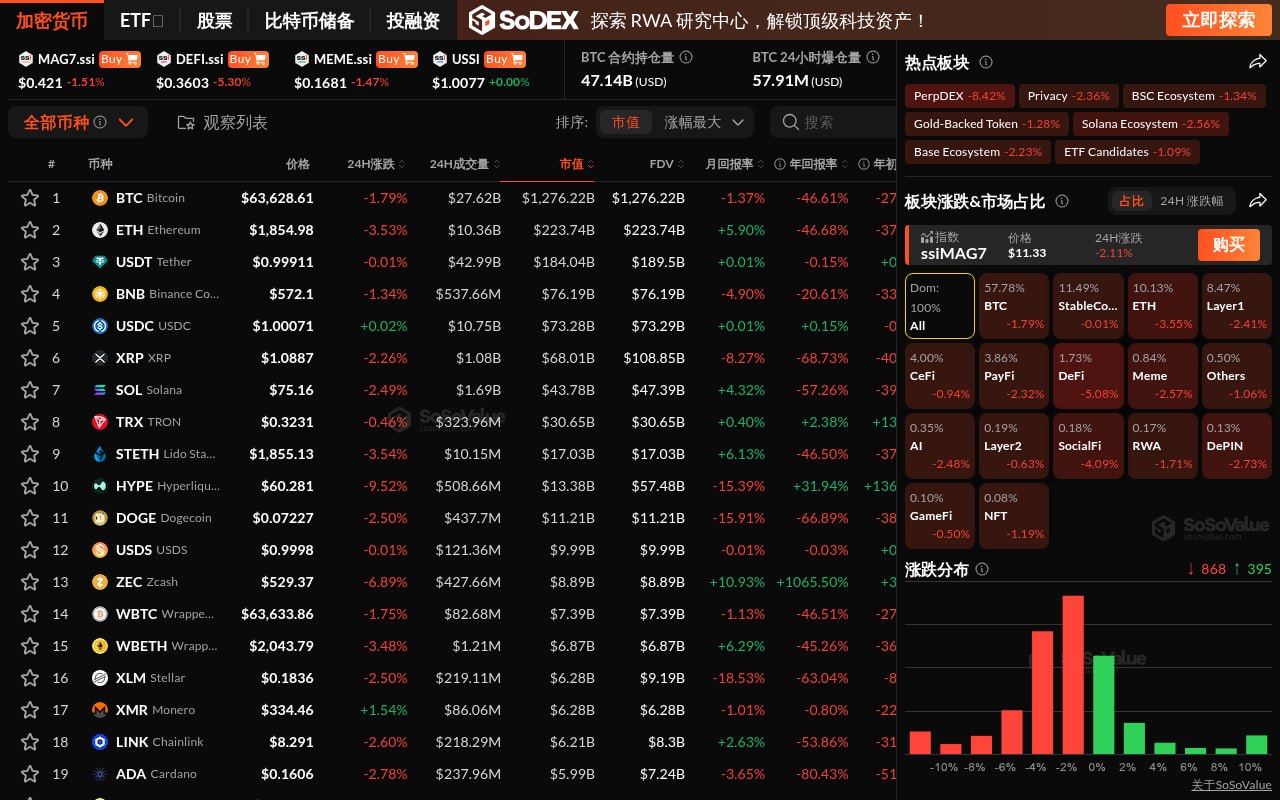
Svmuu News, July 17: According to data from SoSoValue, all sectors of the crypto market declined, with the DeFi sector performing weakly, falling 5.08% over the past 24 hours. Among them, Hyperliquid
-
BNSD Finance (BNSD) Token Analysis: An Overview of the DeFi Platform and Future Outlook
BNSD Finance is a decentralized finance (DeFi) platform that allows users to earn BNSD tokens by offering yield farming opportunities. The token employs a highly deflationary model and incorporates a four-phase halving mechanism; the development team has allocated only 4% of the total supply, half of which is earmarked for buybacks. As of July 17, 2026, the price of the BNSD token was approximately $0.000017, with a market capitalization of approximately $3,100. Although its deflationary design and low allocation of funds to the development team are intended to attract users, the platform currently has a 0% security audit score, which poses a challenge to building trust and achieving widespread adoption in the future. Its future prospects will depend on DeFi market trends, the platform’s TVL, and user engagement.
-
DefiTuna Lending Pool Suffers Attack, Losing Approximately $580,000
Svmuu News: According to DefiTuna’s monitoring, an attacker exploited a vulnerability in the DefiTuna lending pool yesterday to withdraw approximately $580,000, resulting in a current shortfall of $58
-
In-Depth Analysis of the Coin98 (C98) Token: Project Overview, Ecosystem Applications, and Market Performance
Coin98 is a “super app” portal designed to bridge traditional finance with multi-chain DeFi services. Its core products include Coin98 Wallet, Coin98 Exchange, and Space Gate. C98 is its native utility and governance token, used to pay service fees, provide staking incentives, and participate in governance. As of July 16, 2026, the price of the C98 token was approximately $0.013–$0.014, with a market capitalization of approximately $13–14 million. The project has recently continued to integrate new blockchains, launched privacy features, and plans to introduce AI-driven capabilities; however, market views on its prospects are mixed, and its ecosystem development and market volatility warrant close attention.
-
ASET Coin: An Analysis of Its Multiple Roles and an Outlook on Its Future Prospects
“ASET Coin” is not a single entity, but rather a collective term for multiple cryptocurrency projects with distinct focuses, including AI-driven mining solutions, the “Ethereum” internet ecosystem token, the staking and lending protocol Parasset, and the real estate token AssetLink. These projects vary in launch dates, mechanisms, and market performance, and some lack up-to-date public market data.This article will examine the characteristics of these “ASET coins” one by one and, in light of overall industry trends, explore their potential directions for development.
-
Base Ecosystem Fund Launches Developer Recruitment Program to Support the Development of Global On-Chain Financial Infrastructure
Svmuu News: The Base Ecosystem Fund has released “Request for Builders: Funding the Future of Global Finance,” announcing that it will provide early-stage funding and ecosystem resources to startup te
-
An Analysis of the Agility (AGI) Token: Multi-Project Shared Code, Total Supply, and Ecosystem Overview
AGI is a token code used by multiple projects in the cryptocurrency space, which can lead to confusion. This article will provide a detailed overview of the DeFi blockchain project named “Agility” and its native AGI token, while distinguishing it from other projects that also use the AGI ticker, such as the AI-generated meme coin Artificial General Intelligence, Delysium—which focuses on AI and data management—and the liquid staking derivatives platform Agility LSD. We will discuss each project’s positioning, functionality, and the total supply and circulation of its tokens, and provide market data as of July 16, 2026.
-
Analysis of WMATIC’s Value: The Role of Wrapped MATIC and the Long-Term Potential of the Polygon Ecosystem
WMATIC (Wrapped MATIC) is a wrapped version of MATIC, the native token of the Polygon network. It is pegged 1:1 to MATIC and is designed to enhance MATIC’s compatibility and liquidity on Ethereum Virtual Machine (Ethereum, EVM)-compatible DeFi platforms.With the renaming of the MATIC token to POL—as part of the Polygon 2.0 roadmap—WMATIC’s value is closely tied to the overall development of the Polygon ecosystem.Recently, Polygon has made progress in throughput, PayPal stablecoin integration, and AI projects, and has strategically shifted its focus toward global payments and enterprise settlement layers. This article will explore the core value of WMATIC, the latest developments at Polygon, and its long-term investment potential.
-
Anton Bukov, co-founder of 1inch, announced that he has left the project
Svmuu News: Alex, co-founder of Pagga, posted on X stating that Anton Bukov, co-founder of 1inch, has announced his departure from the project. Bukov was previously responsible for designing core arch
-
Dune: 85% of centralized DeFi liquidity is underutilized, resulting in $150 million in lost fees annually
Svmuu News: According to research conducted by the on-chain analytics platform Dune on behalf of 1inch, approximately 85% of the concentrated liquidity in decentralized exchanges is not fulfilling the
-
Galaxy Launches “Galaxy Curator,” an Institutional-Grade DeFi Vault Service
Svmuu News: Crypto financial services firm Galaxy Digital (GLXY) announced the launch of “Galaxy Curator,” an institutional-grade vault management service, built on the decentralized lending protocol
-
ARK Invest Rebuts a16z's View: The Future of Traditional Finance May Rely on DeFi Infrastructure, Not Closed Blockchains
Svmuu News: Lorenzo Valente, Head of Research at ARK Invest, recently publicly refuted a16z Crypto’s view that “traditional finance needs blockchain, not DeFi,” arguing that financial institutions are
-
What Is ROUTE? Router Protocol Token Features, Exchanges, and Latest Updates
ROUTE is the governance token of Router Protocol, a cross-chain liquidity aggregator dedicated to enabling seamless communication and asset transfers between different blockchain networks. Through its “Router Cross-Chain Intent Framework” (CCIF) technology, the protocol enables users to exchange and trade assets across chains at low cost and nearly instantly. The project was founded in 2020 and launched its mainnet in 2022. The ROUTE token recently completed a smart contract migration and is primarily used for protocol governance. As of this writing, ROUTE has a circulating supply of approximately 679 million tokens and is tradable on centralized exchanges such as Gate.io, MEXC, and KuCoin, as well as decentralized exchanges like Uniswap and PancakeSwap.
-
How to Buy and Sell BTL? A Guide to Listing Bitlocus (BTL) on Exchanges
This article focuses on Bitlocus (BTL), an investment management platform designed to bridge traditional finance and decentralized finance. We will provide a detailed guide on how to buy and trade BTL tokens, including through centralized exchanges (such as Bitlocus Exchange and Gate.io) and decentralized exchanges (such as PancakeSwap). Additionally, this article will list the major platforms currently supporting BTL trading and remind readers to be aware of the volatility of the cryptocurrency market and to distinguish between tokens with the same name.
-
What Is PPAD? An Analysis of the PlayPad Token’s Positioning and Current Trading Situation
PPAD (PlayPad) is a cryptocurrency based on the BNB Smart Chain (BEP20). It is primarily positioned as a multi-chain launchpad and DeFi platform, focusing on supporting “Play-to-Earn” VR gaming projects in the metaverse.Participants must stake PPAD tokens to access its launchpad. As of July 2026, PPAD has a low market capitalization, and trading support on major cryptocurrency exchanges is currently limited; Coinbase, and KuCoin have all explicitly stated that they do not currently support trading of PPAD.
-
What Is WAMPL? Features and Trading Guide for the Wrapped Ampleforth Token
WAMPL is a wrapped version of Ampleforth (AMPL). As an ERC-20 token, it is designed to enhance AMPL’s compatibility and accessibility within the Ethereum ecosystem.Unlike the original AMPL, WAMPL does not undergo rebasing; its supply is relatively stable, and it can be exchanged for AMPL on a 1:1 basis. This design makes it easier to integrate into various decentralized finance (DeFi) applications.As of July 2026, WAMPL is primarily traded on decentralized exchanges (DEXs) such as Uniswap V3.
-
Ostium Suffers 18 Million USDC Loss in Oracle Attack; About One-Third of Its Liquidity Depleted
Svmuu News: Ostium, a decentralized perpetual futures exchange, suffered an oracle attack on Wednesday, resulting in a loss of approximately 18 million USDC. The attacker used a compromised oracle sig
-
Summer.fi Announces Closure Following a Protocol Attack; Frontend Will Remain Available Until August 31
Svmuu News: Lazy Summer Protocol was attacked on July 6, and the Summer.fi team announced that it would shut down Summer.fi and its parent company, Labs.The attackers manipulated the share prices of t
-
What is the value of LYD? Is the Lydia Finance token worth keeping an eye on for the long term?
LYD is the native token of Lydia Finance, a decentralized finance (DeFi) platform built on the Avalanche blockchain. It is primarily used for trading, staking, and participating in liquidity pools to earn rewards. The platform offers features such as automated market makers (AMMs), yield farming, and NFT projects. Although LYD leverages the Avalanche network to enable fast, low-cost transactions, its token price has fallen significantly from its all-time high. Current trading volume is low, and market capitalization data is incomplete. As a high-risk asset, LYD’s long-term value requires an in-depth assessment that takes into account market trends, project fundamentals, and ongoing development.
-
TON’s Role and Impact in Financial Innovation: An In-Depth Analysis of The Open Network
TON (The Open Network), originally conceived by Telegram, has evolved into a community-driven, high-performance blockchain platform. With its multi-chain architecture and sharding technology, TON aims to achieve high scalability and, through deep integration with Telegram, leverage its vast user base to drive the adoption of Web3. The TON ecosystem encompasses a built-in wallet, decentralized storage, domain name services, and the rapidly growing DeFi sector. It plays a key role in financial innovation by bridging Web2 and Web3 in payments, gaming, and decentralized finance, but it still faces challenges such as market volatility, regulatory uncertainty, and token concentration.
-
A Real-World Profile of New Robinhood Chain Users: 490,000 Addresses on the Chain, with Only 1.7% Engaging with DeFi
Svmuu News: According to data from on-chain researcher clemh59, Robinhood Chain attracted 492,793 new addresses within 11 days of its launch. However, after cross-referencing user datasets from mainst
-
Chainlink (LINK) Price Soared Over 400% in 2020: An Analysis of the Driving Factors
In 2020, the decentralized oracle project Chainlink (LINK) experienced a significant price surge, with gains at one point exceeding 700% over the course of the year. This explosive growth was primarily driven by the booming DeFi ecosystem, with Chainlink serving as critical infrastructure that provides secure and reliable off-chain data for smart contracts. Furthermore, the gradual adoption of the mainnet, deep integration with numerous projects, and the core technological value of solving the “oracle problem” collectively drove demand for the LINK token and its market performance. This article will delve into these driving factors.
-
OKS Token: What Is the Oikos Network Token? Analysis of Its Future Prospects
OKS stands for Oikos Network Token and serves as the core token of Oikos, a Tron-based synthetic asset platform. It is primarily used for staking to issue and back synthetic assets (Synths), allowing users to trade fiat currencies, commodities, stocks, and more on Oikos.Exchange. OKS holders can earn inflation rewards and a share of trading fees through staking, but they must manage their collateralization ratio and bear the risk of debt volatility. Please note that OKS is not affiliated with the well-known trading platform OKX or its platform token, OKB.







-
Lookonchain monitoring: An address opened a long position of 450,000 LINK 2 hours ago, valued at approximately $5.18 million.
Lookonchain monitoring: An address opened a long position of 450,000 LINK 2 hours ago, valued at approximately $5.18 million.
-
Bitcoin rebounds from midterm dip to around $75,600 as Democrats win Congress, with DeFi leading gains and Trump-linked coins falling
Bitcoin rebounds from midterm dip to around $75,600 as Democrats win Congress, with DeFi leading gains and Trump-linked coins falling
-
Aave borrowers face up to 36% APR during frozen reserves, unable to replenish collateral.
Aave froze some reserves during the Binance hot wallet incident on October 29, 2026, leading to borrowers facing annual interest rates as high as 36% and being unable to deposit additional collateral
-
Research: Non-aggregator routes on Solana transactions exhibit wider round-trip spreads in most sampled pools.
A preprint study published in September 2026 revealed that across six major proprietary liquidity venues on Solana, five showed significantly wider round-trip spreads for trades routed directly (non-a
-
Kinetic's XRP-linked lending market snapshot on November 1st showed a pre-reward base APR of 0.04%.
Kinetic's XRP-backed lending market (FXRP) on Flare showed approximately $24 million in supply and $2 million in borrowing as of the November 1 snapshot. The market's pre-reward base annualized intere
-
Injective Introduces Priority Transaction Rail for Institutions
Injective has introduced a priority transaction rail for institutions. The service is currently in limited production, offering early execution feedback while still relying on the full validator netwo
-
XRP Ledger's 'Cleanup Upgrade' Set for Mainnet Activation This Week
The XRP Ledger (XRPL) is poised for a significant week as its long-awaited 'cleanup upgrade' (fixCleanup3_4_0 amendment) is scheduled for mainnet activation, potentially as early as November 4. This u
-
The Defiant explains Jupiter Lend mechanism: Lenders hold deposit receipts, borrowers have collateralized debt positions.
The Defiant published an article explaining the operational mechanism of Jupiter Lend, stating that lenders earning interest hold deposit receipts, while borrowing and leverage users hold collateral-b
-
THORChain co-founder opposes freezing funds, argues against halting protocol to comply with FBI demands
THORChain co-founder opposes freezing funds, argues against halting protocol to comply with FBI demands
-
Threshold Network pauses tBTC minting and redemption; Aave restricts new deposits and borrowing for $136 million tBTC market.
Decentralized lending protocol Aave has restricted new deposits and borrowing against its $136 million tokenized Bitcoin (tBTC) market after Threshold Network paused tBTC minting and redemption on Oct
-
The Defiant published an article analyzing DeFi capital flows, stating that buybacks and burns can be counted as holder income.
The Defiant published an article analyzing DeFi capital flows, stating that buybacks and burns can be counted as holder income, even if the funds do not directly enter their wallets. The article uses
-
The Defiant: Uniswap v3 Opening New Price Ranges Will Not Reset Cumulative Return Calculations
The Defiant published an article using an ETH/USDC example to illustrate that when a Uniswap v3 position moves outside its price range, opening a new range does not reset the accumulated returns to ze
-
Zero LTV on Aave Loans Means $10,000 Collateral Loses $1,500 Borrowing Headroom
For an existing Aave loan, a hypothetical $10,000 collateral position would lose $1,500 of borrowing headroom, while its health factor of 1.33 would remain unchanged.
-
THORChain co-founder Chad Barraford responded that THORNode operators do not possess non-public information, as all relevant data is publicly available in real-time and accessible to investigators without a subpoena, describing it as an ideal situation for an investigation.
THORChain co-founder Chad Barraford responded that THORNode operators do not possess non-public information, as all relevant data is publicly available in real-time and accessible to investigators wit
-
Premia Vaults exploited, approximately $437,000 in collateral drained.
According to Blockaid, attackers drained approximately $437,000 in collateral from Premia Vaults by transferring vault collateral to option pools and then withdrawing it as liquidity.
-
Morpho borrow rates briefly hit ~40% amid liquidity crunch
Morpho's borrow rates for one reUSD-backed market briefly surged to roughly 40% as liquidity in that market vanished within two hours, according to The Defiant. However, rates across four tracked mark
-
Tydro Restores $75 Million USDC Borrow Cap After Freeze, But Available Liquidity Caps Immediate New Lending at $18.6 Million
Tydro Restores $75 Million USDC Borrow Cap After Freeze, But Available Liquidity Caps Immediate New Lending at $18.6 Million
-
Origami Protocol stated that DNS has been restored, but deposits and withdrawals for its oOHM vault remain suspended. The vault's funds were not affected.
Origami Protocol stated that DNS has been restored, but deposits and withdrawals for its oOHM vault remain suspended. The vault's funds were not affected.
-
Hackers hijacked over a dozen DeFi websites, all registered with Name.com, stealing approximately $138,000 in crypto assets.
Hackers hijacked over a dozen DeFi websites late Friday, using them to drain visitors' crypto wallets, The Block reported. All 12 hijacked website domains were registered through Name.com, according t
-
Chainalysis Flags DeFi Receipt Token Laundering Path in Binance Hack Investigation
Chainalysis identified a DeFi receipt token money laundering path in the Binance hack investigation. An on-chain case showed USDT being deposited into JustLend, converted to jUSDT, and then redeemed b
-
Aave freezes tBTC reserves due to Threshold pausing minting and redemptions.
Aave's decision to freeze tBTC reserves stems from Threshold's suspension of tBTC minting and redemption. Aave's Ethereum core market holds approximately $136.5 million in tBTC deposits, but repayment
-
IPX launches its patent-pending Atomic Router, securing investor funds in bonding curves and offering Coinbase-funded rewards, enabling projects to automatically enter the liquidity market.
IPX has detailed its patent-pending Atomic Router, a core technology of its protocol designed to protect investor funds by maximizing returns, reducing risk, and enhancing secondary market liquidity.
-
DeFi protocol Tydro has resumed new lending, but kept the USDC lending cap at a lower 51.6 million tokens (down 31.2%), with approximately $1.1 million in available capacity remaining at the time of reporting.
DeFi protocol Tydro has resumed new lending, but kept the USDC lending cap at a lower 51.6 million tokens (down 31.2%), with approximately $1.1 million in available capacity remaining at the time of r
-
Aave reopens markets, but keeps LTV at zero for nine assets
DeFi lending protocol Aave has reopened its markets but maintains zero loan-to-value (LTV) collateral limits for nine assets. These restrictions apply to all platforms listing these assets and set dif
-
Kaiba DeFi and KAIBA Token Analysis: Architecture, Tokenomics, and Market Overview
An in-depth analysis of the core architecture, tokenomics design, and current market operational status of the Kaiba DeFi ecosystem, outlining its decentralized trading and staking mechanisms on Ethereum.
-
Top Solana Projects to Watch: 2026 Ecosystem Ecosystem Outlook and Key Sectors
In 2026, the Solana ecosystem expanded from Memes and DeFi into tokenized equities, emerging market asset issuance, trade routing, liquidity protocols, and stablecoin payments. Based on public facts, this article reviews five key fronts—xStocks, NectarFi, Jupiter, Raydium, and Pump.fun—while outlining on-chain data and regulatory risks.
-
What is the BUSY Token? An Analysis of the Busy DAO Project Positioning and Market Status
Busy DAO aims to introduce blockchain technology into the gig economy, combining DeFi and NFT solutions. This article analyzes its market positioning, consensus mechanism, as well as current market pricing and circulating performance.
-
How is the YF-DAI coin? An analysis of YF-DAI coin's future development prospects and application scenarios
An in-depth analysis of the latest market dynamics and development prospects of the YF-DAI coin. Driven by the growth in prediction market trading volume and the rebound in risk appetite, YF-DAI's liquidity value in application scenarios such as prediction and high-frequency arbitrage has attracted industry attention.
-
What is the Value of STG? Key Long-Term Investment Observation Points for Cross-Chain Protocol Tokens
STG typically refers to the governance token of Stargate Finance, a cross-chain liquidity protocol built on LayerZero. Market data from November 2026 shows its price trading between approximately $0.12 and $0.16, with a circulating market cap of roughly $13.5 million to $15.11 million and a maximum supply of 1 billion tokens. Long-term monitoring should focus on risks such as cross-chain demand, liquidity conditions, veSTG governance, token emissions, and security competition.
-
How is DOWS? An Analysis of the Shadows Network Ecosystem and Tokenomics
An in-depth analysis of the positioning and mechanism of Shadows Network and its native token, DOWS. Built on Binance Smart Chain and the Polkadot ecosystem, the network focuses on DeFi derivatives asset issuance and real-world asset mapping.
-
What is the IF token? An analysis of Impossible Finance (IF) and its token
In this article, IF generally refers to the governance token within the Impossible Finance ecosystem. Public project information describes it as a decentralized incubator, launchpad, and trading ecosystem. IF has a maximum supply of approximately 21 million tokens and a circulating supply of around 6 million tokens; market data may vary across sources, and this article does not cite specific price or market capitalization figures. Readers should verify contract addresses and liquidity risks.
-
Why are various blockchain protocols launching native stablecoins?
An in-depth analysis of the underlying rationale behind blockchain protocols frequently launching native stablecoins. From Polkadot and Sui to major decentralized ecosystems, protocol-native stablecoins are not only designed to boost public chains' own liquidity supply, control distribution channels, and capture yield, but also reflect the industry's strategic imperative to reduce external dependencies.
-
What is DAFI Token? A Comprehensive Guide to DAFI Protocol and Synthetic Token Mechanics
A deep dive into the core technical architecture of DAFI Protocol, exploring how it uses synthetic tokens to tie the release of native protocol tokens to actual network adoption, alleviating inflationary pressure and optimizing long-term incentives.
-
What is QBX? An Analysis of the QBX Token, Trading Channels, and the qiibee Ecosystem
QBX is the decentralized payment and rewards economic infrastructure token built by the qiibee Foundation. This article outlines QBX's core positioning, ecosystem utility, and the primary platforms currently supporting its trading, helping you gain an objective understanding of the project's current market status.
-
How to Buy and Sell IPOR Token? IPOR Exchange Listings and Token Overview
A detailed guide to IPOR Protocol and its native token IPOR, including how to trade them, major exchange listings, token supply, and governance mechanisms, helping investors track real-time prices and the latest developments on Svmuu.
-
Current Status Analysis of HMZ Token: Trading Channels and Market Conditions of the BNB Chain Asset
HMZ is a token operating on the BNB Smart Chain (BEP-20) associated with the Harmonized App project, with core functions revolving around liquidity aggregation and yield optimization. Currently, the token is not listed on major centralized exchanges such as Binance or Coinbase. According to recent market data, its 24-hour trading volume is extremely low, suffering from scarce market liquidity and limited activity. This article aims to outline the basic information and current market status of HMZ, reminding investors to be aware of related risks.
-
ERGO Project Analysis and Technical Outlook
Ergo (ERG) is a blockchain project launched in 2019 that focuses on building secure, decentralized financial infrastructure. It adopts a unique extended UTXO model and an ASIC-resistant Proof-of-Work algorithm, aiming to support complex financial smart contracts. The project emphasizes a fair launch with no ICO. Recently, the upgrade of its cross-chain bridge, Rosen Bridge, has enhanced interoperability with the Cardano, Ethereum, and Bitcoin ecosystems. This article analyzes the current status and future potential of the ERG coin from the perspectives of technical architecture, ecosystem, market status, and community views.
-
S.Finance (SFG) Governance Token and Early Mining Review
S.Finance is an Ethereum-based stablecoin trading protocol. Its native governance token, SFG, was launched in September 2020 with a total supply of 21 million. Early participants could earn SFG rewards by providing liquidity to stablecoin pools and staking LP tokens, a process known as "yield farming". Currently, the trading market for the token has dried up almost entirely, lacking effective volume, and project activity is extremely low.
-
What is CMDX? Analysis of Current Status and Trading Activity of the Project with the Same Name
In market data, CMDX corresponds to two distinct assets: the CMDX of the Comdex ecosystem and the ERC-20 token CMDX deployed on Ethereum in 2020. The former bridges centralized and decentralized finance and operates within the Cosmos/Osmosis ecosystem; the latter has a defunct official website, burned liquidity pools, and no active trading markets. Data regarding the price, supply, and market capitalization of Comdex CMDX shows discrepancies across metrics, and its trading activity cannot be verified.
-
Elk Finance (ELK) Trading Guide and Exchange Listings
ELK is the native token of Elk Finance, a cross-chain liquidity protocol designed to facilitate value transfer and exchange between different blockchains. This article will introduce ELK's basic functions, methods for purchase and trading, and list its main exchange listings. Additionally, given its low trading activity, the article will advise investors to be aware of market liquidity risks and to check the latest information on market data platforms such as Svmuu before trading.
-
Dollar On Chain (DOC) Stablecoin: Trading and Platform Listings Explained
Dollar On Chain (DOC) is a Bitcoin-collateralized stablecoin built on the Rootstock network, designed to maintain a 1:1 peg with the US dollar. It is issued through the Money On Chain protocol, utilizing rBTC as collateral, and features censorship resistance and non-liquidation mechanisms. This article will delve into the operational principles and market performance of DOC, and provide its primary trading channels to help readers understand how to buy and sell it.
-
JEUR (Jarvis Synthetic Euro) Analysis and Market Overview
JEUR, or Jarvis Synthetic Euro, is a multi-collateral synthetic token designed to track the price of the Euro, operating on EVM-compatible chains such as Ethereum and Polygon. Despite its design goal of stabilizing the Euro's value, it has recently experienced significant market volatility. Currently, JEUR's 24-hour trading volume is extremely low, indicating insufficient market activity, and investors should be wary of liquidity risks.
-
How Bitcoin Enters DeFi: Wrapped, Layer 2, and Native Protocol Paths
The Bitcoin mainchain does not directly support complex smart contracts. BTCFi integrates BTC into lending, staking, and trading scenarios through mechanisms such as wrapped Bitcoin, sidechains, Layer 2 solutions, cross-chain bridges, and protocols like Taproot, Ordinals, and Babylon. Different approaches involve trade-offs between capital efficiency, trust reliance, and security, and are accompanied by custody, contract, and cross-chain risks.
-
An Analysis of ZCHF (Frankencoin) Issuance and Circulation Status
ZCHF (Frankencoin) is a decentralized Swiss franc stablecoin. Since its launch in April 2023, its issuance and circulation have been entirely managed by smart contracts through an over-collateralization mechanism. As of the end of October 2026, its circulating supply is approximately 35 million tokens, with a market capitalization of about $42 million. This stablecoin has no central issuer, no upper limit on its maximum supply, and primarily circulates on multiple blockchain networks, including Ethereum.
-
SOMM Token: Analysis of Sommelier Protocol's Value, Mechanisms, and Market Performance
SOMM is the native token of Sommelier, a cross-chain DeFi protocol that aims to automate investment strategies through "Cellars" smart contracts, providing non-custodial, efficient DeFi investment services. The SOMM token is used for staking, transaction fees, and governance, with a fixed total supply of 500 million. Although the project has secured multiple rounds of funding, its market performance has been highly volatile, with extremely low current trading volume and a significant price drop from its all-time high. Investors should fully assess the risks.
-
ETHFI Coin (ETHFI) Analysis: Current State and Recent Developments of Liquid Staking Protocols
ETHFI is the governance token for Ether.fi, a decentralized liquid restaking protocol. The protocol allows users to stake Ethereum (ETH) and receive liquid tokens (eETH) while maintaining control over their private keys. Recently, Ether.fi announced a $3 billion long-term ETH staking commitment and has become the third-largest staking service provider. The price of ETHFI tokens has recently been affected by factors such as whale unlocks. Its future development is closely tied to its integration depth within the Ethereum staking ecosystem and protocol governance.
-
What is MATE? An Analysis of the Asset, Project Positioning, and Current Status
MATE typically refers to the DeFi token launched on BNB Chain in 2021. Public market data shows its price ranges from approximately $0.00053 to $0.00058, with a market capitalization of about $1,500. Its 24-hour trading volume is often close to zero, indicating near-depleted liquidity. MATES, a similarly named token, is the ecosystem token for the AI project Moemate, and the two are not the same asset. This article outlines their positioning, data, and risks, and does not constitute investment advice.
-
Deliq Finance (DLQ) Coin Analysis: Project Status and Market Liquidity
Deliq Finance (DLQ) is a protocol built on the Avalanche ecosystem that aims to establish protocol-owned liquidity through a "liquidity-as-staking" model, replacing traditional liquidity mining. Its core mechanisms include providing single-sided liquidity and 100% impermanent loss protection for liquidity providers. However, the DLQ token currently faces extremely low trading activity, with multiple mainstream data platforms showing zero or insufficient 24-hour trading volume. Furthermore, its self-reported circulating supply is zero, making it impossible to calculate its market capitalization. Investors considering DLQ must be fully aware of its current market liquidity risks.












DeFi

24H Trending
-
1
ETH (Ethereum) surged 5.31% in 1 hour, currently trading at $2,439.61
-
2
What Elements Are Included in Tokenomics? How to Use It to Identify Valuable Digital Currencies
-
3
Why are various blockchain protocols launching native stablecoins?
-
4
How to buy and sell HERO? First distinguish the project, then check the listing channels

-
5
Cosmos (ATOM) Outlook Analysis: Tokenomics Restructuring and Cross-Chain Upgrades
-
6
CVS Health plans to split into two independent publicly traded companies by early 2028, reversing its $78 billion acquisition of Aetna.
-
7
Where to Find Reliable USDT Trading Software: Top Exchange References and Selection Criteria

-
8
What is DAFI Token? A Comprehensive Guide to DAFI Protocol and Synthetic Token Mechanics
-
9
Eurozone October CPI rises to 4% year-on-year, hitting a three-year high
-
10
Why 1WO Price Predictions Are Unreliable: Current Status and Liquidity Analysis of 1World Online

Markets Today





Recommended Reading

Hot Topics

Svmuu focuses on blockchain industry trends and cutting-edge cryptocurrency news, while also covering real-time market data and in-depth analysis of the Hong Kong, U.S., and foreign exchange markets. Here, you can not only access professional 24/7 news updates and accurate market data, but also utilize practical investment tools to help you capitalize on opportunities in both digital assets and traditional financial markets. Whether you are a blockchain enthusiast or an investor in Hong Kong, U.S., or foreign exchange markets, we provide efficient and timely information services to empower your investment decisions.
- User Agreement
- Privacy Policy
- Contact Us
- Business Partnerships
- Disclaimer
- Content Statement
- About Us
- Sitemap
 Coming Soon!
